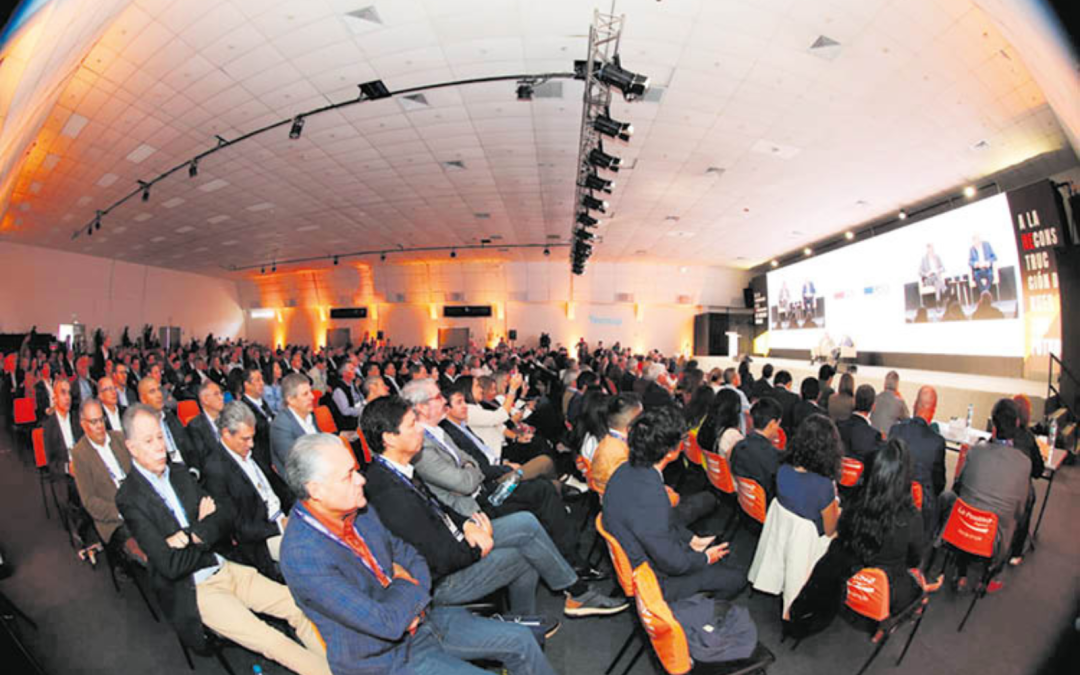
The most important business forum in the country opens its doors today in Lima. In a decisive political and economic context, CADE Executives 2025organized by IPAE Business Actionwill bring together the main authorities, businessmen and opinion leaders of Peru and the region for three days.
This year, the event comes with a call to action: “Firm in action, For the country!”, a motto that summarizes the spirit of commitment and responsibility that it seeks to inspire.
The 63rd edition of CADE Executives returns to Lima after several years traveling through different regions. The return to the capital coincides with a crucial moment for the country, on the threshold of a new electoral process and in the midst of a scenario in which it is urgent to strengthen democracy, recover institutional trust and reactivate the economy.
From today until Thursday, the Lima Convention Center will be the meeting point for more than 55 national and international exhibitors, including ministers, academics and representatives of the private sector, convened to reflect on the challenges of national development. The conversations will be articulated around seven main axes: Governance, Security and Economic Growth, Institutionality, Freedom and Justice for Development, Competitiveness, Leadership and Well-being, and Choosing Responsibly.
Authorities present
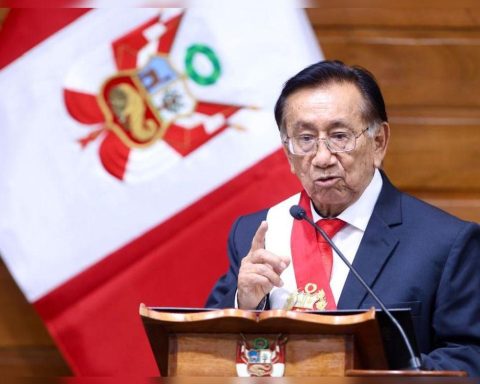
The president of the republic, José Jerí, will participate in the opening day, in which Fernando Rospigliosi, first vice president in charge of the Presidency of Congress, will also participate, who will lead the session “Without public security there is no economy or democracy.” This block promises to be one of the most anticipated moments of the event, as it will address the interdependence between citizen security, the investment climate and democratic stability, topics today at the center of the national agenda.
However, it will be Thursday’s electoral bloc that will concentrate the greatest expectations. Titled “Choose responsibly”, this space will offer a technical and plural look at the political panorama ahead of the 2026 elections.
Next, the pre-electoral bloc will take place, with the participation of three presidential candidates: Rafael López Aliaga (Renovación Popular), Alfonso López Chau ( Ahora Nación) and Mario Vizcarra (Perú Primero). Led by Carlos Gálvez, Liliana Rojas-Suárez, Alfredo Bullard, Marisol Guiulfo and Pablo Bustamante, this space seeks to promote a technical, plural and respectful debate, in which ideas and proposals prevail over slogans.
Thus, beyond the names, CADE 2025 is presented as an invitation to dialogue with rigor and listen with respect, a premise that seeks to return public debate to the level that the country needs. In times of polarization, the forum reaffirms itself as a platform where the public, business and civil society sectors come together to build consensus.
Diego Macera. Director of the Peruvian Institute of Economics (IPE)
In the prelude to CADE Executives, economist Diego Macera suggests that the country must recover the “obsession with growth” and return to focus on investment and formal employment. He also warns that political volatility has slowed Peru’s potential, but he is confident that a better presidential election could mark the beginning of a period of sustained expansion.
What topics do you think cannot stop being discussed at CADE in view of the electoral campaign?
Look, for me the priority always has to be promoting an obsession with growing more, having more investment and more formal employment. I think this idea should unite us as a country: we really need to grow above 4%, even above 5%, if we want to close poverty gaps and expand the middle class. That is, if you want, the mother of the lamb, and hopefully it can be a message that resonates in the campaign: we need to grow more.
Besides the obsession with growth, what other topics do you consider important?
In parallel, there are other topics that we cannot stop talking about. One of them, for example, are the alerts that the Fiscal Council has raised to try to give a greater sense of responsibility to the regulations that have been approved by Congress and the role that the Executive and, perhaps, also the Constitutional Court can play in this.
Of course, the problem is that if you go out and say “we are going to lower spending,” the campaign becomes politically more difficult. Now, it’s not impossible. I think that Mr. Milei showed that you can run a campaign that has greater austerity among its axes. Another issue, which may not be strictly economic, but has a logically economic aspect, is the improvement of the civil service. I think that should be an obsession too.
He spoke of the need to grow at a faster rate than the current one. How to achieve this with political instability and some changes in the rules of the game?
I think that one of the reasons why we are not growing today at the rate we should is, basically, the political volatility that we have had since 2017. Today Peru is having the best moment in its history: record prices for copper and gold, and oil has not risen significantly, close to US$60 a barrel. All these things together should give you a country that grows without too much problem at 4% or 4.5%, if you had a more predictable institutional environment.
Is there a way to be optimistic?
If you want to see the glass half full, there is an argument. This year should be the first in which Peru exceeds US$50 billion in private investment. We had never had US$50 billion of private investment; This year we should reach them, even approaching US$55,000 million or US$56,000 million. This value includes national, foreign, large, small, mining and non-mining investment.
Next year, hopefully we will get close to US$60 billion. That is to say, there is still a significant commitment to Peru, and much of the growth in private investment has been driven, I believe, by double-digit growth rates in several sectors in the last year.
This despite the weakness of the Boluarte government?
Yes. The reflection one can make about that is that the previous government, that of Mrs. Dina Boluarte, which may have been limited in many aspects, at least gave it some sense of predictability. For better or worse, you already knew where you were going in the coming months. The management of the Ministry of the Interior was a disaster, but you knew what to expect, you knew what you were playing for, and at an economic level you had a certain level of predictability. That was more or less enough to generate expectations that began to improve, as well as investment. So what that suggests is that with a little predictability there are already results. Imagine if we also had a competent government.
I think that is one way to read the panorama: yes, political volatility has cost us a lot, but if we manage to choose fairly well in 2026, Peru has quite good growth potential.
How likely is it that there can be some political stability with a new administration?
I have no idea what the results of the next election will be like. One thing I could say is that I have some confidence that the Senate can be a force that helps give some stability to the current political system. Clearly there has been enormous volatility with a single camera. I’m not trying to say that now, with the Senate, everything is fixed, but I think that, after adding and subtracting, it could be a force that helps balance the board a little, to provide some predictability and prevent much of what we have seen in recent years.
Receive your Perú21 by email or WhatsApp. Subscribe to our enriched digital newspaper. Take advantage of the discounts here.
RECOMMENDED VIDEO: