SANTO DOMINGO.- The implementation of the new scheme will take six months from its approval, during which time the Social Security Treasury (TSS) will make the necessary adjustments, according to the superintendent of Health and Occupational Risks (Sisalril), Miguel Ceara Hatton.
The resolution establishes “granting a period of up to six (6) months, counted from the approval of this resolution, to the Social Security Treasury (TSS) for the implementation of the necessary controls and adjustments in the Single Information and Collection System (SUIR).”
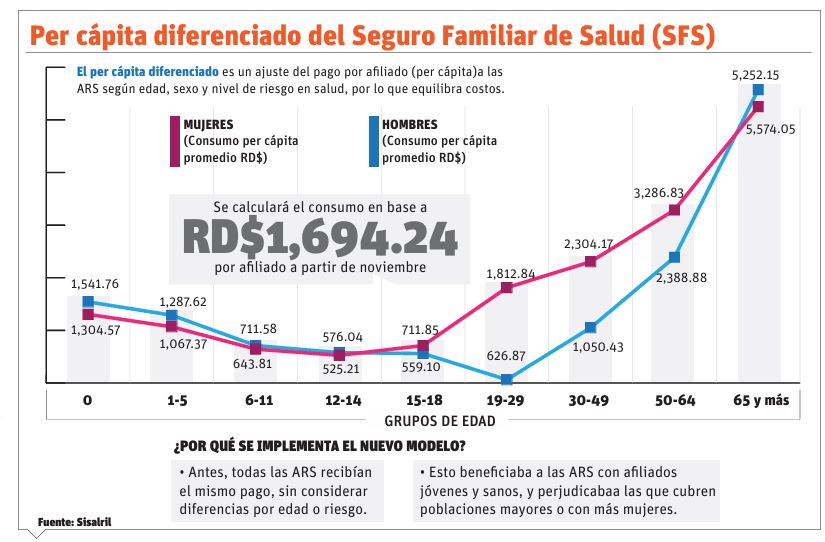
The differentiated per capita is nothing more than assigning a higher payment per member (per capita) to the health risk managers (ARS) when it comes to populations with a higher risk of getting sick or with care needs and a lower amount for those with low risks.
In other words, the new model seeks a payment adjusted according to the health risk of 4.8 million affiliates distributed in the 17 ARS of the Contributory Regime, which is determined mainly by age and sex.
This responds to the fact that certain groups, such as older adults and women of reproductive age, generate greater health spending than others, such as young men. Currently, the ARS receive the same capitation for all people, so the measure adopted by the Superintendence of Health and Occupational Risk (Silsaril) proposed the solution to counteract possible actions of the ARS to avoid populations with higher accident rates.
Examples of Consumption
An example of this is that a man between 15 and 18 years old consumes only 33% (RD$559) of the current per capita, while a man over 65 years old can consume up to 329%, that is, more than triple, which would be 5,574 pesos.
In the case of women, spending is reduced in childhood and adolescence, reaching just 31% (RD$525) of consumption from 12 to 14 years old; however, it is triggered from the age of 19that is, in the reproductive age and old age, with 1.36 to 3.1% more of the value based on the monthly capita, going from 1,812.84 pesos to 5,252.15 pesos.
This measure does not imply an impact on affiliates, since what will change will be the way in which the payment is distributed for each affiliate, but within the same range of income that they receive through the TSS.
Currently, the SFS pays the ARS a single (per capita) monthly rate of RD$1,683.22 per member in the Contributory Regime, regardless of the patient’s health profile. However, in the approved resolution an increase of RD$204.32 to that capita was agreed upon, for a total of RD$1,887.54as an inflation adjustment.
The per capita model differentiated by risk maintains all the coverage, benefits and services of the Basic Health Plan, guaranteeing access to medical care and quality of services, in accordance with the real structure of the affiliated population.
More medications
The same resolution expands the catalog of the Health Services Plan (PDSS) with new essential medications and high-cost treatments.
Includes therapies against HIV, hepatitis B and tuberculosisin addition to drugs to control cholesterol and mild neurological disorders.
The payment of fees for medical consultations is also increased. RD$500 to RD$750in response to the rate adjustment agreed with the Dominican Medical College.
The resolution expands the catalog of medications for the Basic Health Plan.
Aura Celeste Fernandez
The general manager of the CNSS, Aura Celeste Fernández, He highlighted that the difference lies in grouping the frequency of service used by the member and the value associated with coverage by age and sex groups. He reiterated that it does not impose new obligations on citizens or restrict services, but rather constitutes a measure to redistribute resources among the ARS.
Correction
-Distortion
Ceara Hatton explained that the change responds to a distortion accumulated for years in the distribution
of resources.
—Equal amount
This is because all ARS received the same amount per capita.
CNSS Includes Breast Reduction for Health in Insurance
The National Social Security Council (CNSS) approved the inclusion of reduction mammoplasty within the coverage of Family Health Insurance (SFS). This change recognizes this surgery as a medical procedure that was previously denied because it was considered purely aesthetic.
The decision, contained in Resolution 624-03, benefits thousands of women who, for years, were denied this service despite suffering from health problems directly related to the excessive size of their breasts.
Mammoplasty is a reconstructive plastic surgery that modifies the size or shape of the breasts. There are two main types:
Breast augmentation, when seeking to increase breast volume.
Reduction mammoplasty, which consists of reducing the size of the breasts to relieve physical pain and improve posture.
In the case covered by the new resolution, the intervention is applied to women who suffer gigantomastia or symptomatic breast hypertrophy. These conditions can cause chronic back, neck and shoulder pain, spinal deviations, skin irritations, breathing difficulties and limitations in performing daily activities.