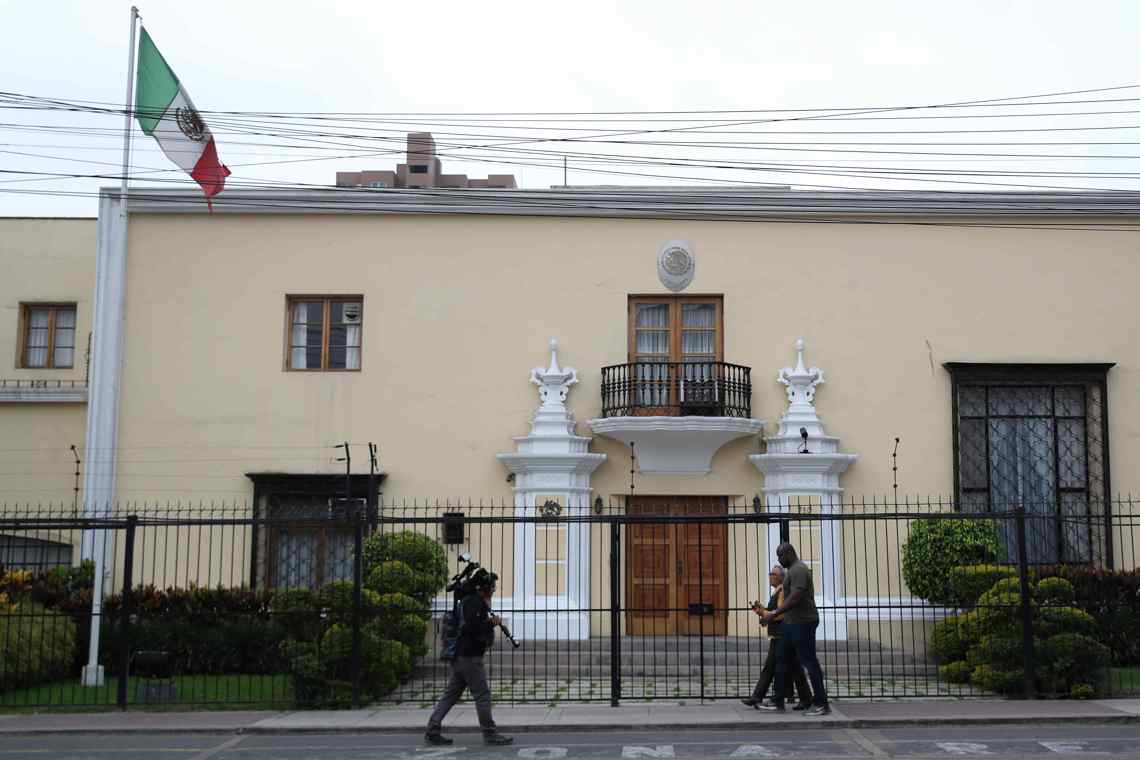
The Government of Peru announced this Monday its breaking of diplomatic relations with Mexicowhich reacted by regretting Lima’s “unilateral” and “disproportionate” decision.
The drastic measure by the Peruvian Executive was due to the granting of asylum by Mexico to Betssy Chávez, former prime minister of former President Pedro Castillo, prosecuted alongside him for a failed coup attempt at the end of 2022.
When announcing the news, the Foreign Minister of Peru, Hugo de Zela, said that his Government had learned “with surprise and deep regret” that Chávez was sheltered in the Mexican embassy, something that he classified as an “unfriendly act” on par with other actions and statements on the matter by the highest Mexican authorities.
“I want to deeply regret that the Mexican Government persists in its mistaken and unacceptable position, which has reached the point of forcing us to break diplomatic relations with a country with which until before these events we had a fraternal relationship and multiple coincidences,” said De Zela, quoted by the agency. EFE.
The Government of Peru announces that it has decided to break diplomatic relations with Mexico, after reporting that former Peruvian Prime Minister Betssy Chávez “is being granted asylum in the residence of the Mexican embassy” in Lima.https://t.co/V31zcTznbw
— EFE News (@EFEnoticias) November 3, 2025
Mexico also regrets
For its part, the Government of Mexico regretted the break in relations announced by Peru and defended its decision to grant asylum to the former Peruvian prime minister.
The Mexican Ministry of Foreign Affairs (SRE) considered Lima’s measure as a “unilateral, excessive and disproportionate decision” and stated that it granted asylum to Betssy Chávez “in full compliance with international law,” in particular, the so-called Caracas Convention, to which both countries are parties.
The SRE pointed out that the now asylum seeker “has mentioned that she has been subject to repeated violations of her human rights as part of political persecution” against her, and said that, according to what is established internationally, “the granting of asylum cannot be considered an unfriendly act by any other State.”
In addition, he reaffirmed that Mexico will remain faithful to its tradition of providing protection to people persecuted for political reasons, and that it will prioritize dialogue and a friendly solution in these cases, while reiterating the “historic ties of friendship” that unite Mexico and Peru.
For his part, the Peruvian foreign minister said that Mexico’s version is “tendentious and ideologized” by presenting Chávez and Pedro Castillo as politically persecuted, but denied that his Government considers intervening in the Mexican Embassy to capture the former prime minister.
“That possibility does not exist. Peru is a country that respects international law and an action of this type is not provided for in any norm of international law,” said De Zela, who also said that, despite the announced break, consular relations will be maintained.
Betssy Chávez, who is being prosecuted by the Peruvian Justice Department for her alleged involvement in Castillo’s coup attempt, had been detained since 2013 and last September she had been released pending the conclusion of the trial against her.
While the Prosecutor’s Office is asking for 25 years in prison for her and 34 for Castillo, both the current Mexican president, Claudia Sheinbaum, and her predecessor, Andrés Manuel López Obrador, have asked to be released considering that they were the ones who really suffered a coup d’état by the Peruvian power groups that dominate the Congress of that country.