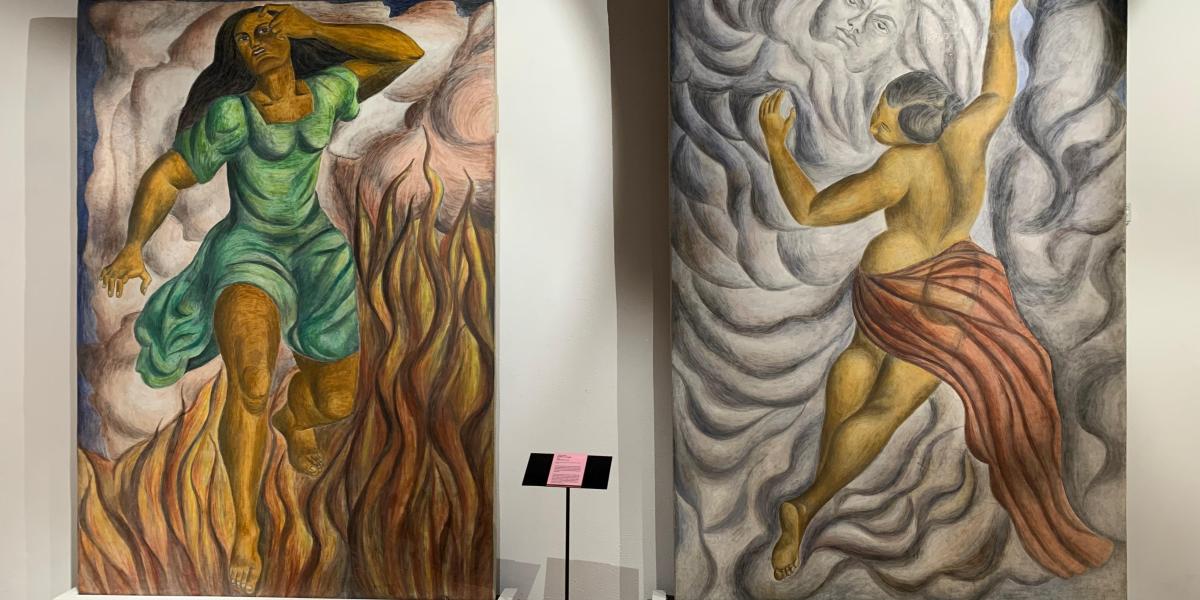
The Ministry of Public Education (SEP) and the Living Museum of Muralism (MVM) pay tribute to María Cenobia Izquierdo Gutiérrez (1902–1955), on the 70th anniversary of her death. Muralist artist and disciple of two of the most important masters of Mexican painting, Diego Rivera and Rufino Tamayo, she stands out in the emblematic MVM with two frescoes: Music and Tragedy (1946), highlighted the head of the department, Mario Delgado Carrillo.
The head of the SEP commented that the MVM keeps alive the feminist vision and firm character that defined the work of this Jalisco creator. Likewise, she pointed out that, as part of the 100 commitments of the president of Mexico, Claudia Sheinbaum Pardo, both institutions work for a reading and cultural Republic, in parallel with a Republic of and for women, which vindicates the fundamental role of artists like María Izquierdo throughout the country’s history.
He explained that the museum exhibits in the Carlos Mérida Room, as part of the exhibition “Muralism in educational spaces, the two transportable murals of one of the most representative painters of the 20th century and the first Mexican to exhibit at the Art Center of New York (1930).
Frescoes in the Carlos Mérida room of the MVM Photo: Special
He recalled that María Cenobia Izquierdo Gutiérrez, originally from San Juan de los Lagos, Jalisco, married at the age of 15 and was the mother of three children. She got divorced at a time when that decision was socially censored and entered the National School of Fine Arts, where she met Rufino Tamayo.
Delgado Carrillo highlighted that María Izquierdo is considered an icon of feminism in Mexican art, and that she structured her pictorial work based on recurring elements such as altars, offerings, cupboards and still lifes, in which she captured her unmistakable passion for color. Oil paintings such as Friday of Sorrows (1944) and The Earth (1945) reflect the prominence he gave to women, by subverting the allegorical character to which male muralism confined them and giving them an active and symbolically powerful role. His work also incorporates esoteric and surreal elements that enrich his plastic language.
She mentioned that she was a friend of the French poet and essayist Antonin Artaud, with whom she had an aesthetic exchange that influenced her artistic production and introduced a different sensitivity into the so-called Mexican Renaissance, marked by introspection and spirituality.
The canceled mural
However, Izquierdo also faced the exclusion of the great Mexican muralists. In 1945, after being selected to create a mural on the stairs of the Palace of the Central Department of the Federal District – commissioned by Javier Rojo Gómez, then head of the Department – the project was canceled after Diego Rivera and
David Alfaro Siqueiros argued that the artist did not have sufficient technical experience in the fresco technique.
The controversy intensified when it was pointed out that the real cause could be the leading role that Izquierdo gave to women in his sketches. In response, the artist publicly denounced the blockade and male hegemony within muralism, which marked a transcendental episode in the history of Mexican art, as she was the first woman to climb the scaffolding.
Newspapers of the time that published the event. Photo: Francisco de Anda
He commented that the MVM currently safeguards the two pieces by Izquierdo thanks to an agreement with the National Institute of Fine Arts and Literature (INBAL) and the loan from the Faculty of Law of the National Autonomous University of Mexico (UNAM). In addition, it exhibits a replica of the sketch that the artist made for the canceled mural, within the temporary exhibition “Women and Muralism”, along with works by Aurora Reyes, Valetta Sean and Graciela Iturbide, among other creators.
Finally, the head of the SEP pointed out that, in this way, the MVM is not only a space to appreciate the manifestations of Mexican muralism, but also a place where history, memory and social issues vindicate the aesthetic expressions of women.
The venue invites the public to reflect on the role of female creators in national art, from Wednesday to Monday, from 10:00 a.m. to 6:00 p.m., on Calle Argentina no. 28, Historic Center of Mexico City.