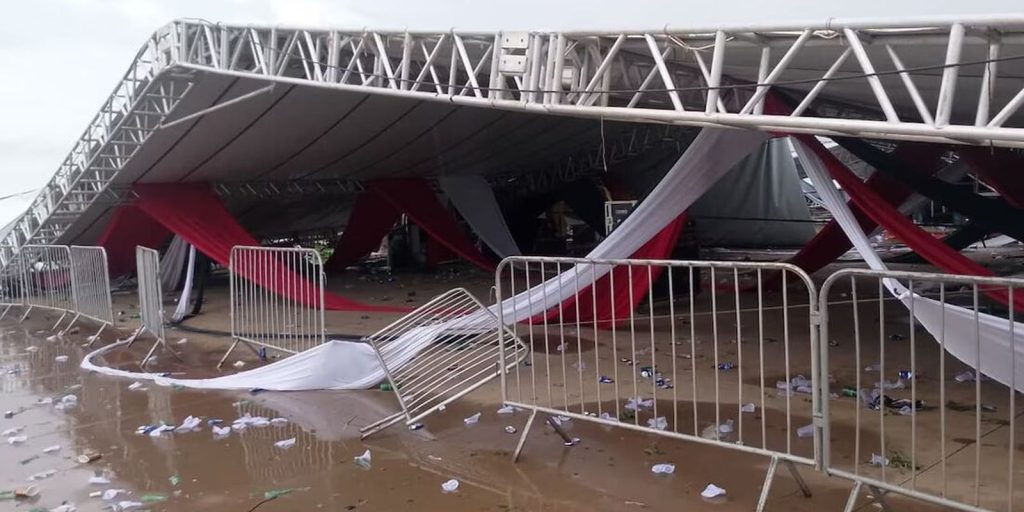
45% of the central and western region of Cuba will experience power outages this Sunday, while a large part of the east of the country continues without service after the passage of the Hurricane Melissareported the state company Unión Eléctrica (UNE).
The cyclone, which hit the eastern territory last Wednesday with category 3 on the Saffir-Simpson scale, caused severe damage to the electrical infrastructure, leaving most of the 3.5 million inhabitants of the provinces of Granma, Santiago de Cuba, Holguín, Guantánamo and Las Tunas without supply.
With winds of up to 200 kilometers per hour and rains that exceeded 400 millimeters in some areas, Melissa knocked down poles and lines and extensively affected the distribution network. Authorities have warned that recovery could take several days.
Added to the emergency caused by the hurricane is the deep crisis of the National Electroenergy System (SEN), which for more than a year has been facing one of its most critical stages, with generation deficits of more than 50% and blackouts of up to twenty hours a day in different provinces. In the last twelve months there have been five national blackouts, the most recent in September.
According to the UNE, for the ten provinces not directly affected by Melissa, a maximum demand of 2,600 megawatts (MW) is estimated and an availability of only 1,527 MW during peak night hours, which represents a deficit of 1,073 MW and a planned impact of 1,143 MW.
Among the main incidents are four thermoelectric units out of service due to breakdowns or maintenance and 76 distributed generation engines paralyzed due to lack of fuel.
Thermoelectric plants, the backbone of the Cuban energy system, have suffered decades of exploitation and lack of investment. Meanwhile, the Government’s solar program – which has installed 32 photovoltaic parks this year – barely mitigates the daytime deficit, with no storage capacity to cover the night.
Independent specialists attribute the crisis to chronic underfinancing of a completely state sector, while the Government blames US sanctions, which it describes as a policy of “energy asphyxiation.”
According to external estimates, Cuba would need between 8 billion and 10 billion dollars to recover its electrical system, a figure today beyond the reach of its economy.
The prolonged blackouts affect national production and aggravate the economic contraction: GDP fell 1.1% in 2024 and has accumulated a decrease of 11% in the last five years, according to official data. ECLAC predicts another negative year.
Growing social unrest over electricity cuts has been behind several protests in recent years, from the massive ones in July 2021 to the most recent ones in Havana and Gibara.
EFE