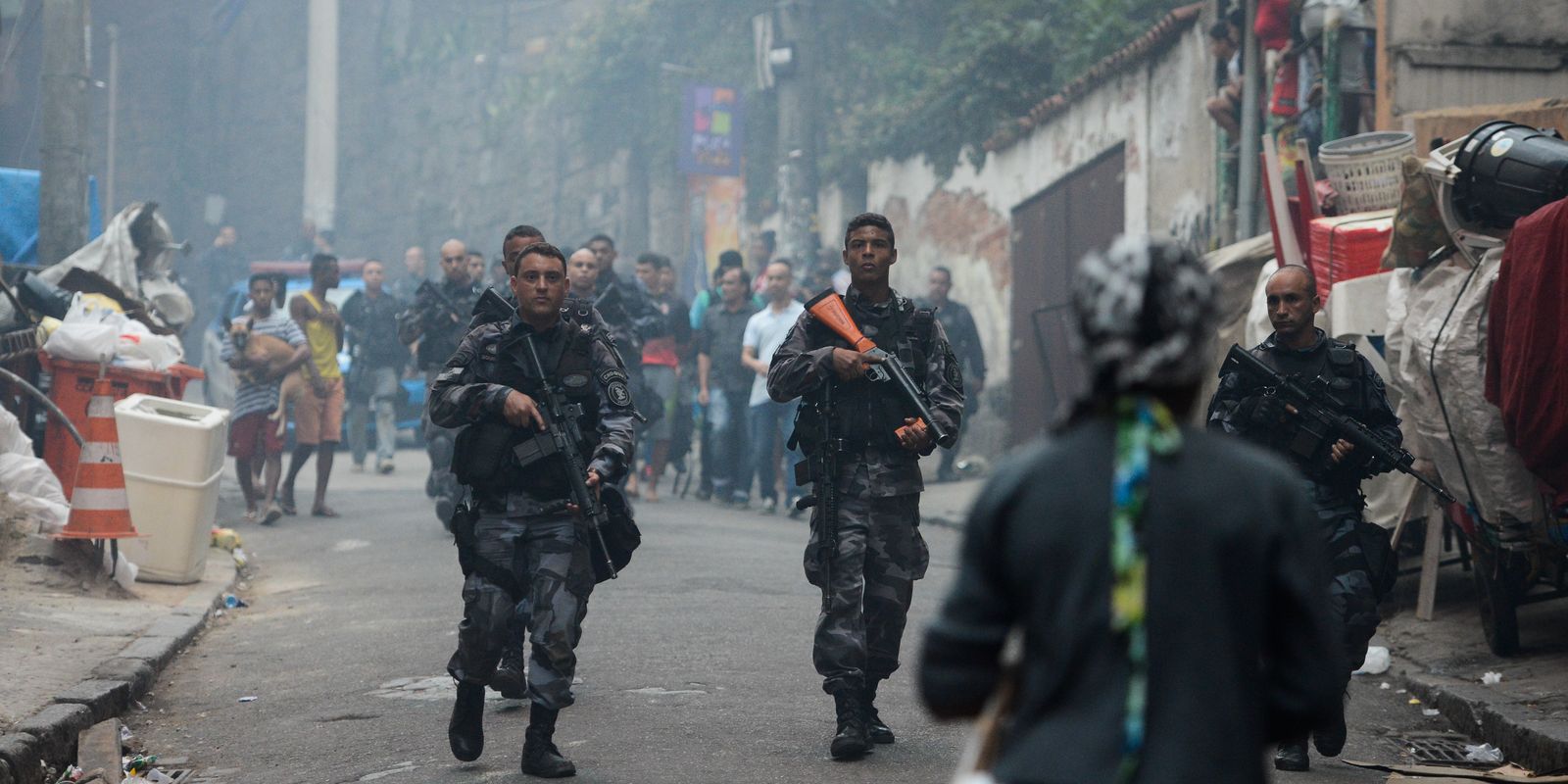
Conflicts are not only managed with rifle shots, but also with political speeches. In parallel to the police operations in the Alemão and Penha complexes, in Rio de Janeiro, governors aligned with the head of the Rio de Janeiro administration, Cláudio Castro, created the “Consórcio da Paz”, an integration project to combat organized crime in the country.
Sociologist Ignacio Cano, professor at the State University of Rio de Janeiro (UERJ), criticizes the term. For him, it is a discursive strategy that inverts the real meaning of operation that left 121 dead.
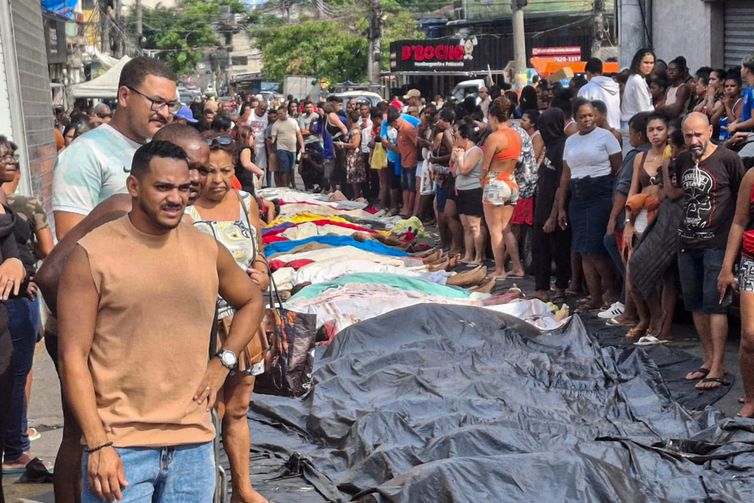
Bodies are lined up in Praça São Lucas, in Penha, north of Rio de Janeiro, after police action from Operation Containment, last Tuesday (28). Photo: Eusébio Gomes/TV Brasil
“The governors got the name wrong. It should be called the Consortium of Death, because that’s what they’re proposing. It’s certainly not peace,” says Cano. “Rhetorically, it won’t go down well and, every time they use the term, they will be reminded of the number of deaths their governments produce. Most right-wing governors are promoting police lethality.”
Seven governors are part of the “Peace Consortium”. In addition to Castro, Tarcísio de Freitas (Republicans), from São Paulo; Romeu Zema (Novo), from Minas Gerais; Jorginho Mello (PL), from Santa Catarina; Eduardo Riedel (Progressistas), from Mato Grosso do Sul; Ronaldo Caiado (União Brasil), from Goiás; and Ibaneis Rocha (MDB), from the Federal District.
“Narcoterrorism”
Sociologists, political scientists and public security experts consulted by the Brazil Agency analyzed the vocabulary adopted by the authorities in the latest speeches. And they pointed to the political and symbolic uses of terms related to the most lethal operation ever recorded in Brazil.
Among the recurring words is “narcoterrorism”. It was used by Castro, Tarcísio and Zema to refer to criminal factions, especially the larger ones with Rio de Janeiro and São Paulo as centers of power.
“This is yet another nonsense that hinders the police, public security, society and the government itself. In the same way they use ‘narcomilícia’ and other older categories such as ‘Parallel State’. This, in fact, hides incompetences, incapacities and political opportunism”, says Jacqueline Muniz, anthropologist and political scientist, professor in the public security department at the Universidade Federal Fluminense (UFF).
“When you say that you are facing narco-terrorism, you are saying that you need more power, more money, more budget and that you don’t need to give any information about what you are going to do”, he adds.
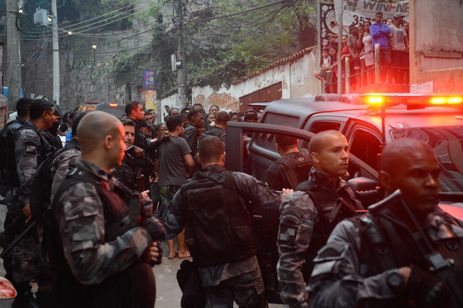
Police operation following attacks on the bases of the Pacifying Police Units (UPP) in the communities of Cantagalo and Pavão-Pavãozinho, in Copacabana, at the beginning of the year. Photo: Fernando Frazão/Agência Brasil
For Ignacio Cano, the term is also wrong from a conceptual point of view. “Terrorism is normally associated with political objectives. It is the indiscriminate use of violence against civilians to pursue these objectives. A narco-terrorist would not have any political motivation. The objective is the same as that of every criminal, which is profit. The term is a contradiction in itself”, explains the sociologist.
In Brazil, the Law No. 13,260, of 2016defines that: “terrorism consists of the practice by one or more individuals of the acts provided for in this article, for reasons of xenophobia, discrimination or prejudice based on race, color, ethnicity and religion, when committed with the purpose of provoking social or generalized terror, exposing people, property, public peace or public safety to danger”.
Drug trafficking factions are classified by Brazilian legislation as criminal organizations. And this is how the federal government, especially the Minister of Justice and Public Security, Ricardo Lewandowski, has positioned itself.
A group of deputies is trying to change this through Bill 724/25, which expands the concept of terrorism to include illicit drug trafficking. The project was authored by deputy Coronel Meira (PL-PE) and was approved a few weeks ago by the Public Security Committee of the Chamber of Deputies.
It will still be analyzed by the Constitution, Justice and Citizenship Commission (CCJ), before being voted on by the Chamber Plenary. To become law, it must be approved by the Chamber and the Senate.
International pressure
This understanding has received international pressure from right-wing politicians. The governments of Javier Milei, in Argentina, and Santiago Peña, in Paraguay, recently classified the criminal organizations PCC (Primeiro Comando da Capital) and Comando Vermelho (CV) as terrorists. The United States suggested that Brazil do the same when the North American delegation visited the country in May this year.
Public security experts understand that pressure from governors in Brazil to use “narco-terrorist” is a form of political alignment with these external forces. In this way, the debate is transferred from the police field to the geopolitical field. For them, the term, if adopted in the country, would weaken democracy and increase the risk of international interference.
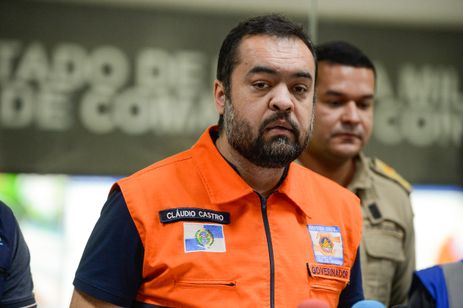
Right-wing governors aligned themselves with the governor of the state of Rio de Janeiro, Cláudio Castro, in the policy adopted by him to combat drug trafficking. The last operation left 121 people dead, including four police officers. Photo: Tomaz Silva/Agência Brasil
“One way for the United States to intervene more effectively in our territory is precisely to appeal to what Americans historically fear, especially after September 11, which is the issue of terrorism”, says Jonas Pacheco, research coordinator at the Security Observatories Network.
“It’s a speech that deals with an issue of domination in Latin America. The countries that have groups classified as terrorists are clearly not ideologically aligned with the Trump administration”, he adds.
“Terrorism is used by the president of the United States to commit summary executions on the coast of Venezuela and Colombia. The term was adopted by the governments of El Salvador and Ecuador as well. They are attempts to evade any legal limit. Terrorist laws lengthen provisional prison terms and reduce procedural guarantees. But, it is important to highlight, no anti-terrorism law authorizes the summary execution of people”, says Ignacio Cano.
“War on drugs”
Another very common semantic category among state authorities is “war”. The military police would be faced with conflicts similar to those suffered in other realities in Eastern Europe, Africa and the Middle East.
Political scientists and sociologists are categorically opposed to the terminology, due to a series of symbolic and material consequences that it produces.
“When you base the debate on the idea of war, you validate actions that barbarize an entire territory. Who is the enemy in this war? Is it the drug dealer who is in Faria Lima laundering the money? No, it is the drug dealer who is in the favela. It is the poor and black people who live in territories of extreme vulnerability and precariousness”, says Jonas Pacheco.
“Public security is to generate security, not to kill. The use of force must respect the appropriate legal regulations. It is not an end in itself. The end is to generate security. The social pact provides that the State must guarantee the preservation of life”, he adds.
“It’s always good to remember that, if society authorizes the police to act without legal controls and parameters, without supervision by the Public Prosecutor’s Office, we are all at risk. If people think that only the residents of Alemão and Penha will suffer the consequences, they are very mistaken”, says Ignacio Cano.
“The objective is to bring war into the cities. And there is nothing better than a war against crime. But it’s not about fighting any crime. It’s about producing repression and spectacle. If we want to solve it, we also have to change this language”, analyzes Jacqueline Muniz.
“We are talking about an authoritarian project where insecurity becomes public policy. The greater the insecurity, the better for these authorities, because we are loyal to fear. In the face of threat, we can all give up individual and collective guarantees in favor of those who can protect us and then tyrannize us”, he adds.