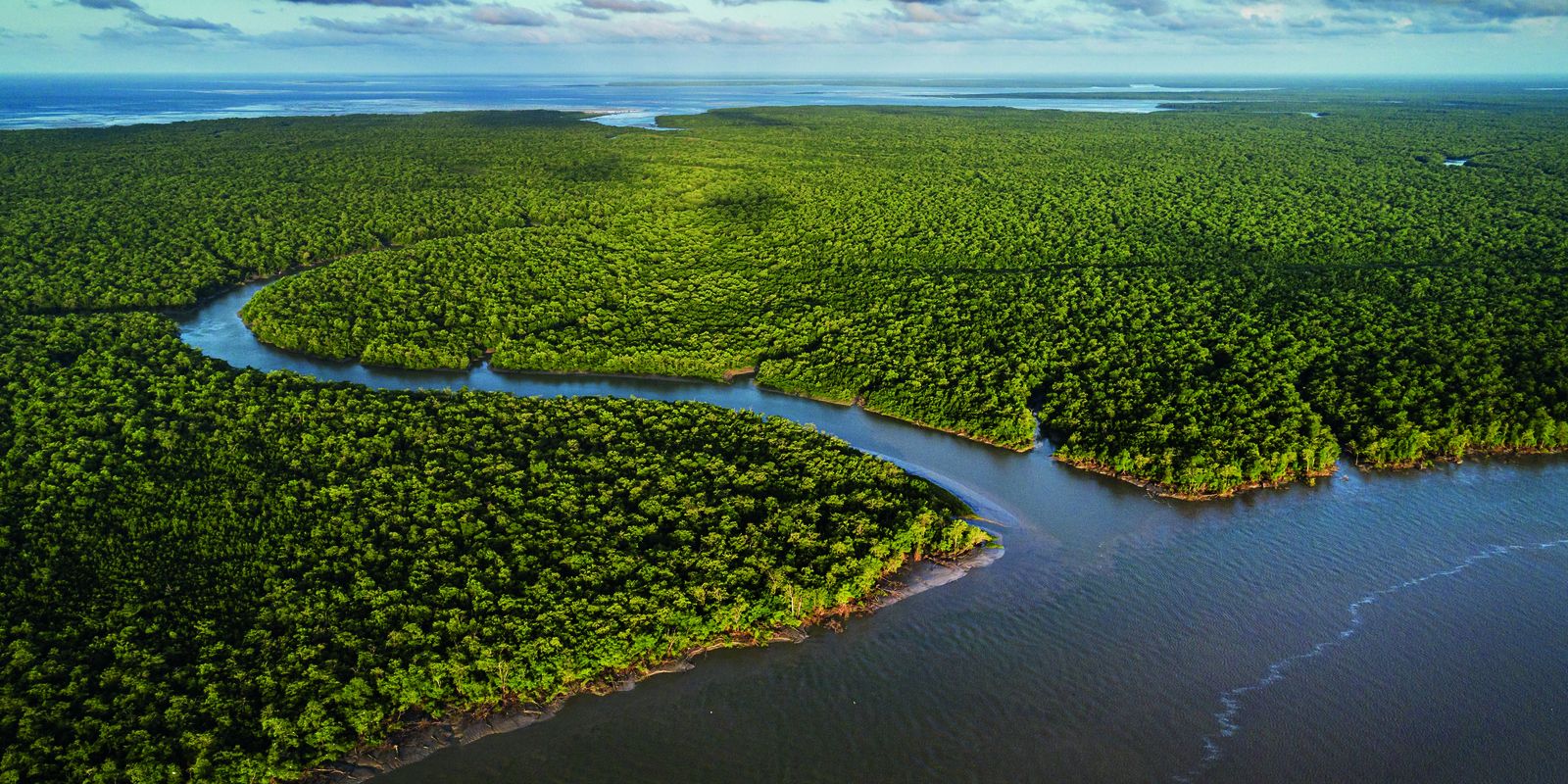
With photographs from North to South of Brazil, oceanographer, environmentalist and photographer Enrico Marone portrays mangroves as environments full of ecological, cultural and economic riches, confronting a collective imagination that once considered these ecosystems as marginalized, dirty and smelly. The work is part of the Manguezal exhibition, which arrived last Wednesday (29) at the Banco do Brasil Cultural Center in Rio de Janeiro (CCBB-RJ) and welcomes visitors free of charge until February 2, 2026.
“This exhibition somewhat fulfills this role of bringing information closer to people about the richness that these environments represent. They are unique, very important environments”, analyzed Marone, in an interview with Brazil Agency. “Today, the key is changing. It is an important and disruptive moment for the recognition of mangroves.”
The exhibition project, curated by Marcelo Campos and produced by Andrea Jakobsson Estúdio, was based on the book of the same name, the fifth volume of Ocean Decade Collection (2021–2030), designed and produced in partnership with the Unesco Chair at the USP Oceanographic Institute and illustrated by photographer Enrico Marone.
After visiting mangroves in different parts of the country, the photographer considers that projects that include the participation of local communities and fishermen are beginning to change society’s perception of these ecosystems.
“They were not recognized and were filled in for construction. They did not have the value that we recognize today. The ecological function of mangroves is not just a question of life and fishing, but the mangrove has an infinite number of ecological functions. The roots filter nutrients, and the sediments that come from rivers and estuaries. The mangrove protects the coast against erosion and storms, because it protects against waves and sea invasion”, he indicated.
He also points out that the realization that these environments are very important for combating climate change has gained ground.
“Mangroves sequester and store a lot of carbon. Because they retain, mainly in their sediments, in the mud, an environment with little oxygen, they do not decompose the carbon, which is trapped in the mud for a long time. Therefore, they are a carbon sink. The researchers give figures that mangroves retain between four and five times more carbon than other tropical forests. Mangroves play a very important role in mitigating the climate crisis. That is why they are called ecosystems blue carbon, new UN name”, he reported.
In addition to climate sustainability, Marone points out the socioeconomic importance of mangroves for copmunities, since the life cycle of many species that are fished and support communities of fishermen and women are born in the mangrove, which is a nursery for life, not only for crabs, but for many fish that are caught along the coast.
“They reproduce in mangroves. So, mangroves are very important for maintaining biodiversity and support important chains of fishermen, who depend on these healthy environments for their maintenance, their own survival, but also for their income generation”, pointed out the photographer.
Curation
Marcelo Campos’ curation mixes multiple languages and generations of artists, with around 50 works by 25 fundamental names in Brazilian art.
“During the exhibition, we will see performance artists, who dive into the mangroves to produce their performances from there, and, at the same time, we will hear the Ganhadeiras of Itapuã, singing the mangrove. This makes us take away [de nosso imaginário] the erroneous impression of mangroves”, said Marcelo Campos, in an interview with Brazil Agency.
Just like Enrico Marone, who was enchanted by this ecosystem, the mangrove is highlighted in the work of artists, such as modernist Lasar Segall, who portrayed the old mangrove zone in Rio de Janeiro, a central region in the formation of samba and Rio’s urbanism. Another was Hélio Oiticica, who redefined mangue in his linguistic games, uniting mangue and bange in criticism of urban violence. Both are also on display.
The exhibition also features works by other artists who use the mangrove as inspiration: Ygor Landarin, Lucélia Maciel, Azizi Cypriano, Almir Lemos, Aislane Nobre, Gabriella Marinho, Abelardo da Hora, Ayrson Heráclito, Carybé, Celeida Tostes, Marcel Gautherot, Frans Post, Maureen Bisilliat, Marcone Moreira, Uýra Sodoma and Ganhadeiras de Itapuã.
“It’s curious and very cool to see different artistic aspects coming together, always having the mangrove as its central axis, inspiring different artistic languages”, said Marone, adding that he feels extremely honored to participate and contribute to artists of this order of magnitude.
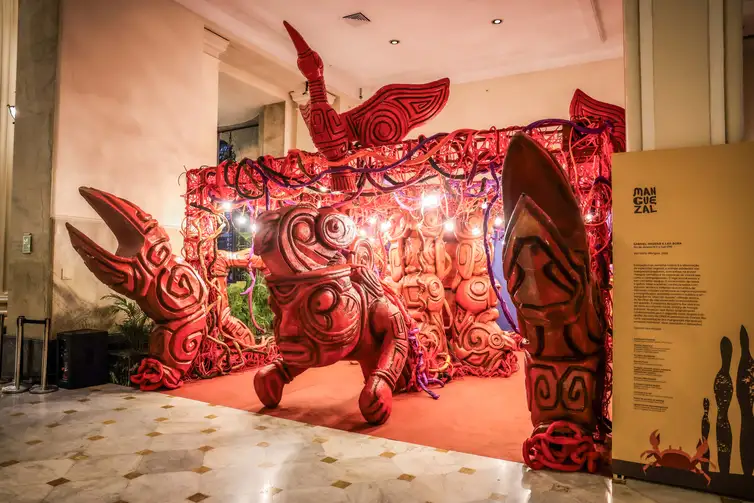
Mangrove Exhibition at CCBB in Rio de Janeiro Photo: Rafael Arantes/Disclosure
Carnival
Carnival is also present in the exhibition and should arouse great interest from the public. Gabriel Haddad and Leonardo Bora, who until this year were carnival performers in Grande Rio, are the authors of an installation based on caruanas, enchanted beings that inhabit mangroves and are present in Brazilian indigenous mythology.
“As soon as I saw the Grande Rio parade, in 2025, I saw a car [alegórico] about the carriages. I immediately called the carnival workers, who I know, and asked them to store the car, because I would need it. The great coincidence is that, when Grande Rio announces the plot of the 2026 carnival, it will also be a carnival dedicated to mangroves. So, we combined the two carnivals. We will bring four new costumes for the 2026 carnival, designed by Antônio Gonzaga [atual carnavalesco da Grande Rio]”, said curator Marcelo Campos.
Manguezal is an organization of the Ministry of Culture, CCBB RJ and MaisArte, sponsored by the City of Rio de Janeiro, Municipal Secretariat of Culture and Instituto Prio, with co-sponsorship from TGS and support from EnvironPact, through the Municipal Culture Incentive Law, the so-called ISS Law.