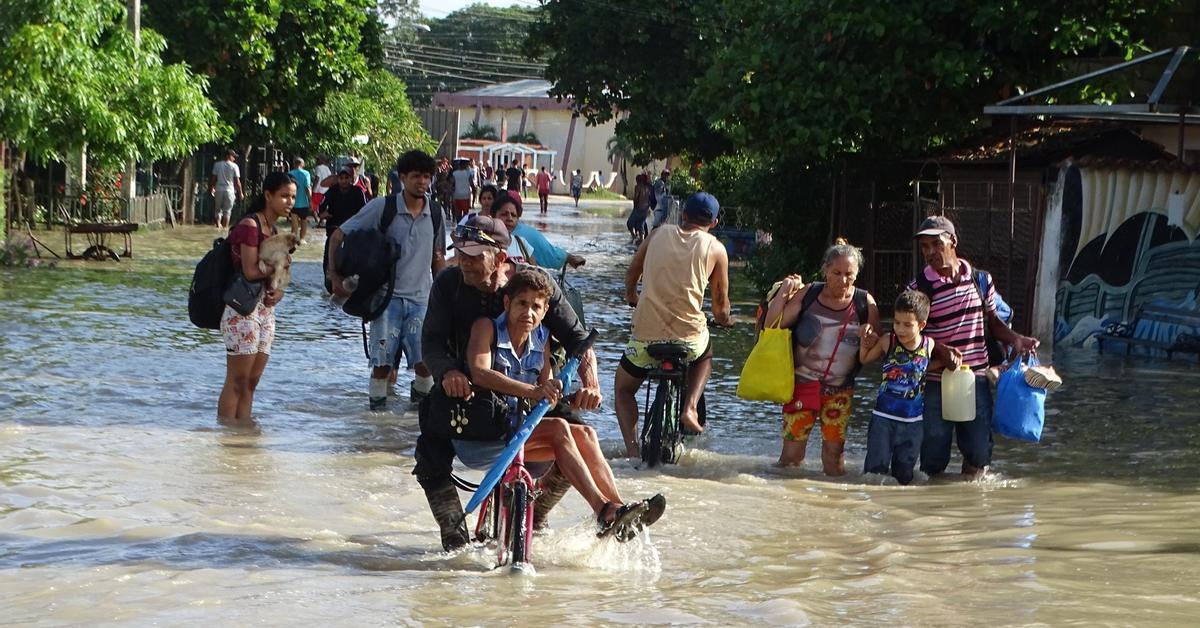
Havana/Hurricane Melissa left Cuban territory since Wednesday morning, but in eastern Cuba there are still flooded areas, collapsed roads and bridges, unstable communications and blackouts, while the authorities announce the “recovery phase” in Santiago de Cuba and Granma. However, the Granma municipalities of Río Cauto and Cauto Cristo continue in the Cyclonic Alarm phase.
The Provincial Defense Council of Granma, in coordination with members of the Revolutionary Armed Forces (FAR), activated an emergency operation this Saturday in response to the critical situation generated by the intense flooding in the communities of Grito de Yara and Río Cauto. The order is to massively evacuate residents of the most affected areas, where the water level continues to rise and threatens to completely isolate several rural settlements. Authorities have described the situation as “high risk,” warning that “it will become more difficult as the days go by” if the rains persist and the reservoirs continue to overflow.
To execute the complex evacuation logistics, a combined Army device was deployed with land, river and air operations. Amphibious units are in charge of accessing the most compromised areas, rescuing people and transferring them to safe points on the main road, from where they will be taken to temporary shelters.
In parallel, military helicopters carry out rescue and rescue missions from the air, concentrating on homes completely surrounded by water. The Defense Council asked the population to actively collaborate with the operations, move immediately to the previously indicated high areas, make visible signals to be located quickly and comply without delay with the evacuation orders, the deadline for which expires during the day.
In the province, damage was reported in 1,431 homes in Guisa, Campechuela, Bayamo, Cauto Cristo, Bartolomé Masó, Manzanillo, Jiguaní, Buey Arriba and Río Cauto. Of them, 23 suffered total collapses and 137 suffered partial collapses, while 593 homes completely lost their roofs and 678 reported minor damage. The authorities clarified that these are preliminary figures and that the real number of affected properties could exceed 10,000, especially due to the deterioration of the roofs. At the same time, the rescue of almost 3,000 people was reported in operations carried out in several municipalities, with 413 emergency interventions that continue against the clock in the lowest and most isolated areas.
It has spread on social networks the plea of the daughter of an operator who was trapped in the Cauto del Paso reservoir, after 72 hours without hearing from the state worker. The municipality official told the young woman that her father was “a hero” for deciding to stay when they went to rescue the group of people who accompanied him. But in Bayamo, the head of the substations confirmed that the man “did not fit in the helicopter.” The young woman asks that “not to play with the emotions” of a desperate family and demands precise information about her father.
On the other hand, the Guamo train became another scene of the chaos that Hurricane Melissa has left in eastern Cuba. The images and testimonies narrate a mixture of improvisation, heroism and institutional lack of control. Locomotive 52554, with more than 2,600 passengers fleeing the floods, left for safe areas without real guarantees of railway safety.
Less than a kilometer from the station, the water undermined the track and the train separated in two, leaving nine cars stranded. Although the Ministry of Transportation was quick to clarify that “there was no derailment,” what happened shows the fragility of a deteriorated infrastructure system and the lack of effective protocols to move thousands of people in the midst of an emergency.

/ CMKX Radio Bayamo
With cars and private boats, about 80 passengers were evacuated, including children and the elderly, while others were transferred by bus to Colombia, in the province of Las Tunas. The authorities highlighted the “control” and “delivery” of the operation, but avoided answering why a train full of people was allowed to circulate on an already flooded track. The story of the “train that outweighed the waters,” as the official media titled it, actually ends up revealing improvisation and luck, rather than organization and risk reduction.
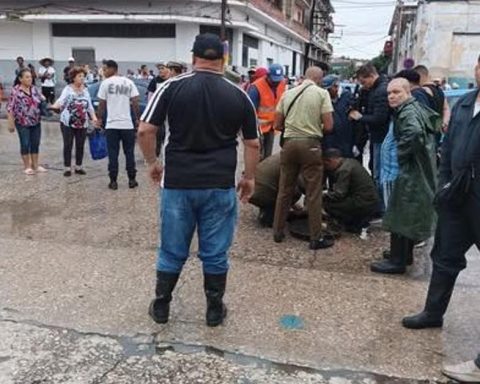
Roads are another open front. The Santiago-Granma highway is “severely affected” by river overflows and sinkholes, a bottleneck that complicates the arrival of aid and the transfer of evacuees.
Although the CMKX Radio Bayamo station presented the story of the “little dog from Río Cauto” – abandoned during the evacuation – as an “emotional” chronicle, the event has generated a wave of indignation inside and outside Cuba. The story reveals that, while the official discourse exalts sensitivity and heroism, neither the evacuees nor the authorities present intervened to save the animal, which was left at the mercy of the flooding river.
The image of the dog alone, looking towards the sky, was assumed by organizations such as Bienestar Animal Cuba (BAC-Havana) as a symbol of institutional and human abandonment in the midst of the disaster. What CMKX describes lyrically, many Cubans read as a metaphor for the country itself: a territory where the most vulnerable – people or animals – are the first to be left behind.