“An invisible bomb”. This is how professor José Claudio Sousa Alves, from the department of social sciences at the Federal Rural University of Rio de Janeiro (UFRRJ), describes the consequences for the population of police operations such as Operation Containment, considered the largest and most lethal in recent years in Rio de Janeiro.
The operation, carried out last Tuesday (28), in the Alemão and Penha complexes, in the north of Rio de Janeiro, left at least 121 people dead, generated panic with shootings, the closure of businesses, schools and health centers, with the closure of the city’s main roads, altered public transport routes and burned buses. Bodies were laid out in the middle of the street amidst relatives and an entire horrified and grieving community. The consequences will continue to be felt, warns Alves.
“People get diabetes, hypertension, emotional disorders, mental disorders, they don’t sleep, they have strokes. [acidente vascular cerebral]numerous health complications, vision problems, glaucoma. It’s an invisible bomb”, says the professor, who is a reference in urban violence and public security.
Research conducted by the Center for Security and Citizenship Studies (Cesec) attempts to describe this scenario. The study compared the health situation of residents of favelas exposed to a greater number of shootings involving state agents with that of people who live in quieter communities, with fewer armed clashes.
Research has shown, for example, that the risk of residents of favelas most exposed to shootings developing depression and anxiety is more than twice as high as that of those in other communities. They are also more likely to experience insomnia (73%) and high blood pressure (42%). A third of residents in these communities also reported sweating, lack of sleep, shaking and shortness of breath during the shootings.
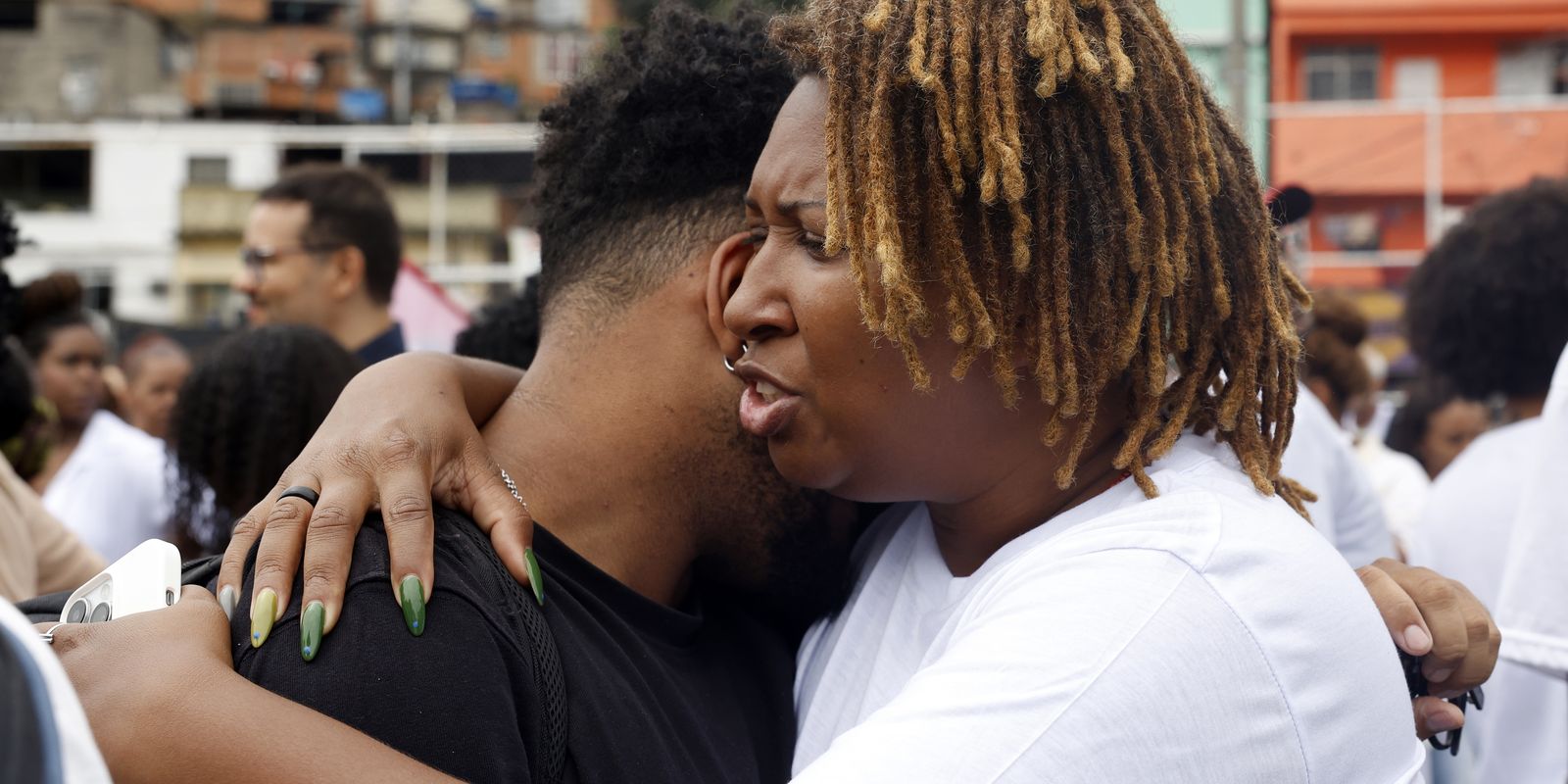
Union leader Raimunda de Jesus was one of the people who participated in the demonstration against Operation Containment, held in Complexo da Penha last Friday (31).
“The way it happened here doesn’t happen in the South Zone, in the richer areas, but there are also bandits there. We, who live on the outskirts, are discriminated against. But the State cannot see us as enemies. The State has to treat and take care of its people, its entire population”, he stated.
Liliane Santos Rodrigues, resident of Complexo do Alemão, also attended the event. She lost her son Gabriel Santos Vieira, aged 17, just six months ago. The young man was on the back of a motorcycle, on his way to work, when he was shot five times during a police chase.
“I’m feeling the pain of these mothers. It was a huge blow to see that a boy was killed in the same place my son died. I haven’t known what it’s like to sleep properly for three days””
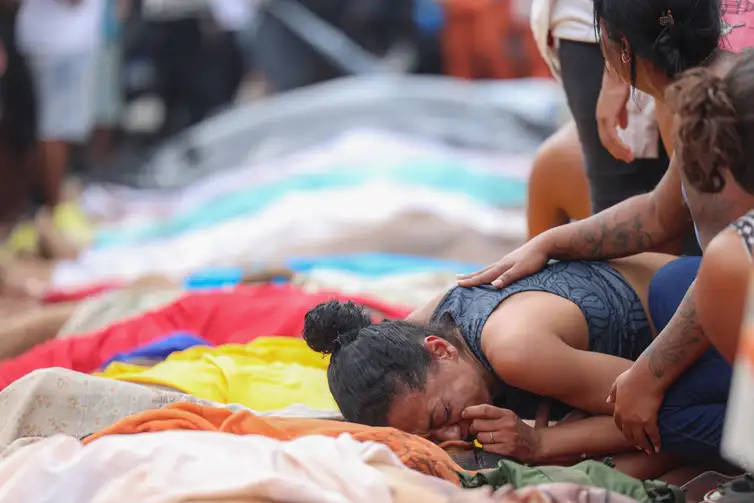
Dozens of bodies are brought by residents to Praça São Lucas, in Penha, north of Rio de Janeiro. Operation Containment. Photo: Tomaz Silva /Agência Brasil
favela complexes
According to the Rio Janeiro Security Secretariat, the Alemão and Penha complexes are considered the headquarters of the Red Command, with leaders from different states.
“There, it is the place where several hill owners, several leaders of local drug trafficking firms, end up living. The few who are free ─ the majority of drug leaders in Rio de Janeiro are already in prison and lead drug trafficking from prison ─ it is very common for them to live, to have houses within Complexo da Penha, Complexo Alemão, where there is an armed containment that offers greater resistance. In other words, there is more time to hide, to escape, to change places home, from the beginning of a police operation until its end”, says the coordinator of the Study Group on New Illegalisms at the Universidade Federal Fluminense (Geni/UFF), Carolina Grillo.
These places, however, are not restricted to crime. More than 110 thousand people live there, who are directly impacted by police operations. Operations like this, even with the 113 arrests made, with the deaths and seizures, do not affect the structure of Comando Vermelho, but they have a huge impact on the population, assesses the researcher.
“Those who will be impacted will be the families, the people murdered, the residents of that territory who will be traumatized forever”, he says.

Assistance to family members during the recognition of the bodies of those killed in Operation Containment at the Legal Medical Institute. Photo: Fernando Frazão/Agência Brasil
Red Command
The operation targeted Comando Vermelho, a criminal organization that was born in Rio de Janeiro’s prison system in the late 1970s. “It is associated with conditions in the prison at Caldeirão do Diabo, in Ilha Grande, torture, death, absolutely degrading treatment, as is no different to this day. Comando Vermelho responds with an organizational capacity that will shift crime from the world of bank robbery to the world of drug trafficking, which is much broader and was a form This Red Command, then, has been growing”, says José Claudio Sousa Alves.
According to a technical note from the Brazilian Public Security Forum, Comando Vermelho is considered the second largest criminal organization in the country, also present in 24 states and the Federal Districtin addition to maintaining international connections for drug trade and other activities.
Research by Geni and Instituto Fogo Cruzado showed that Comando Vermelho was the only criminal faction to expand its territorial control from 2022 to 2023 in Greater Rio. With an increase of 8.4%, the organization surpassed the militias and now accounts for 51.9% of the areas controlled by criminals in the region.
According to the study, militias reduced their areas by 19.3%, from 2022 to 2023, and now account for 38.9% of territories controlled by criminal groups. The research showed that Comando Vermelho regained leadership of 242 km² that had been lost to the militias in 2021. That year, 46.5% of the areas under criminal control belonged to the militias and 42.9% to Comando Vermelho.
The places where the faction grew the most were Baixada Fluminense and Leste Metropolitano. The militias suffered the biggest losses in Baixada and the west zone of the city of Rio de Janeiro.
It is no surprise that organized crime establishes itself and thrives in territories with a vulnerable population. “There is an almost inexhaustible supply of labor for criminal work, due to the very precarious opportunities offered to young people in Brazil today, due to the terrible social inequalities, which are structural in the country”, says Carolina Grillo.
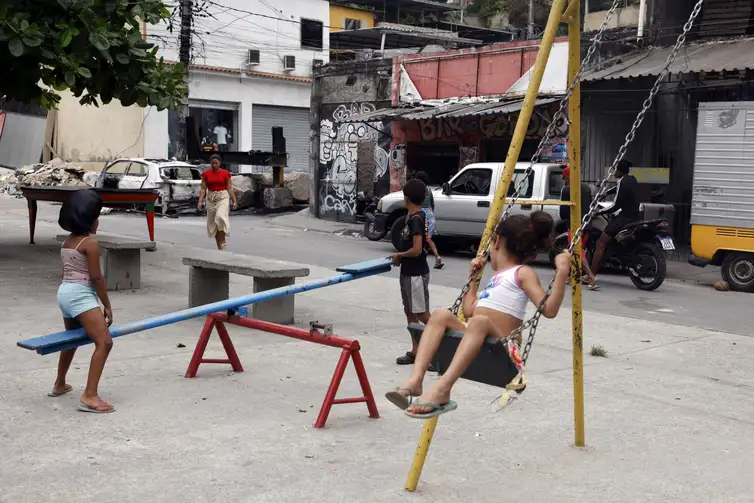
Children play in the Vila Cruzeiro square next to barricades that were placed to contain the advance of police officers during Operation Containment. Photo: Tânia Rêgo/Agência Brasil
Population is victim
Comando Vermelho’s way of operating also changed over time, no longer making profits solely from the sale of drugs. According to José Claudio Sousa Alves, this was mainly due to contact with the modus operandi of militias in Rio de Janeirowho exploit residents of controlled territories, charging services and fees.
Although the operation seized tons of drugs – the total has not yet been specified –, the Civil Police Secretary himself, Felipe Curi, recognized that drugs are not the main source of financing for organized crime.
“Drugs today account for around 10% to 15% of the factions’ revenue. She saw that the territory is synonymous with revenue, money, economic exploitation. Precisely exploiting everything that is within it: internet, gas, electricity, water, irregular constructions, extortion of traders within the community, residents, etc. So, this is what the red command wants, precisely, to exploit the territory economically”, said the secretary.
Fighting crime
Both José Claudio Sousa Alves and Carolina Grillo argue that police operations are not the most effective way to combat organized crime. For them, proof of this is that even with the operations carried out over the last few years, organized crime has not lost territory.
According to the study by Geni and Fogo Cruzado, 3,603,440 residents of the metropolitan region of Rio de Janeiro are in territories under the control of militias (29.2%). The Red Command has hegemony in an area inhabited by 2,981,982 residents (24.2%); followed by Third Command, with 445,626 (3.6%) and Amigo dos Amigos, with 48,232 (0.4%). Just over 4.4 million people from Rio de Janeiro live in neighborhoods that are still the subject of dispute (36.2%).
“There are other strategic links, whose combat takes place in a non-violent way. Operations that dismantled structures, financial arms of the PCC [Primeiro Comando da Capital]were triggered without any shot being fired”, says Carolina Grillo, citing the Operation Hidden Carbon as an example.
Another example given was the operation launched by the Federal Police that dismantled, in Rio de Janeiroa criminal organization specializing in the production, assembly and illegal trade of restricted-use firearms.
“It has a much greater disarming effect on organized crime than these actions focused on confrontation, which have a gigantic impact on society, traumatize children, make a series of families vulnerable who are prevented from working, prevented from taking their children to school, subjected to irreparable trauma, without any positive result of liberating these families from the judgment of these armed groups being enjoyed”, says the researcher.
José Claudio Sousa Alves adds: “Where does all this money from drug trafficking go? Who is operating it? Is it Alemão’s slipper? Is it the poor retail salesman? Where does all this money go? Are you with him? No. Obviously not. You have much broader structures. You have an international structure, today, for drug trafficking. There are conditions to investigate. Carbono Oculto shows us that this is possible”, he says.
Another possible line of action is to offer opportunities to populations in favelas and vulnerable areas, especially young peopleso that they do not become part of organized crime and strengthen the factions. “There are no proposals either from the current government, much less from the previous ones, in relation to this mass of people who cannot access the job market, they are increasingly precarious, there is a population that lives without a salary”, says the professor.
Carolina Grillo highlights the importance of Pronasci Juventude, from the Ministry of Justice and Public Security, which aims to prevent violence and crime associated with illegal drug markets. Young people receive support for studies, training and entry into the job market.
*Tâmara Freire collaborated.