The World Food Program has begun distributing supplies in the most affected provinces, but the regime’s lack of transparency raises questions about the destination of international aid.
MADRID, Spain.-The United Nations World Food Program (WFP) warned that around 700,000 people in Cuba, more than 7% of the population, require urgent humanitarian assistance after the devastating Hurricane Melissa passes through the east of the country. The agency noted that the cyclone left serious damage to homes, crops and basic supply networks.
According to explained the WFP to the EFE agency, Half of those affected will need support for at least three months, while the rest may require support for six months or more. As part of the UN’s anticipatory action plan for emergencies in Cuba, the organization has already mobilized 617 tons of rice, grains and oil, destined mainly to the provinces of Granma, Santiago de Cuba, Guantánamo and Holguín, the hardest hit by the cyclone.
However, to sustain operations over the next six months, WFP estimates that an additional $30 million is required, of which $25 million would go toward the purchase of basic foodstuffs.
Other agencies of the United Nations system also participate in the joint effort, including the Pan American Health Organization (PAHO/WHO), the United Nations Children’s Fund (UNICEF) and the United Nations Development Program (UNDP), which are working to send medical supplies, drinking water and basic necessities to the most affected rural areas.
International cooperation towards Cuba, with shadows over its management
The Secretary of State of the United States, Marco Rubio, assured this Thursday in his X account that Washington “is prepared to offer immediate humanitarian aid to the Cuban people affected by Hurricane Melissa.” The State Department reaffirmed in a statement its willingness to provide direct support to Cuban citizens, not the regime, and expressed its solidarity with the affected families.
Also this Thursday it emerged that the Chinese Red Cross sent a shipment of one thousand emergency family kits to Cuba destined for the eastern provinces. According to reported the Chinese ambassador in Havana, Hua Xin, this is the first international shipment of humanitarian aid after the hurricane. The kits, which include hygiene products, shelter and other essential items.
Days before the impact of the cyclone, The UN released 4 million dollars from the Central Emergency Response Fund (CERF) as “anticipatory action” before the arrival of the hurricane. However, there is no official information on the actual use of these resources or independent oversight mechanisms.
Added to that contribution was another of $400,000 from the Norwegian Embassy in Cuba, announced by Ambassador John Petter Opdahl in X.
As has happened in previous emergencies, the regime disposes of these funds without accountability, while affected communities face shortages of food, drinking water, and basic services. Experts and activists denounce that the Cuban Government manages international aid without transparency, while the population of the east continues to suffer blackouts and collapsed infrastructure.
The impact of Hurricane Melissa
Hurricane Melissa—a system that entered eastern Cuba as a category three hurricane, after having reached category four as it passed through Jamaica—hit the eastern region from early morning until the morning of Wednesday, October 29.
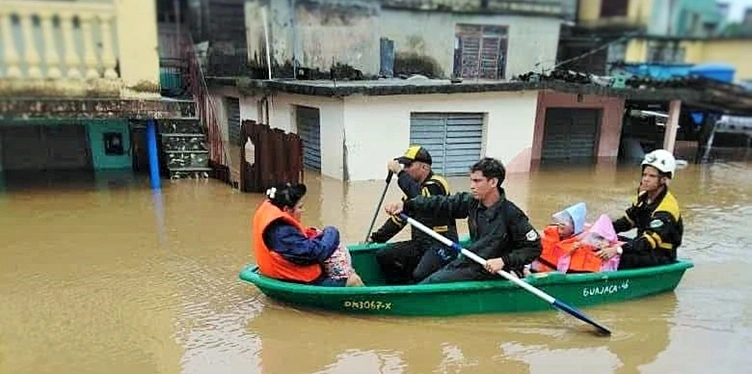
Although the authorities have not yet published an exhaustive official report of the damage, multiple images and testimonies have been released showing destroyed homes, entire communities flooded, people who have lost everyone, and entire areas cut off.
The rainfall was extraordinary: accumulations of up to 500 mm were recorded in mountainous areas, storm surges that raised the sea level between 2.5 and 3.7 meters above normal on the southeastern coast, and wind gusts that exceeded 190 km/h at the time of impact.
The magnitude of the phenomenon and the lack of communication generate a scenario of high vulnerability, in which the most affected communities await urgent and transparent assistance.