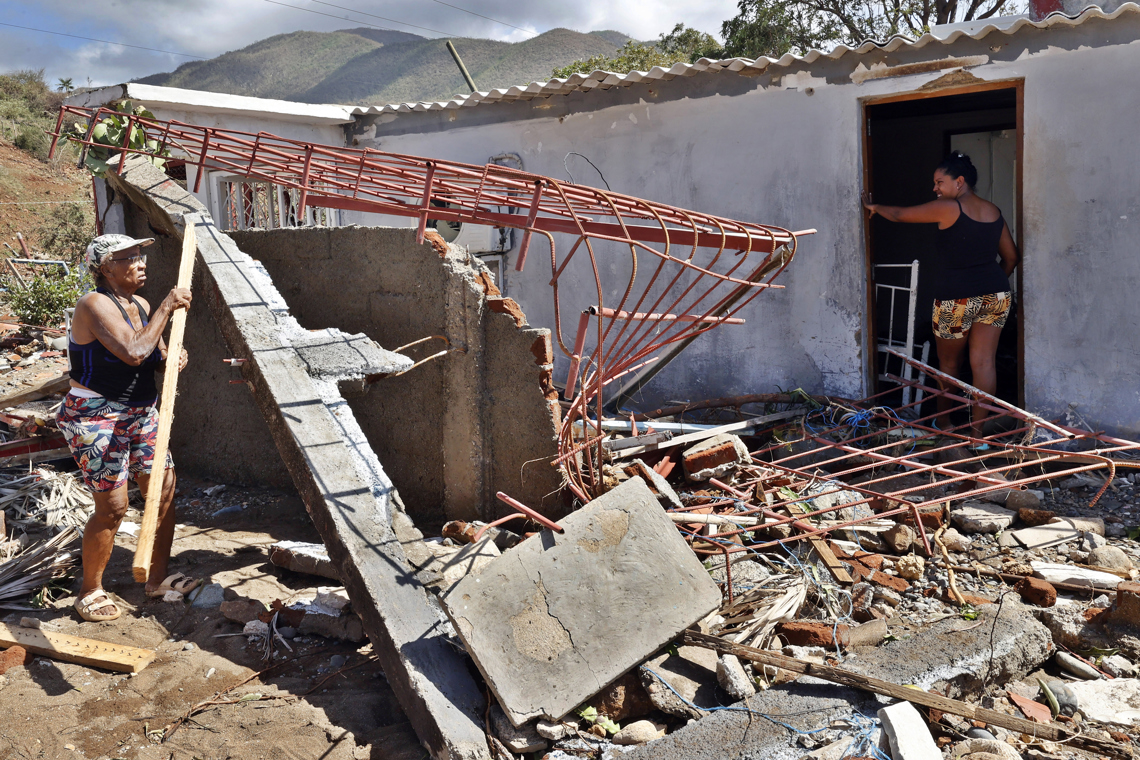
The United States Government opened the door to the delivery of donations to Cuba by private individuals to contribute to the recovery from the disastrous impact of Hurricane Melissa.
After a first announcement in which Washington said it was “prepared” to offer help to the island and in the middle of contradictory reactions from Havana To that offer, the State Department dusted off a package of general and specific licenses that would facilitate these donations.
These licenses allow individuals and companies in the United States to send food, medicine and medical supplies to Cuba and their approval could be “accelerated” given the catastrophic scenario that the Caribbean country is suffering and despite the validity of US sanctions.
“While the embargo remains in effect, the United States Government prioritizes support for the Cuban people, so US legislation and regulations include exemptions and authorizations related to the export of food, medicine and other humanitarian products to Cuba, as well as disaster response,” explained the State Department.
In a fact sheet issued this Thursday on the subject, the entity assured that in cases where necessary it is possible to “accelerate” the review of license applications by private parties “to facilitate the timely export of humanitarian goods, including medical supplies, to Cuba.”
“Through the Departments of Commerce and the Treasury, there are many options available to expedite the export of humanitarian products to Cuba,” reiterated the official statement, which “actively encouraged those who wish to support the Cuban people to make use of these options” and to contact the State Department “if any inconvenience arises.”
The authorizations
As explained in the US Government publication, among the existing general license authorizations that could now be used to make donations to Cuba are those included by the Office of Foreign Assets Control (OFAC) in the Cuban asset control regulations (CACR).
This is the case of an article that authorizes “ordinary transactions inherent to exports from the United States” to Cuba, directly or through a third country, as long as they are articles authorized by the Department of Commerce and under “certain conditions.”
Also another that allows persons subject to US jurisdiction to “provide maritime or air transportation services to, from or within Cuba”, in relation to authorized trips, “without the need for a specific license from OFAC” and complying with certain aspects.
Among these is that they may transport cargo and luggage accompanying an authorized traveler, provided that the export of said cargo and luggage is authorized by the Department of Commerce, as well as any other unaccompanied cargo or luggage whose export to Cuba is authorized by the Department of Commerce, explains the Regulation.
In addition, transactions related to travel and others aimed at “providing support to the Cuban people” are also authorized – although “subject to conditions” – as long as these are independent, human rights organizations or related to humanitarian projects linked to civil society and unrelated to the island’s Government.
Another section, for its part, makes it possible to provide Cuba and its nationals, including state authorities and entities, with “services related to the development, repair, maintenance and improvement of infrastructure,” as long as it “directly benefits the Cuban people” and is in accordance with the licensing policy of the Department of Commerce.
This license covers sectors such as public transport, water and waste management, electricity generation and distribution, as well as hospitals, homes and schools.
Specific licenses and licenses from other US entities
In the case of specific licenses, the Washington statement points out that “for most transactions that are not exempt or authorized by OFAC’s general licenses,” there are also avenues for approval.
In this regard, it points out that requests are reviewed “on a case-by-case basis” and priority is given to “the review of license applications, compliance questions and other requests related to humanitarian support to the Cuban people.” OFAC, in particular, “offers express expediting for medical supplies.”
Meanwhile, the Bureau of Industry and Security (BIS) of Commerce also has regulations for exports to the island that may apply to sending aid to the island after the hit of Hurricane Melissa.
While the fact sheet acknowledges that “there is a general denial policy for most exports and re-exports to Cuba,” it also states that there are categories that “may be approved generally or reviewed on a case-by-case basis,” as well as “certain types of exceptions.”
In general, he points out, there is a general approval policy for items such as medicines, medical devices (even donated), as well as telecommunications equipment for the Cuban people, aviation safety items and environmental protection.
The case-by-case review would apply to “items for export or re-export to state-owned companies, agencies and other Cuban Government organizations that provide goods and services for the use and benefit of the Cuban people.”
Finally, the report highlights the license exception for gift packages, which includes a monthly shipment per recipient (individuals or independent NGOs), for a maximum value of $800—with no limit on food—, with medicines, clothing or communication devices.
Cuba contacts the US to specify the aid offered to victims of Hurricane Melissa
From Cuba
The State Department’s publication that opens the door to private donations to Cuba is released while the extensive damage caused by the hurricane in eastern Cuba is being evaluated and the first international aid to the country has begun to be announced and arrive.
After the initial offer from the United States, the Cuban Foreign Ministry reported on official contacts to find out how the humanitarian aid announced by Marco Rubio would be provided.
However, the Government and the Communist Party of the island have also questioned Washington’s announcement and have pointed to a lifting or humanitarian pause of the embargo “without conditions” as the “sincere” way to support the Cuban people.
The official reactions from Havana have not explicitly referred to the ways indicated by the State Department to channel and expedite private donations to the island. For its part, Washington’s publication does not refer to a possible direct participation of the Trump Administration in shipments of humanitarian aid to Cuba.
Meanwhile, in the networks and areas of the country hit by Melissa—and in the face of the enormous losses left by the hurricane—calls to accept the aid offered, whether from the United States or any other country, are beginning to emerge, as well as criticism of the political positions and conditions attached to these donations.