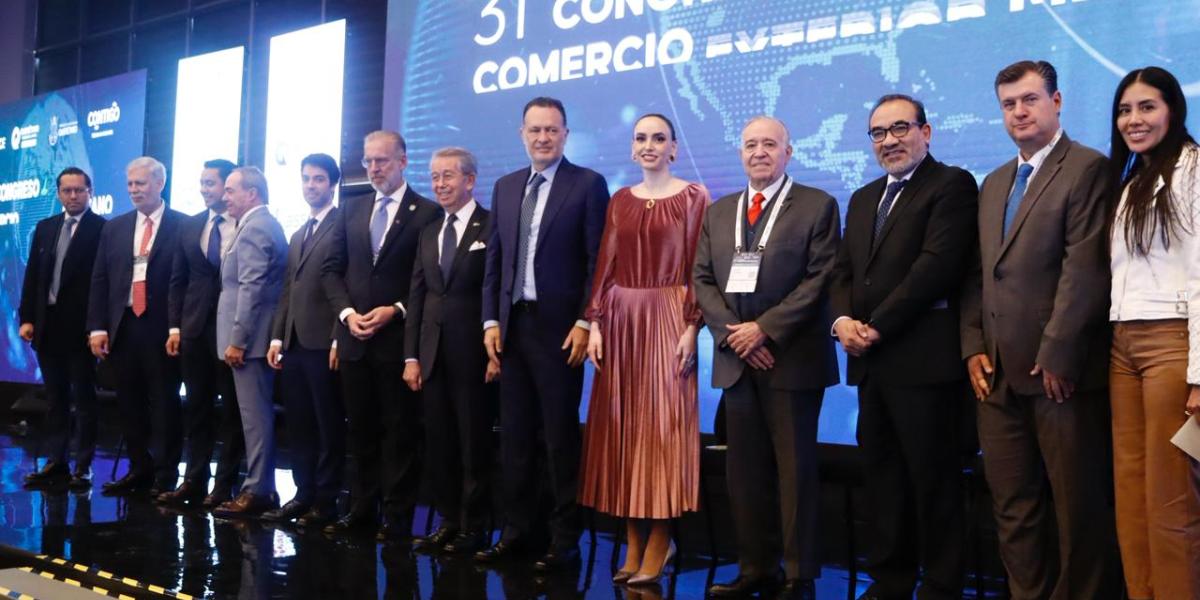
Querétaro, Qro. The Treaty between Mexico, the United States and Canada (T-MEC) requires addressing fair and loyal trade, he stated this Thursday Altagracia Gomez Sierracoordinator of the Advisory Council for Regional Economic Development and Relocation (CADERR).
By participating in the 31st Mexican Foreign Trade Congressthe official explained that there are many challenges and discussions between the three countries about how to improve regional competitiveness.
“If the world changes, the treaty (T-MEC) It can’t stay the same. There are new topics, such as what fair trade looks like, beyond nationalism, fair trade practices, and how unfair trade practices can be eradicated; the investment policies of foreign states; regional positions regarding priority sectors, alliances such as the Semiconductors Alliance Act, and how the three countries can work together,” he said.
The T-MEC entered into force on July 1, 2020. Its Article 34.7 establishes that the Agreement will terminate 16 years after its date of entry into force, unless each Party confirms its wish to continue it for a new period of 16 years.
Before some 750 attendees, Gómez Sierra raised two projection points. The first: “I think that what we can expect is of course that Mexico continues to comply with its international and national commitments going forward, during the consultation period (of the T-MEC), but also during the formal review period and until the signing of the revision of the free trade agreement.”
According to the Ministry of Economy, 85% of Mexico’s trade with the United States is tariff-free, which puts Mexico in a better commercial condition than other countries.
Secondly, Gómez Sierra added: “That we make use of this not only resilience, but also the position of comparative advantage against other countries, to bring more and better investments that are adding more value, because this is important, as there is an approach to raising the rules of origin, both local content and regional content. We necessarily have to bet on adding value, we necessarily have to bet on more innovation. And that can only bring benefits to Mexico.”
At the event, Sergio ContrerasExecutive President of the Mexican Business Council for Foreign Trade, Investment and Technology (COMCE), highlighted that companies are experiencing a crucial moment for international trade.
“The United States depends greatly on Mexico’s industrial sector. We have become extraordinarily integrated into the most important country in the world. We are the number one partner of the United States, of the most important economy in the world, and we will continue to be so,” he said.
Contreras indicated that 90% of the Mexican exports corresponds to manufacturing, produced with high integration with North America, which provides some resilience to Trump’s tariff policies.
“We are going to continue being the first trading partner of the United States due to this integration that we have in the industrial part. And that is also very important, because we are capable of exporting quality manufacturing.”
In mid-October, Sergio Gómez Lora, director of the Index USA Officeanticipated that the T-MEC countries will discuss adjustments on how to regulate Chinese investment.
“I believe that the possibility of having common rules in North America for all countries on how to treat trade and investment with Chinathe three countries as a region,” he commented then.