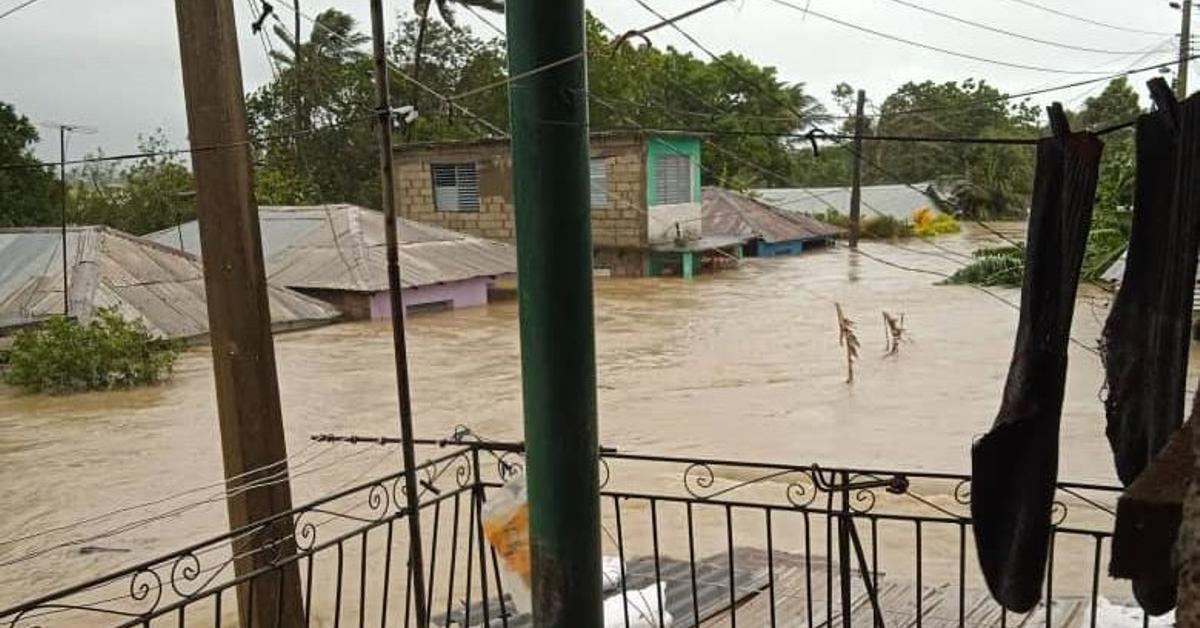
Havana / Holguín /As Hurricane Melissa moves away from Cuban territory, it is becoming clear that flooding is the main problem it has left in its path through the Island. Overflowing rivers, reservoirs that are almost at maximum capacity and houses covered by water are some of the most alarming images that are emerging from Granma, Holguín and Santiago de Cuba.
In the city of Bayamo, the family of Pablo, 61, left last night to go to the house of relatives “who live in a higher area,” the man from Granma tells by phone. 14ymedio. “Luckily we left because the water on our block right now is knee-deep.” They left behind what they couldn’t take and have lost: two mattresses and the washing machine that they couldn’t take out in time.
Similar stories are repeated in towns and cities throughout Melissa’s journey, which began with her entry at 3:05 in the morning near Chivirico, near Santiago de Cuba, and her departure from the Island through the municipality of Banes, in the north of Holguín. In most cases, images or testimonies of what happened in those communities have not even been able to be disseminated due to the interruption of telecommunications.
Climbing to the roofs of the houses, in Cueto, Holguín, some neighbors have filmed the mighty river that runs through their streets and has covered the homes to the point that some have disappeared from view beneath the waters. The torrent carries branches, garbage and fragments of metal tiles that flew with Melissa’s winds or gave way to the push of the current.
“Tonight we don’t think we’ll be able to return,” a local resident who stayed at the home of neighbors living on the first floor told this newspaper. His home is one of those that has been lost under the earthy-colored water that has flooded the community. “I have relatives who live in the hills and I don’t know anything about them,” he says.
“Attention! The Sagua River continues to rise due to the intense rains from Hurricane Melissa. The population in low-lying areas is recommended to take extreme precautions and follow the instructions of the authorities,” warned an official Facebook profile that accompanied the text with several photos of wooden homes submerged, more than half, in the waters.
In the city of Holguín, most people are still without electricity. “We also don’t have a mobile phone signal,” explains a neighbor who contacted this newspaper through a friend’s Nauta Hogar service, for cable web browsing. “It was a black night, noises everywhere and when it was dawn and the sun came out, that’s when we saw the disaster.”
The Holguín resident explains that there are downed trees and abundant fallen branches in the city, but that the biggest concern is the flooding in the Holguín towns where many of the residents of the provincial capital have families. “I have my grandmother in Mayarí and I have no news about her, the only thing that relieves me is that she is with my two nephews who are young.”
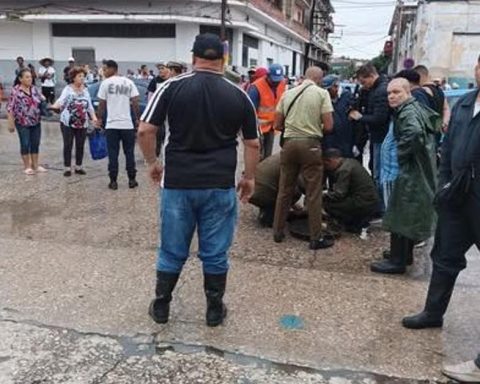
The street that runs in front of the Holguín Municipal Cemetery, or “old cemetery” as it is known, became a torrent. In the videos that circulate on networks you can see how the water dragged fallen trees and everything in its path at high speed. Neighbors denounce that the overflowing of the Jigüe River is also a consequence of “the drains not being unclogged, with reports shelved several years ago.”

/ Facebook / Juan Pablo Carreras
Despite the exit to sea of Hurricane Melissa, it is predicted that areas of rain and strong storms will continue in eastern Cuba for the rest of this Wednesday, which will also be encouraged by the orography of the region.
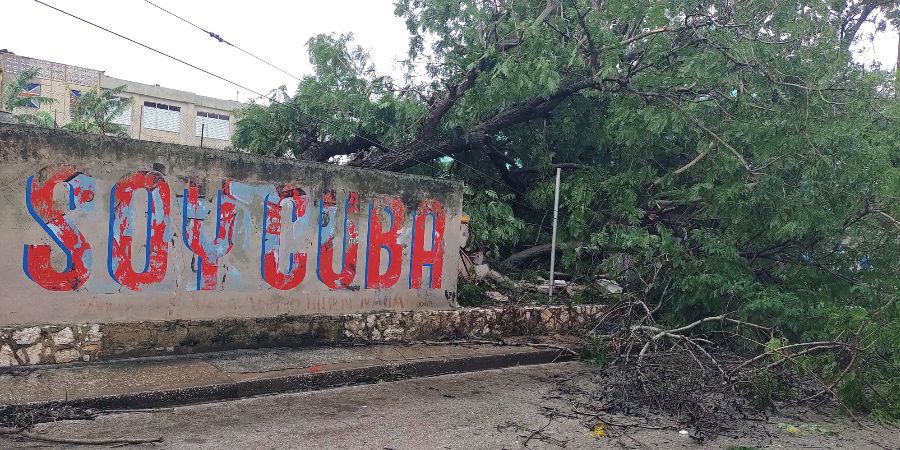
During its passage through Santiago de Cuba and Holguín, the center of the cyclone caused considerable damage, uprooting trees and roofs from homes, flooding entire towns,
From El Cobre, in Santiago de Cuba, they report one deceased person. Father Rogelio Dean confirmed – through audio – that “there is only one known fatality in the area, an elderly person.” He adds that in the town “only a few houses with plate roofs were left standing; most people have lost everything.”
In the last 24 hours, the National Institute of Hydraulic Resources reported 51 rain gauges with accumulations between 100 and 200 millimeters, 12 between 200 and 300 millimeters and six rain gauges with records of more than 300 millimeters of precipitation. The highest records are: 377 millimeters at the Charco Redondo Telecorreo, 355.9 millimeters at the Las Villas Reservoir and 346 millimeters at the El Salto Hydrometric Station, all in Granma.
The Electric Company of that province reported that, due to the damage caused by Hurricane Melissa, heavy rains and winds affected the telephone center lines, temporarily leaving the population without communication. They also stated that, due to the cyclonic alarm phase, it is not possible to carry out evaluation or repair work on the power lines, since the weather conditions prevent any safe intervention.
/ Social networks
“Once the Civil Defense declares the recovery phase, the technical teams will begin the identification and repair of damage to gradually restore service, prioritizing hospitals, water systems and evacuation centers,” they added. In addition, it was clarified that the thermoelectric plants in eastern Cuba are out of operation for the moment, affecting the entire national electrical system. Therefore, the deficit in generation capacities from Camagüey to Pinar del Río “will be high.”
From Contramaestre, the writer Arnoldo Fernández narrated his experience in a shocking way: “In my case, we locked ourselves in a bathroom, because we feared the wind, which could break down the door of the shelter house. We lived moments of infinite agony, we almost saw death behind the small bathroom window.”
Fernández, whose municipality experienced the passage of the eye of the hurricane, continues his testimony: “the saddest thing, upon returning home, there was no roof, Melissa carried it, she tore it to pieces. Today I saw it raining inside my house and I cried.” Melissa also uprooted the trees in her yard. “It seems like a bomb fell on Eden,” he said.
Their pain is greater because the moment they got into the bathroom, their dog’s heart stopped: “He couldn’t overcome his fear of those roars of a beast ready to eat us.”