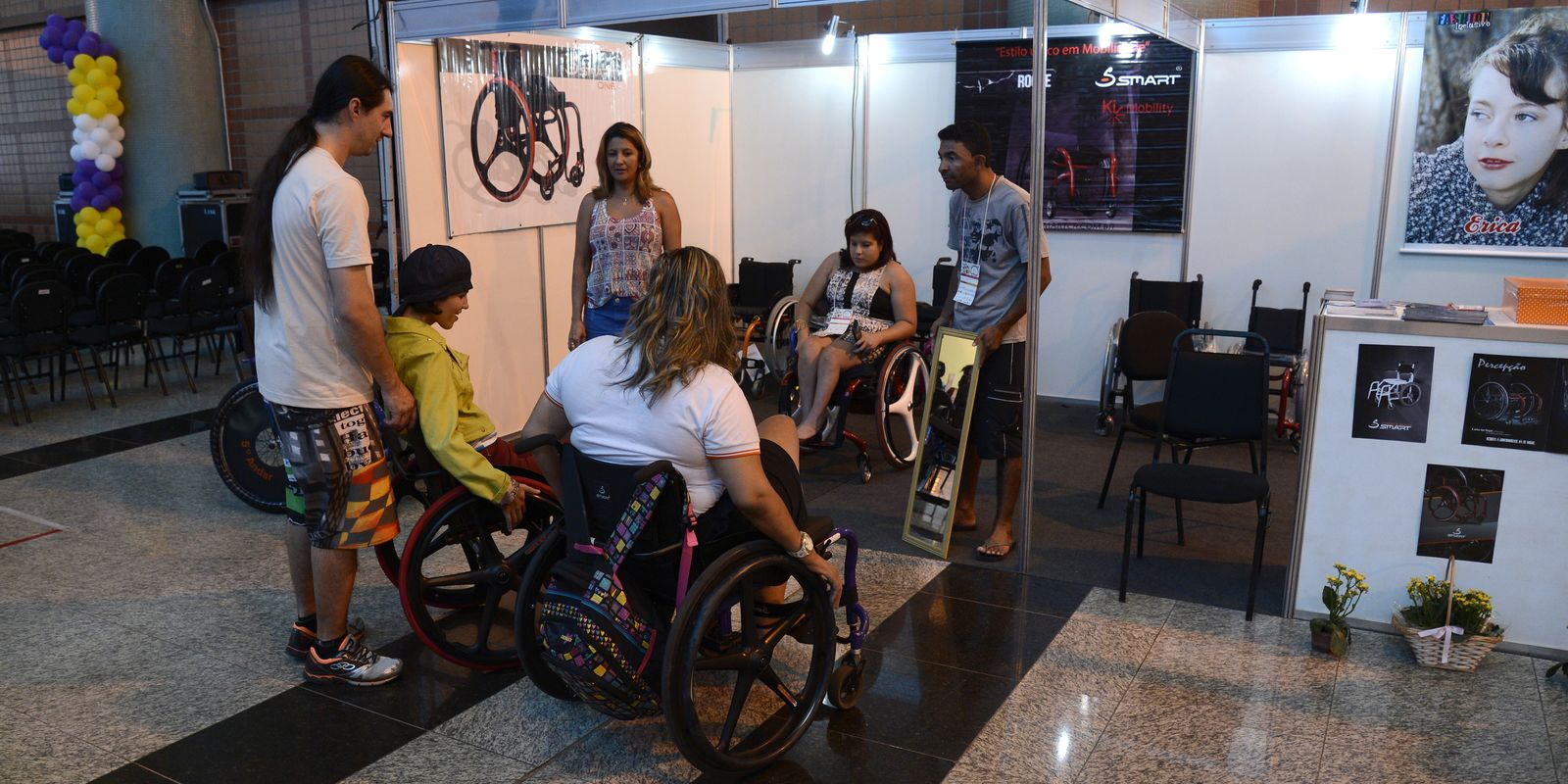
To try to guarantee effective participation of people with disabilities in artistic production and creation, Itaú Cultural (IC) launched, this Tuesday (28), the Accessibility Dossier, in São Paulo. In addition to providing data on legal and statistical frameworks, the material provides cultural workers with information on how to prepare spaces and works so that this portion of the population has their right to artistic enjoyment fully respected.
One of the main principles that guide the defense of the rights of people with disabilities is autonomy. However, for the more than 18 million Brazilians who make up this groupnot only is this denied at the most basic level of everyday life, but also when trying to perceive literature, photos from an exhibition or a sculpture displayed in a museum, experts at the event warned.
Organizations and artists sometimes try to convince themselves that they care about this aspect when putting their art out into the world, when in reality they only strive to provide one or two of the resources for people with disabilities, such as installing a ramp or hiring a professional who has mastered Brazilian Sign Language (Libras). This does not serve the entire public, as they ignore other singularities. This was one of the criticisms made by accessibility consultant, cultural producer, illustrator and manager Claudio Rubino during the dossier launch event.
As researcher Mariana Oliveira Arantes added, “the resources are not always really inviting and available”, as, for example, a tactile floor may have been installed for blind people and people with low vision, but it ends up leading to a wall, as often happens. Another point she highlights is the need to understand accessibility not as a merely technical issue, but as an aesthetic one, simultaneously, which is why the number of artists and def culture activists is expanding.
The IC dossier explains that def culture is an expression coined by them and which aims to value the experiences and diversity of bodies and capabilities of people with disabilities, transforming them into input, within the scope of culture. The report also updates terms such as “inclusion”. Rubino clarifies that, when using the word “inclusion”, it is assumed that someone is included and that someone else includes, which generates a hierarchy, something opposite to what def culture proposes. The aspiration is to promote equality also in the decision-making sphere, fighting for them to occupy not only operational and less complex positions, but also This commonly happens, including in the private sector.
For Rubino, who consolidated his expertise also through his work in Tomie Ohtake Instituteprofessionals with disabilities must be aware that they cannot fight alone in their organizations to make this happen.
“It’s a collaborative and continuous process, in which we take risks, which can be organized in a way that seems very simple, easy, but has a lot of commitment, structure and organization,” he said, referring to the complexity and negotiations that permeate initiatives such as the IC dossier.
After visiting almost 200 cultural facilities in Greater São Paulo, Mariana Oliveira Arantes found that there is work to be done in relation to improvements in the vocabulary and repertoire of cultural agents. One of the problems he observed was the use, by workshop staff, of inappropriate and outdated nomenclatures, such as “special students” or “students with special needs”.
The historian, who records her perceptions and assessments about accessibility in website World in Accountalso says that cultural professionals are anxious about the change they have had to deal with, with more favorable winds for people with disabilities, since funding notices are making specific actions for them compulsory or, at least, something that counts for points in the selections. “People, artists, are desperate, not knowing what to do”, she reports, reproaching those who leave it to think about it in the last phase of their projects, characterizing a “somewhat fake access”.
By participating in the 1st International Congress on Disability at the University of São Paulo (USP)held last week, Arantes confirmed, through the speech of a professor at the institution’s Polytechnic School (Poli-USP), that much of the time adverse circumstances can be related to the lack of willingness and disinterest of those without disabilities, which leads to the failure of projects. According to her, the academic said that he has already come across a closet full of dusty projects, which corresponds to the reality evidenced in a study that revealed that the majority of those designed for people with disabilities are interrupted in their first prototype, that is, in their first testing phase, and are therefore not finished.
Eye
“Accessibility depends much more on changing behavior than on funds and structure”, says the educator.
Former colleague of Claudio Rubino and still an employee of the Tomie Ohtake Institute, publishing specialist Divina Prado comments on a project developed by the two, ten years ago, which was like a lantern on the path they have been paving since then. In developing the Tomie Ohtake Artist Grant, sought to produce educational materialwelcome and treat children with and without disabilities with the same dignity. A game was designed that called for collective and individual action, with all the paraphernalia that was quite essential for the proposal, including a notebook, an illustrated book about the artist’s history, audio description, paper, paint, canvas and brushes. The beginning of all this was the exhibition Tomie Ohtake 100 101, which was on display at the institute that bears his name, from April to June 2015.
Through the pilot project and with a large number of visually impaired children, both learned, in a certain way, a method, constantly renewed with each goal that is intended to be achieved. The anti-capacity stance, Prado points out, admits the combination of elements such as the insertion of textures, the description of environments that are unfamiliar to everyone who is in contact with the works and the construction of soundscapes.
In the case of Bolsa de Artista, they attributed the same importance to the CD with the soundscape and to the sawdust to mix in the paint.
“At the time, CDs were used. This is also a discussion in this field. We have to keep up with the technologies. Today we use the QR Code. In a while, this will be obsolete”, reflects Prado, who, at that time, had just arrived at the institute, to work on the team responsible for the educational function. “Shortly after, I started building the educational materials and the first of them was already made with the participation of invited people, teachers, educators, students.”
The specialist mentions two highlights of the institute in this area this year. The first of them is Essay notebook 3: Peoplefor which the professionals stopped to understand which sounds refer to the idea of people. “It’s something that brings together children playing, people stepping on the ground, water boiling, something that is common to people anywhere in the world”, she says.
The other reason for Prado’s pride, an identical accessibility tool, is Palavra, winner of the Graphic Design category, in the Editorial Production Axis of the Jabuti Award. In this case, they opted for string instruments, “a little voice, a little Guarani singing”.
“There is a process of circularity, which is an attempt to make this more pleasant for the person to listen to, for the visually impaired person, for the illiterate person, for the person who is crossing the city on a crowded train and doesn’t want to carry the book, but will be able to listen to it. The book also has audio description of all the images and which thinks about an aesthetic sensitivity and also considers other elements that are there, understanding that this is an editorial mediation tool. It is for everyone.”
It’s about “inviting each person to read in their own way.” “You can listen, read, read while listening, just listen to the soundscape. There are many possible inputs. This is a desire to also think about, let’s say, a contemporary reading habit”, concludes Prado.
The Accessibility Dossier will be available on IC website.