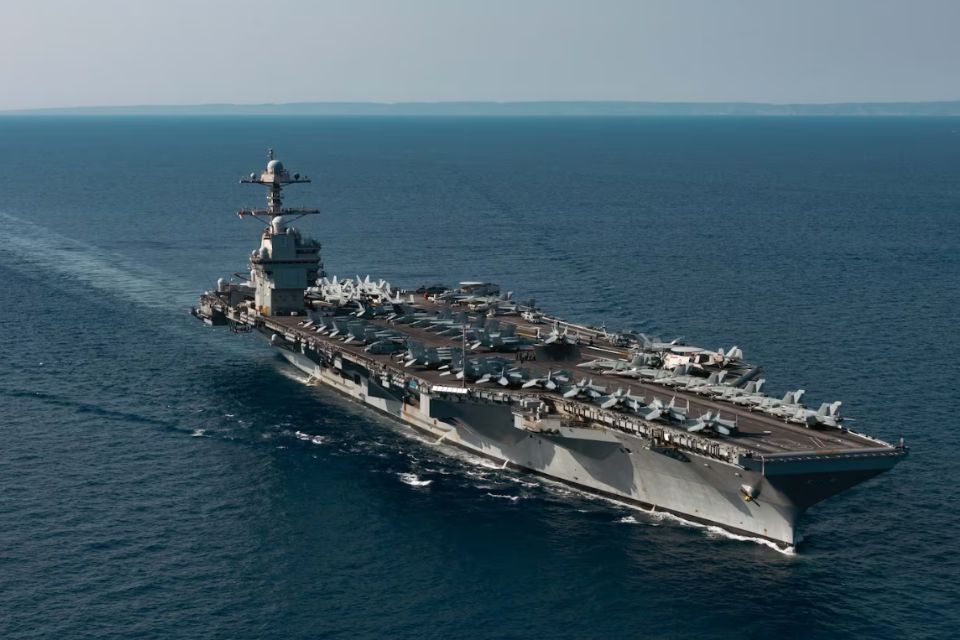
With the arrival of the USS Gerald Ford aircraft carrier strike group, which is expected next week, the United States will have a total of thirteen naval units, something that did not even occur in the 1989 invasion of Panama or the invasion of the island of Grenada in 1983.
The deployment of US naval forces in the Caribbean, off Venezuela, is already the largest in the country’s history since the first Gulf War (1990-1991), according to a study by experts from the Center for Strategic and International Studies (CSIS), pending the arrival of the Gerald Ford aircraft carrier strike group.
«You don’t send one of your most important naval assets to stand around and walk around. You either use it or reassign it immediately. The most likely thing is a missile attack against Venezuela,” retired Marine Colonel and author of the CSIS analysis Mark Cancian said in an interview with EFE.
With the arrival of the USS Gerald Ford aircraft carrier strike group, expected next week, the United States will have eight warships (six of them destroyers), three amphibious assault ships and one submarine. A total of thirteen naval units, something that did not even occur in the invasion of Panama in 1989 or in the invasion of the island of Grenada in 1983.
“This is the largest naval deployment in Latin America in at least 25 years or perhaps even the last 40 years,” says Cancian, a CSIS defense expert.
The Gerald Ford, which is assembling its full strike team off the Italian coast, will be escorted by three destroyers and includes supply ships for long campaigns.
The impressive deployment, which will be added to overflights of strategic bombers, will include SH-60R helicopters, which together with the fighter planes, fighters and support planes of the aircraft carrier, will be able to carry out a much larger scale campaign than that ordered by the president, Donald Trump, against drug trafficking.
US forces will have more than 700 missiles, in addition to about 180 Tomahawks, for ground attacks.
“Air strikes, but no ground invasion”
The announcement of the deployment of the Gerald Ford strike group, the most modern and important aircraft carrier in the US fleet, from the strategic eastern Mediterranean to the waters of the Caribbean Sea highlights the interest of the Donald Trump Administration in maximizing tension with the administration of Nicolás Maduro.
«Sending this imposing naval asset, when the US only has three active attack groups on the planet, is a very clear message. The US will have a great capacity to carry out air and missile attacks, so an attack of this type is most likely. “What this force is not designed for is an invasion,” says Cancian.
Additionally, CSIS notes that the Caribbean has been “a low-attention region for decades with rare aircraft carrier visits.”
Experts point out that another indicator that this operation could not simply be a show of force without further ado is the establishment of large military camps in Puerto Rico, which would indicate preparations for a major movement of troops towards the region, something that has not yet occurred.
Getting closer to the invasion?
The US is increasingly better positioned to carry out an air campaign but does not have sufficient force to carry out a ground invasion into foreign territory, something that Trump has always opposed as a general principle of his foreign and defense policy.
Stephen Biddle, professor at the School of Public and International Affairs at Columbia University (New York), assured EFE that “in the event of an invasion, it is assumed that the United States would send its fighters to the area first, but the displacement alone (of Gerald Ford) does not guarantee it.”
For his part, Michael Desch, director of the International Security Center at the University of Notre Dame, in the state of Indiana, sees similarities between the possible actions of the aircraft carrier in the Caribbean with the campaign that Trump ordered between March and May of this year against Houthi targets in Yemen.
In the operation, which involved the aircraft carrier USS Harry Truman, more than 800 targets were attacked and “hundreds of Houthi fighters” were killed, according to the US Central Command (Centcom). Even so, Washington acknowledged having failed to stop the insurgents.
In Cancian’s opinion, “something will have to happen in the coming weeks. Once you send all that combat power you create a situation that is not stable, you either use it or withdraw to another strategic point.
With information from the EFE agency
*Journalism in Venezuela is carried out in a hostile environment for the press with dozens of legal instruments in place to punish the word, especially the laws “against hate”, “against fascism” and “against the blockade.” This content was written taking into consideration the threats and limits that, consequently, have been imposed on the dissemination of information from within the country.
Post Views: 160