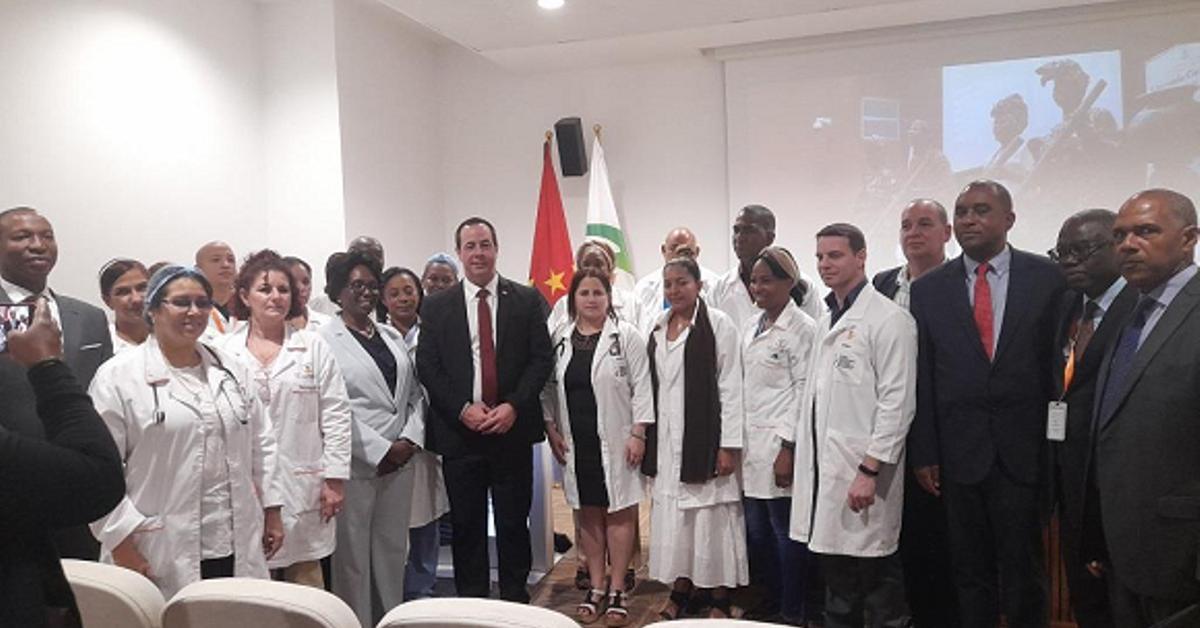
Havana/“We are somewhat resigned, but not at all satisfied,” summarizes Héctor, a Cuban doctor in Angola who participated in the meeting on October 23 between health workers and representatives of Antex, the state company that manages the missions in the African country. The meeting, held in Luanda, served to announce a new payment mechanism through the Classic card, which maintains restrictions on access to foreign currency and frustrates the hopes of health workers to recover their money in dollars.
The meeting took place in a tense atmosphere, although with fewer complaints than on previous occasions. “It’s not that we have given up, but people have already realized that these officials neither puncture nor cut, it is like talking to a wall,” explains the doctor, using a pseudonym for fear of reprisals. According to his testimony, the document read during the meeting had already been leaked days before, so the attendees arrived “more than warned.”
The official text established that, since October 20, Cuban professionals in Angola and Algeria can transfer the savings accumulated in their accounts in freely convertible currency (MLC) to a Classic card, with which they can buy in dollarized stores, purchase a car or pay for fuel at gas stations that operate in foreign currency.
The change does not solve the main problem: the impossibility of extracting cash in dollars from Cuba
However, the change does not solve the main problem: the impossibility of extracting cash in dollars from Cuba. “The chicken in rice with chicken has not changed at all,” Héctor ironically says. “The availability of foreign currency continues to depend on the bank, and the answer is always the same: that there are no dollars.”
The measure was to be applied in January 2026, but was brought forward due to growing unrest among aid workers, tired of being paid in a devalued currency. “All this prevents us from carrying out housing, investment or migration plans,” laments Héctor, who is about to finish his mission after more than three years. “The MLC is worth much less than the dollar, and the balance in a Classic is also lower. In the end we lose money in each transaction.”
The mismatch between currencies is confirmed by the informal market: while the dollar is trading this Tuesday at 485 Cuban pesos, the MLC barely reaches 200, and the money on a Classic card is equivalent to 446. “We can forget about part of our savings; that money evaporates among so many tricks that we have to do to obtain the cash,” he summarizes.
For months, several aid workers had trusted that the authorities would allow direct payment in dollars or kuanzas (Angolan currency), and then buy foreign currency in the local market. But the decision of the Cuban Government, announced this week, fell like “a bucket of cold water” on those expectations.
In September, professionals received only half of their monthly payment in kuanzas – about $200 –
The discomfort is aggravated by other non-compliance. In September, professionals received only half of their monthly payment in kuanzas – about $200 – and in October the disbursement was further delayed. Some doctors have not yet been paid. “People are demoralized, but also scared,” says another health worker in Luanda. “They have tried to divide us and instill fear so that no one would protest.”
The clearest warning came a few days ago from the Cuban Ministry of Public Health, which in a official note described doctors as “ungrateful and traitors” who criticize the system or denounce irregularities. “It was like a direct message,” says the doctor. “Anyone who complains fears being returned to Cuba and losing their savings.”
The discontent had reached such a point that a group of collaborators wrote a letter to the Cuban Prosecutor’s Office, on behalf of everyone, demanding payment in foreign currency and better working conditions. At the center of their complaints is Antex, a subsidiary of the Gaesa military conglomerate, sanctioned by the United States Office of Foreign Assets Control (Ofac). The company manages an extensive business in Angola that includes road construction, airfield repair and travel agencies, in addition to the management of medical missions.
The discontent had reached such a point that a group of collaborators wrote a letter to the Cuban Prosecutor’s Office.
In July, The professionals also sent a letter to Miguel Díaz-Canel, denouncing the “non-compliance with the payment method established in the contract” and demanding access to his funds in dollars deposited on the Island. There was no response. “Instead of rectifying it,” laments another doctor, “what they have done is give us another plastic card, but with dollars in cash, nothing.”
Most have lost hope for change. “They don’t want to give up the money,” says Héctor. “They have kept our foreign currency for years and they are not going to return it, even if it costs them more complaints and complaints at meetings.”