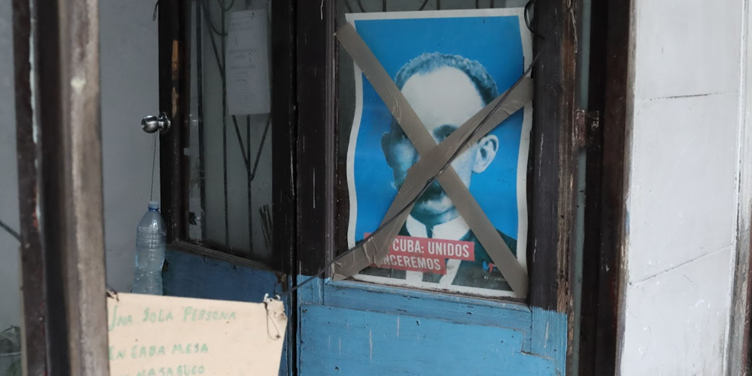
More than a century ago, José Martí warned about the role of social conditions in crime. Today, his words gain strength in the face of criminality marked by the action and omission of the Cuban State.
PUERTO PADRE, Cuba.- Cuba has been suffering for more than half a century from the causes and conditions of continued crimes, markedly increased by these times of economic and sociopolitical crisis, but, above all, by hostile interventions of the State in the nation and nationality.
There are crimes that can be considered perennial, everyday in the Cuban criminological panorama, that were created by government policies aimed at perpetuating the socioeconomic monopoly of the totalitarian State, and this is the case of cattle rustling. Since the early 1960s when private butcher shops passed into state hands, the cattle theft major constitutes the main brake on the development of livestock farming in Cuba.
By reducing or annulling private property and adapting the “national conscience” to the parameters of the Castro-communist regime, and such adaptation is understood as the castration of all verbalization of thought opposed to the so-called “socialist morality”, which is nothing but a sophistry spread over crime as a smokescreen, Cuba as a nation and Cubans as human beings in conditions of survival, subsist as in the worst eras of crimes in the country, which were those of banditry in the Spanish colony and that of gangsterism in the first decades of the republican period, which descended into political crime during the dictatorship of Fulgencio Batista and the criminal initiation of Fidel Castro.
We now see this landscape in the Cuban criminal ecosystem being overshadowed by a resurgence of the animus necandi (the intention to kill), in what we technically call “the criminal person”, thus resulting in aggravated criminality, as we are seeing by the people injured or killed in criminal acts that, I repeat, have their origin in the action or omission of public policies of the powers of the State with respect to the nation.
And within that criminological panorama, rare for our aborigines, but which is already 533 years old with the arrival of Columbus to Cuba on Sunday, October 28, 1492, which we have succinctly reviewed, I bring to the readers and because it seems written right now, notes from the review that for the newspaper The Nationfrom Buenos Aires, Argentina, wrote Jose Marti on May 6, 1888, reporting on the criminal anthropology congress that took place in New York at that time, with the participation of eminent international experts in the Criminal Sciences.
That was the time when the Italian doctor and criminologist Cesare Lombroso (1835-1909) spread his theory of criminological positivism. And then we see that José Martí, as a journalist, outlined what he, as a politician and humanist, combats through Mundesley’s thesis brought to the congress: “Crime does not depend on a certain region of the skull, nor does it settle in such a lobe, nor does the skull of criminals present more depths and slopes than that of virtuous people, whether they are occasional criminals, due to outbursts of untamed fury or bad advice of the moment, or of the predisposed to crime due to their ignorance or moral weakness, and those whose judgment is taken away by epilepsy or melancholy. All crimes, all brutalities, all vileness are in germ in the most honest man. The most vile or bestial has appeared at some moment, possible to the purest soul.”
And Martí continued to review Mundesley when he said of the social environment in the incidence of crime: “The will, the associations, the culture, suffocate, just as their lack favors the germs of crime.”
The English anthropologist immediately stated in a trial that was already visionary for its time, and publicized in Spanish-language media thanks to the journalism of José Martí: “The criminal is not distinguished from honest people; in the predominance that those who prosper now have in the world, in the name of businessmen, with stock market strategies, who bring other people’s fortune into their coffers, which makes them modern pirates, so treacherous and thieves in their contemporary calculations and methods like those that previously caused rich ships to run aground on their coasts to seize the loot. And the founders of fake companies, what are they more than highwaymen? They are criminals, like the vilest of convicts, and they are not seen in any region or lobe: on the contrary, they usually have a very placid face, and, above their round skull, their hair is very straight and well combed. No: there is no reliable anthropological theory that can be adduced as a defense before criminal judges. No: there is no general criminal constitution that predisposes to crime or excuses it.
The criminal anthropology theses to which José Martí as a journalist had access during the international congress held in New York in 1888, are the foundations of modern Criminal Sciences, which are, in turn, the missing foundations in Cuba for the reduction of crime, and the most important thing for applied criminological science: the sanitation of society, which begins with families and concludes with the civic nation.