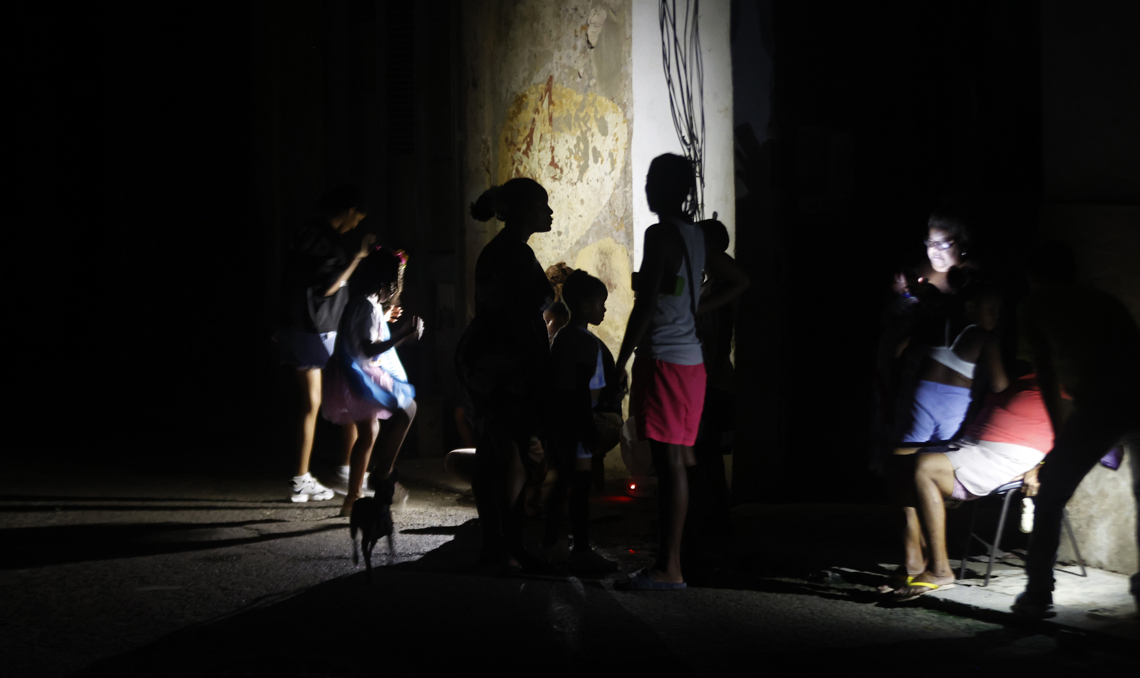
With the Hurricane Melissa increasingly closer to Cuba, the electrical situation this Tuesday, at least at night, will depend on the complex meteorological scenario facing the eastern region of the island.
This was explained by the Electrical Union (UNE), which in its part of today He did not offer a forecast of the impact on peak hours and assured that it “will depend on the behavior of availability and demand resulting from the weather conditions in the eastern zone.”
The UNE, which in recent days has said prioritize the electrical service for eastern Cuba, reported a maximum impact this Monday of 1,776 MW at 7:40 PM and confirmed that at dawn this Tuesday there were already 1,099 MW affected, while the availability was only 1,574 MW.
At noon the deficit should be 1200 MW.
Regarding the electricity generation scenario, there are six thermal units out of service due to breakdowns or maintenance, after the incorporation of block 6 of the Renté thermoelectric plant, in Santiago de Cuba.
However, due to the limitations of the units in operation, 513 MW are lost, while another 711 MW are not available due to lack of fuel and lubricants for distributed generation.
“Controlled disconnection”
With this scenario, blackouts will continue to hit the country hard while Melissa approaches and work is being done against the clock to protect life and resources in the face of the catastrophic impact that the hurricane is estimated to have in eastern Cuba.
With the winds and rains of the meteorological phenomenon increasing on the island, as a precautionary measure, the service must be cut off in the affected areas, where a priori A strong impact on the electro-energy infrastructure and a long recovery period is expected.
In this regard, the UNE confirmed that it will carry out a “controlled disconnection” in the eastern region.
The entity reported that “in areas where winds reach 60 km/h, the linked circuits will be disconnected.”
In addition, he confirmed that the Renté thermoelectric plants in Santiago de Cuba will be disconnected; Felton, from Holguín, and Central Fuel from Moa, due to their geographical location. “This process will be done in a controlled manner to maintain the integrity of the operation of the National Electroenergy System in the Central-Eastern Zone.”