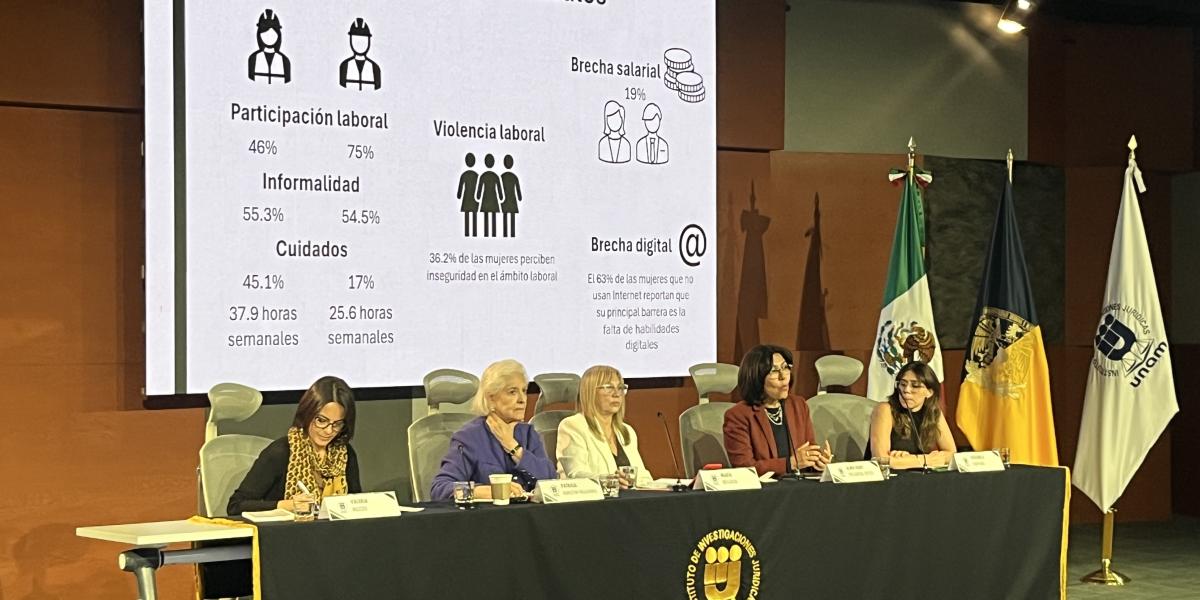
Although female economic participation has advanced, conditions Entry and permanence continue to be marked by profound lags, since of the 5.5 million existing economic units, less than 40,000 have a collective bargaining agreement, which means that less than 1% have a formal instrument to negotiate working conditions with a gender perspective.
This is what Alma Ruby Villareal, former labor judge and former Bologna scholarship recipient, said after stating that “there is participation, but there is no negotiating power; that explains why economic independence has not yet translated into real equality.”
After highlighting a panorama in which, even the 6 most important unions in the country, are headed by a man and do not even have schemes that allow women to have access to greater leadership.
At the table “The labor market with a gender perspective; perspectives and challenges”, he explained that “the first obstacle is the low formal participation“While 75% of men participate in the labor market, only 46% of women manage to join, and the majority do so without social security or full access to rights.”
A second obstacle, he said, is the occupational segregation and the high informalitygiven that women are concentrated in the lowest paid sectors, commerce, services and care, and 55% remain in informal schemes, without benefits or stability.
A third structural factor is the wage gapsince on average, women receive 19% less than men for the same work, although the disparity is even greater in rural areas and between agricultural and indigenous workers. “To this is added a fourth obstacle: the workplace violence and discrimination. “More than one in three women has experienced some type of violence in the workplace and the regulatory weaknesses in distinguishing between harassment and harassment make sanctions difficult.”
Furthermore, he said that a fifth critical factor is the digital dividewhere 63% of women do not use the internet, identify the lack of digital skills as the main barrier, which limits their access to better-paid jobs and emerging sectors associated with the digital economy.
The sixth obstacle is unpaid care overloadin the absence of structural policies and public infrastructure, such as daycare centers and care centers, forces millions of women to choose between employment or family responsibilities, which hinders their permanence and career progression.
For her part, Patricia Kurczyn, a former Bologna intern, said that although there are relevant advances, such as the 2019 labor reform, the ratification of ILO Convention 190 and the constitutional reform on substantive equality approved in 2024, its implementation is still insufficient.
They agreed that union representation also shows lags. Only between 15% and 16% of the general secretaries are headed by women and the largest unions are still under male leadership.
In the business sector, progress is also gradual: only 36% of companies have policies to combat the wage gap and only 40% have active pay equity strategies, despite the fact that 53% have already prepared diagnoses.
The specialists stressed that the transition towards equality will not only be legal or declarative, but structural, and will require coordination between the State, companies and unions, along with a national care policy that recognizes the economic contribution of unpaid work.
“Equality is not a concession or a favor, it is an act of justice. As long as women’s work remains invisible, there will be no economic justice,” they stated.
Meanwhile, the Italian, Valeria Nuzzo, University of Campania Luigui Vancitelli, explained that the wage gap between men and women is not limited solely to a difference in base salary, but is deeply linked to the way in which female work is distributed in historically devalued sectors.
He pointed out that, when a sector is “feminized”, it usually loses social prestige and economic value. She gave as an example the educational sector, which in the past, when it was dominated by men, enjoyed social authority and better salaries, while today, as it is mostly occupied by women, it is no longer perceived as strategic and is lagging behind in recognition and remuneration.
He also explained that the other side of inequality is interrupted work trajectories: the lower number of years of accumulated work due to the lack of co-responsibility in care and motherhood translates into lower income, a lower pension and a structural “salary ceiling.” Added to this is the so-called “motherhood penalty”, an informal but extended penalty that impacts promotions, promotions and performance evaluations.
Valeria Nuzzo recalled that in Europe there is a robust legal framework to combat wage inequality, with principles that were already contemplated since the Treaty of Rome (1957) and reinforced in multiple subsequent directives. However, he clarified that initially these regulations were promoted more for reasons of economic competition between countries than for a real recognition of the right to equality.