Havana/Almost 650,000 people in eastern Cuba must be prepared to be evacuated or protected from the next impact of Hurricane Melissa, according to the Presidency this Sunday after an expanded meeting of the National Defense Council (CDN). At the meeting, Miguel Díaz-Canel stressed that “the fundamental thing is the protection of the population” and ordered “to evacuate all people who are downstream of the dams, microdams and in everything that is a flood zone.”
“We must work intensely for the remainder of Sunday and Monday. If we work for the worst of the variants, we are guaranteeing tranquility in this entire issue. This event will occur at night or early morning, and what we do not do now we will lose later,” he stated yesterday. He also called for paying “special attention” to the vulnerable population and ensuring primary health services and the epidemiological surveillance system.
Díaz-Canel asked to maintain “constant communication” with the residents of the areas, using “all possible means, especially in the midst of the country’s electrical situation.” Many citizens live almost untouched by what is coming, since the long days without electricity, especially in the eastern area, which Melissa will reach, prevent them from watching television or having access to other sources of information.
Many citizens live almost untouched by what is coming, since the long days without electricity, especially in the eastern area, where Melissa will arrive, prevent them from watching television.
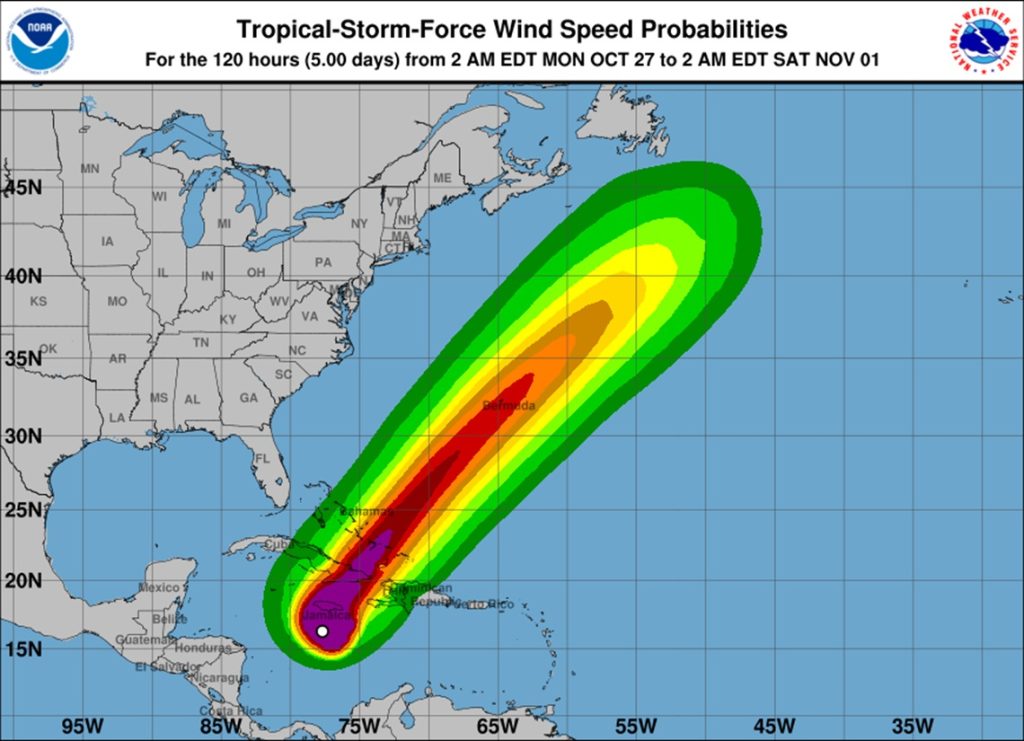
The Institute of Meteorology (Insmet) predicts that the hurricane, now a category 4 (out of 5) on the Saffir-Simpson scale, will make landfall in Cuba on Tuesday night and will travel from south to north through the country for 12 hours.
The presidents of the Defense Councils of the provinces declared in the “alert” phase reported by videoconference on the work they carry out to protect people and vital resources, the conditioning of evacuation and food processing centers, as well as communication through various means. The fears, in the midst of a very precarious situation for the Island, are enormous.
In the provinces of Santiago de Cuba and Las Tunas, it provides protection for 258,579 and 72,000 people, respectively. In addition, 110,000 residents will be evacuated in Granma, 69,000 in Holguín and 139,914 in Guantánamo. In total, about 7% of the Cuban population is on alert for Melissa, according to official figures.
The director of Insmet, Celso Pazos, specified that Melissa is a “high intensity” hurricane, accompanied by winds exceeding 200 km/h and intense rains that represent one of the “most dangerous” factors of this system, which will generate flooding upon its arrival on the southeastern Cuban coast.
Accumulations of between 200 and 400 millimeters are estimated in 34 or 48 hours, which will be higher in mountainous areas. Sea penetration is also expected on the southern coast, at its entrance, and in the north, at its exit, with coastal flooding.
General Ramón Pardo Guerra, chief of the National Civil Defense Staff, reported that several hundred people will be evacuated, including tourists, due to the rains that are already occurring. “It is a situation that will continue to become more complex due to the saturation of the soil,” he specified.
The foreseeable scourge of Melissa on Cuba has as its closest precedent the tropical storm Imelda, which at the end of last September also hit its eastern region with heavy rains, leaving two dead, several thousand displaced, floods, landslides, overflowing rivers and house collapses, among other damages.
In Granma, Yudelkis Ortiz Barceló, first secretary of the provincial committee of the Communist Party, said that the territory has been preparing for a week. 98 critical areas were identified and evacuation centers (224 in total) and food processing points have been prepared. The official maintained that sanitation and unclogging work, branch pruning and other cleaning actions have also been carried out.
15% of the population of Granma is on alert, including 470 pregnant women who have been admitted for prevention, since they reside in vulnerable areas or have some type of risk. In addition, there are 116 families protected, and the bulk of the evacuations began yesterday, Sunday, which have been undertaken with “rigor and discipline,” according to Ortiz.
In addition, there are 116 families protected, and the bulk of the evacuations began yesterday, Sunday, which have been undertaken with “rigor and discipline,” according to Ortiz.
The same words were used by Beatriz Johnson Urrutia, first secretary of the Party in Santiago de Cuba. There, the nine municipal defense councils and the 126 defense councils at the zone level have been activated. 25% (258,573 people) of Santiago residents are in protection plans while the most important dams are released. The official warned that special attention is paid to the coffee harvest, “since in the crop beds there are about 49,000 ripe cans.”
In Holguín, 305,530 people are expected to be evacuated in the 151 available centers. Joel Queipo Ruiz, first secretary of the provincial committee of the Party, said that they have worked with the criterion of “preparing for the worst scenario, so that nothing surprises us.”
Meanwhile, in Guantánamo, his counterpart, Yoel Pérez García, said that 30% of the population, some 140,000 people, are on alert and there are 108 centers. Las Tunas has 113 for the 72,000 people expected to be evacuated, said Osbel Lorenzo Rodríguez, first secretary of the provincial committee.
Cuban meteorologists have warned that the current cyclone season in the Atlantic Ocean and Caribbean Sea, valid from June 1 to November 30, will be “very active”, with the possible formation of eight hurricanes.
According to their forecasts, the probability of at least one hurricane originating and intensifying in the Caribbean is high (75%), while it is 50% for one of Atlantic origin to penetrate the Caribbean Sea and affect the Island.
In the 2024 hurricane season, two hurricanes directly hit the Island. The first was Óscar, which in October also hit the east of the country with category 1, and then a month later Rafael, with category 3, hit western Cuba and caused the total collapse of the national electrical system.
As it passed through Haiti, the hurricane, which continues to be a threat, has left three dead and 16 injured, in addition to 10 houses affected and 450 flooded.
As it passed through Haiti, the hurricane, which continues to be a threat, has left three dead and 16 injured, in addition to 10 houses affected and 450 flooded, according to the most recent balance sheet from the Directorate of Civil Protection (DPC). “In view of the amount of rain that has fallen, there is a risk of flooding and landslides, since the ground is saturated with water,” the authorities said.
For his part, the president of the Dominican Republic, Luis Abinader, called this Sunday to move towards “normality” after several days with a large part of his provinces at red alert levels, in which the working day was suspended.
The Dominican Emergency Operations Center (COE) decided yesterday to reduce the provinces on red alert to four, which are located in the southwest of the country, while another thirteen are on yellow alert and the same number on green.
Until now, Melissa caused one death and flooding in Dominican territory, and the COE indicated that there are “735 homes affected, 3,765 people displaced, four shelters activated, with 77 people housed and 48 communities cut off.”