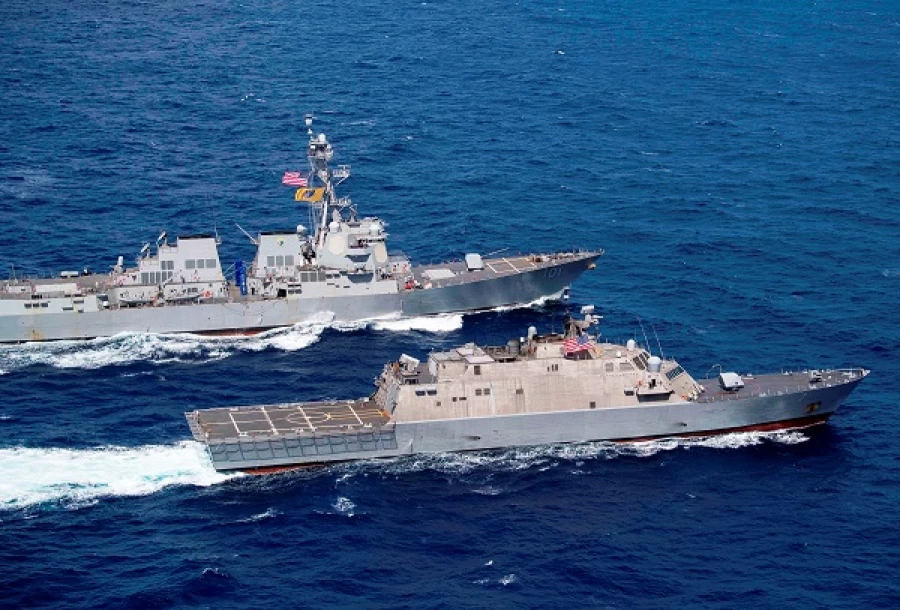
The sectoral vice president of Communication and Culture and Minister for Communication, Freddy Ñáñez, announced through a publication on his Telegram channel, a statement from the bishops of the Episcopal Conference of the Antilles in which they reject the presence of naval and military resources in the southern Caribbean, where they warn about the interference that seeks to be imposed to break regional stability.
Ñáñez asserted that while the Venezuelan Episcopal Conference remains silent, international organizations express their rejection of the military threat of the empire against Venezuela.
“The bishops of the Episcopal Conference of the Antilles observe with great concern the recent accumulation of naval and other military resources in the southern Caribbean and the possible implications that this entails for the socioeconomic, political and humanitarian well-being of our region and its people,” said Ñáñez on the social network.
In the letter, they warn about the risks of justifying violence as a conflict resolution mechanism: “However, the arbitrary and unjustified deprivation of life cannot be justified as a means of resolution. Such acts violate the sacredness of human life. Contempt for the sovereignty of independent nations cannot be accepted as a reasonable measure in the name of border security.”
Below is the full text:
The bishops of the Episcopal Conference of the Antilles observe with great concern the recent accumulation of naval and other military resources in the southern Caribbean and the possible implications this entails for the socioeconomic, political and humanitarian well-being of our region and its people.
In a few weeks, the world will commemorate the 59th World Day of Peace. As we reflect on the words of Pope Paul VI, who in 1966, in instituting this celebration, urged humanity to seek negotiation rather than war, we recognize that we once again find ourselves at a crossroads. Dialogue and cooperation are urgently needed to ease rising geopolitical tensions and foster lasting peace.
At the same time, we must speak clearly about the moral challenges facing our region. Drug trafficking continues to devastate Caribbean societies, eroding lives, futures and the very moral fabric of our communities. This is a serious crisis for the Church and for families around the world, which we have a duty to confront. However, the arbitrary and unjustified deprivation of life cannot be justified as a means of resolution. Such acts violate the sacredness of human life.
Likewise, disregard for the sovereignty of independent nations cannot be accepted as a reasonable measure in the name of border security. War or the threat of war is never the right solution. To quote Pope Leo in a recent general audience: “We must never get used to war.” His call is echoed by Pope Saint John XXIII, who proclaimed that “true peace can only be born from a heart disarmed of anxiety and fear of war.” The presence of warships and the disruption of maritime livelihoods in our Caribbean waters represent real and immediate threats to regional stability and the well-being of our nations. As people united by a common heritage and a collective identity, we must continue to reject aggression and intimidation as means to resolve conflicts or ideological differences. Our history has shown that dialogue and negotiation have served us well as independent nations, united in community and cooperation.
We are attentive to the voices and concerns expressed by our people and urge that we be guided by the teachings of the Scriptures. We are commanded to love others, even our enemies. The world may be at war, but we are called to pray for peace and act for peace. In this Jubilee Year of Hope, as the Church continues the ancient tradition of forgiveness and restoration, we reaffirm our common purpose and our shared brotherhood that transcends borders and national interests.
The Church remains firm in the need to protect all members of society, especially the most vulnerable and economically marginalized. The goals of protecting our borders and eliminating drug trafficking must be pursued with respect for the law, the dignity of human life, and with a tacit understanding of our region’s deep commitment to peace.
To those entrusted with leadership, we ask you to reduce militarization and renew your commitment to dialogue and regional unity. To the faithful, we ask you to refocus on faith and trust in the Lord, resisting the discouragement and cynicism that threaten to overwhelm you. Acts of reconciliation, faithful observance of the sacraments, and the family rosary continue to be powerful expressions of hope. Expressions that move the sky and can change the hearts of humanity.
We stand in solidarity with all the people of the Caribbean, especially with those most directly affected by this situation. Together. We place our hope, trust and prayers in the search for a peaceful and just solution that defends human dignity, national sovereignty and the common good of all.
END
Episcopal Conference of the Antilles