The Colombian president, Gustavo Petro, attacked this Friday against the decision of the United States Department of the Treasury to include him in the “Clinton List” of the Office of Foreign Assets Control (OFAC), calling it “an arbitrariness typical of a regime of oppression.”
In a message on social media, Petro rejected accusations from US Treasury Secretary Scott Bessent, who blamed him for allowing “record levels of coca crops, flooding the US with cocaine.”
“Crops grew by 42% in Duque’s government (2018-2022). In my administration, we reduced that rate to 3% in 2024,” argued the president, highlighting the record seizure of drugs and the voluntary replacement of 22 thousand hectares of coca.
Petro, who claimed to have no accounts or properties in the US, called the sanction a “paradox”: “I fought against drug trafficking and this is my reward. But I will not take a step back.”
Washington’s arguments: “Petro allowed the cartels to prosper”
The US government justified the sanctions — which include Petro’s son, Nicolás; his wife, Verónica Alcócer; and the Minister of the Interior, Armando Benedetti—alleging that the president “has granted benefits to narco-terrorists under his Total Peace plan.”
Bessent accused Colombia of registering “265 thousand hectares of coca in 2024”, tripling figures from a decade ago. The Pentagon also announced the sending of an aircraft carrier to the Pacific to “combat narcoterrorism,” in a military escalation that Petro denounces as “extrajudicial executions.”
Trump, who days ago called Petro “a thug who produces drugs,” warned: “We will take severe measures if he does not act.” Military aid to Colombia has already been cut by 18 million dollars.
Maduro: “Sanctions are an arms farce”
The Venezuelan government came to Petro’s defense, calling the sanctions “illegitimate and neocolonial.” In a statement, Foreign Minister Yván Gil linked them to “transnational mafias infiltrated in Washington.”
For his part, President Nicolás Maduro compared the bilateral relationship with Colombia as “Siamese sisters united in Bolívar,” and criticized American “interference.”
Caracas also rejected US military operations in waters near Venezuela, where at least 43 people have died extrajudicially through US air attacks against alleged drug vessels.
Massive support for Petro and the Constituent Assembly in Bogotá
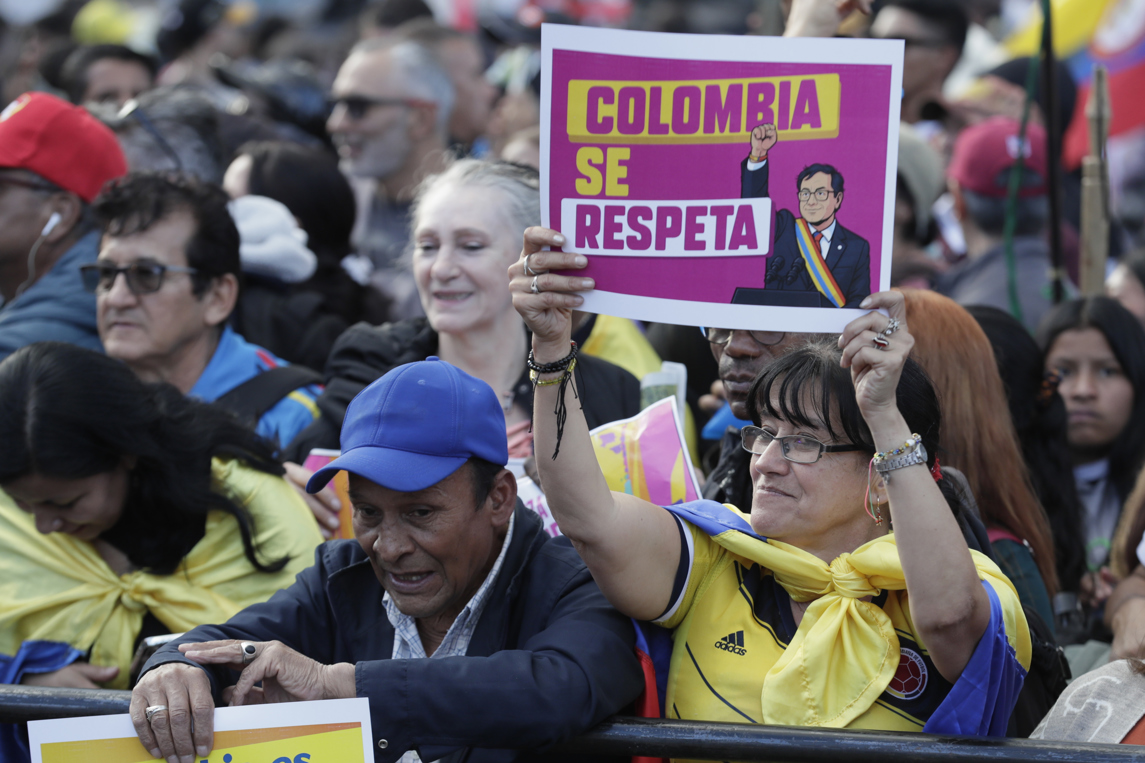
This Friday, thousands of Colombians gathered in the Plaza de Bolívar to support Petro and back his proposal for a Constituent Assembly.
Between batucadas, music, flags and banners with messages of support, the central square, the political and symbolic epicenter of the country, was filled with protesters who chanted slogans such as “Petro friend, the people are with you!” and “Constituent now!”, while they raised signs with “Yes to the constituent assembly” and “Sovereignty, peace and democracy.”
“We are here to reform a Constitution manipulated by elites and confront imperialism,” Ingrid Gómez, one of the attendees, told the EFE agency.
Petro took advantage of the stage to announce that he will collect signatures to call the constituent assembly in the 2026 elections, despite criticism from jurists who consider the reform unnecessary.