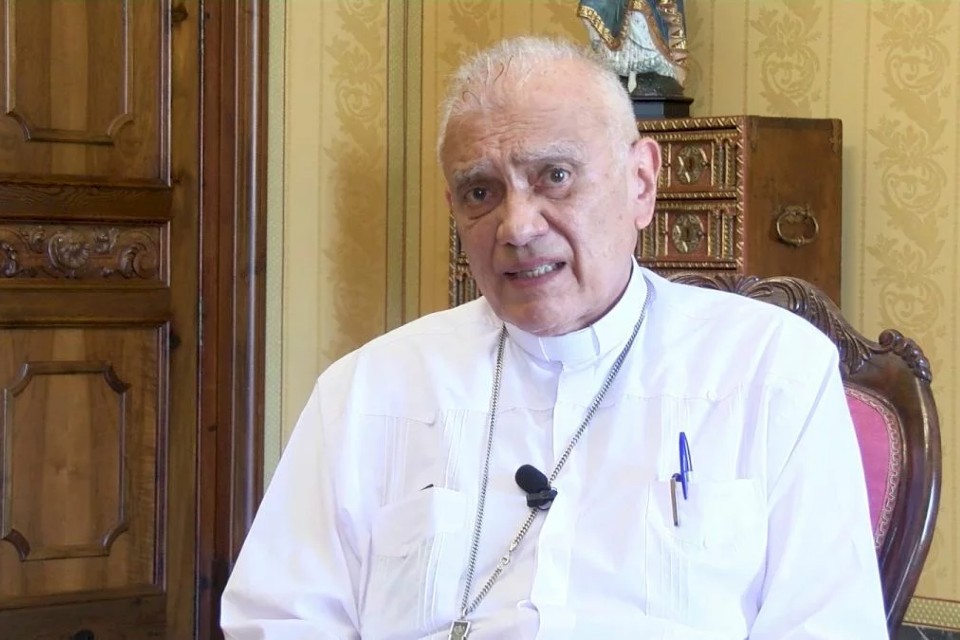
Cardinal Baltazar Porras denounced that the Government prevented him from traveling by air and land to Trujillo to celebrate a mass for the canonization of José Gregorio Hernández. He assured that he was surrounded by soldiers and that the authorities alleged “risk of riots” and “danger” due to his presence in Isnotú
Cardinal Baltazar Porras denounced this Saturday, October 25, that the authorities prevented him from traveling to the state of Trujillo, both by air and by land, to preside over the mass of thanksgiving for the canonization of Dr. José Gregorio Hernández, which will be celebrated in Isnotú, the new saint’s homeland, this October 26.
Porras reported that on Friday night, the Vice Minister of Religious Institutions and Worship, Edgar Arteaga, contacted the Venezuelan Episcopal Conference (CEV) to report that there were “inconveniences” with his presence in Isnotú, “because there was news of disturbances or things that were going to take place there,” despite the fact that – as he explained – it was made clear to him that the event consisted only of a Eucharist. They were also told that their presence was “a danger.”
Hours later, around midnight, the cardinal received a WhatsApp message and an email notifying him that the Conviasa flight to Trujillo had been suspended until October 28. However, he later learned that the aircraft took off and landed as planned.
“We began to realize that something strange was happening,” he said.
*Read also: Relatives of political prisoners were attacked at the UCV during mass for new saints
Given the impossibility of traveling by commercial flight, the cardinal tried to reach the region on a private aircraft, but was forced to land in Barquisimeto due to alleged adverse weather conditions at the Valera airport. According to his testimony, upon arriving at the Larense terminal “We were surrounded by a number of soldiers armed to the teeth and there were five of us waiting for how to continue.”
Porras added that the public force also prevented the rental of a transport unit to continue the journey by land, so his team had to return to Caracas without receiving official information about what happened.
«It is striking that these types of things happen and there is no freedom for one as a citizen to move from one place to another. With a military deployment that makes it seem like we were plotting who knows what. We were able to understand that they are superior orders, only because of the presence of me,” he denounced.
The archbishop of Caracas questioned the reasons behind the operation and wondered “what crime he has committed” to prevent him from attending a religious celebration. He also assured that the regional authorities of Trujillo received orders to avoid his presence “because he was a danger.”
«What does this mean? “That is not the way to celebrate the example that José Gregorio Hernández leaves us, this is an outrage,” he said.
The complaint occurs less than a week after the cardinal offered a reflection on the Venezuelan crisis in Rome, on October 19, the day of the canonization of Dr. José Gregorio Hernández and Sister Carmen Rendiles. During a speech, Porras remembered the political prisoners and stated that Venezuela is going through “a morally unacceptable situation”as the CEV has reiterated on various occasions.
On that occasion, the cardinal made a critical diagnosis of the national reality and warned that poverty, corruption, the lack of independence of public powers and the growing militarization of power “excite violence and introduce it as part of daily life.”
These factors, he noted, “do not contribute to peaceful coexistence or to overcoming the structural deficiencies of society.”
The representative of the Catholic Church insisted that the country needs to “rebuild trust between citizens and institutions” and appealed to solidarity and reconciliation as ways to achieve peace.
*Journalism in Venezuela is carried out in a hostile environment for the press with dozens of legal instruments in place to punish the word, especially the laws “against hate”, “against fascism” and “against the blockade.” This content was written taking into consideration the threats and limits that, consequently, have been imposed on the dissemination of information from within the country.
Post Views: 762