The energy map of the Colombian Caribbean reflects a paradox that is difficult to sustain in which thousands of families have access to energy, but without paying for it, since in the so-called electrically subnormal neighborhoods, the Afinia company barely manages to collect 5% of what it bills monthly. a figure that translates into losses of more than $300,000 million pesos annually.
To understand this reality, it must be said that these sectors, recognized since Law 812 of 2003 as special zones due to their technical and socioeconomic conditions, today concentrate one of the greatest problems of the regional electrical system and of the 887 neighborhoods served by Afinia, only 377 have current technical certification. The rest operate with improvised networks, without consumption control nor individual measurement, which increases electrical risks and energy losses.
Check here: Pension savings: guidelines for a safe retirement from work
According to the company’s most recent management report, as of August 2025, more than 165,070 families live in these neighborhoods, consuming around 49 million kilowatt hours (kWh) monthly; Therefore, the estimated billing reaches $26,483 million, but the effective collection is only $1,375 million.
Each home consumes on average more than 330 kWh per month, a figure higher than that of users low strata and because of this, the situation, as explained by the company, has deep social roots, given that many of these settlements arose due to displacement, poverty or disorderly urban growth, and do not have formal electrical infrastructure.
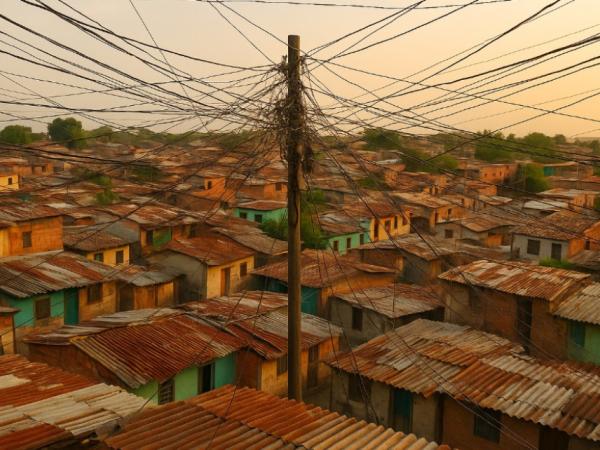
The low levels of energy payments in the Caribbean are a threat to the sector.
Image from ChatGPT
“The lack of safe networks forces inhabitants to resort to informal connections: hanging cables, wooden poles or recycled wires that put people’s lives and the stability of the system at risk,” they highlighted.
Due to this, the general manager of Afinia, Ricardo José Arango Restrepo, said that while resources are managed to execute standardization projects, this firm maintains the service through 2,169 totalizing or community meters, which group together the consumption of hundreds of families.
More information: Anif warns that tax on digital transfers is inconvenient for the country
“Although these devices allow energy to be maintained, they prevent individual billing and make it difficult to control spending. Overcome The electrical subnormality is not only a technical challenge, but a social emergency,” said Arango Restrepo.
Actions to reverse the trend
Based on this reality, the company has initiated a detailed census of non-residential supplies in these areas, in order to establish more equitable billing schemes and improve the sustainability of the system. In parallel, it is advancing in technical tables with mayors’ offices, governorates and the Superintendency of Home Public Services to identify priority neighborhoods and accelerate electrical modernization projects.

The low levels of energy payments in the Caribbean are a threat to the sector.
Image from ChatGPT
“These projects include the installation of individual meters, the renewal of networks and educational campaigns on payment culture and the safe use of energy. We want users to understand that the legalization of the service not only guarantees stability, but also security and quality of life,” they said from Afinia.
As a temporary measure, the company applies the so-called agreed continuity periods, endorsed by regulation; a series of community agreements that allow partial service cuts at certain times or days, which are gradually reduced as compliance with payment commitments improves. This figure, according to the company, has made it possible to maintain dialogue with the communities and reduce tensions in sectors of high conflict.
You may be interested in: Does Petro’s inclusion on the Clinton list affect trips to the US by Colombian citizens?
Beyond the economic impact, Afinia recognizes that electrical subnormality is also a reflection of social inequality and explains that the lack of formal infrastructure condemns thousands of families to live with dangerous networks, without fair metering and with intermittent outages.
“Therefore, our purpose is to transform the energy reality of the Caribbean, but to achieve this it requires the joint effort of all actors: company, authorities and community,” said Arango Restrepo.

The low levels of energy payments in the Caribbean are a threat to the sector.
Image from ChatGPT
However, the company insists that citizen co-responsibility is key to guaranteeing the stability of the regional electrical system. Without payment, he warns, there is no possible sustainability. Therefore, while driving technical modernization, Afinia insists on building trust and awareness among users.
DANIEL HERNÁNDEZ NARANJO
Portfolio Journalist