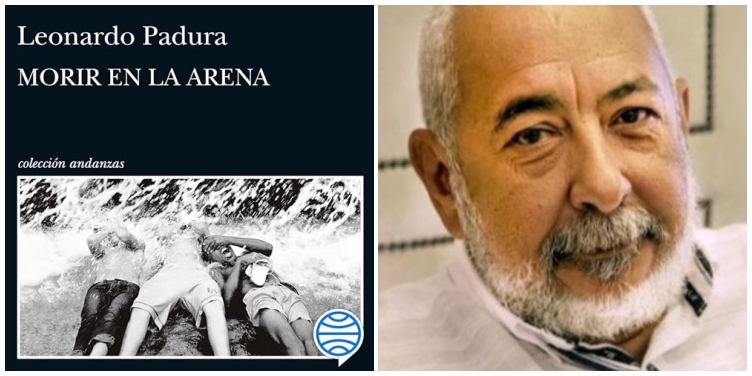
The plot of “Dying in the sand”, according to its writer Leonardo Padura, is based on real events: a patricide.
HAVANA, Cuba – “I won the lottery!” I exclaimed when receiving Leonardo Padura’s most recent novel as a gift a few days ago. Die in the Sandwhich was put on sale in Spain since last August 27.
Previously they brought me the two previous titles by Leonardo Padura, Decent People and Go to Havanaso I am privileged: there must not be many who own these three copies here in Cuba, where Padura is practically silenced.
The plot of die in the sandaccording to the writer, is based on real events, a patricide. Padura has said that “he speaks of the unfortunate and ungrateful fate of so many people of my generation in Cuba,” and that “the reality of certain events, and the life experience that I have accumulated are the ingredients of this story,” where “everything I tell about our experiences are verifiable truths.”
In recent interviews made to Padura abroad has pointed out that the three fundamental elements in the novel are fear, forgiveness, and redemption, reflected in the central characters and even in the secondary ones.
I think that in these characters there is also anguish, despair, restlessness, anger, hatred, helplessness, disenchantment, and other negative feelings, which produce a permanent sadness in all of them, and that, in a certain way, also end up invading the reader, especially if he is a Cuban on the Island.
The axis of the narrative is Geni, nicknamed Malacara, a being with deviant social behavior, who murders his father and for that reason serves a thirty-one year prison sentence; his brother Rodolfo, somewhat faint-hearted, retired, with problems of conscience regarding certain past situations in his life, during his stay in the war in Angola, causing his ambivalent character, and psychiatric treatments; and Nora, Rodolfo’s ex-girlfriend when she was a teenager, who later became his brother’s wife.
The secondary characters in the plot are family and friends: the grandparents and parents of the main protagonists, Quintín, Flora, Lola and Fermín (the murdered father); the brothers’ daughters, Aitana and Violeta; the school friends, Pablo the Wild, Fumero, the writer (Padura?), his son the babalao Humbertico, and very in passing he lies to the former police officer Mario Conde.
It is significant that all the characters express reproaches for the system and criticism of the situation. what is lived in Cubaespecially to the class differences between the most dispossessed and the privileged minority. It seems that none of the characters in the novel sympathize with the government.
Several of the characters, in the past, were “integrated into the revolution” and had faith in the better future that the leaders promised. But in the face of repeated failures, increasingly greater and more evident, today they only aspire to survive, and if they could, to emigrate, just as Rodolfo and Geni’s daughters did.
In this work, Padura adopts greater complexity in the story, given the attitudes and ways of thinking of each protagonist, in relation to the circumstances in which they develop their lives, something that gives a psychological touch to the theme. At times he remembers Vargas Llosa, a writer of Padura’s preference, as he has expressed on several occasions.
It is evident that in die in the sandPadura has used experiences and stories from his life that he has mixed with fiction.
It catches my attention that in this novel Padura addresses erotic issues and profusely uses swear words and popular slang in the vein of the dirty realism of Pedro Juan Gutiérrez and other authors.
Everything that Padura expresses in die in the sand It is true, but there are points that it omits from the reality that is experienced in Cuba today. In none of his novels does he talk about protests on public roads, nor about dissidents or political prisoners; avoid mentioning people by name government leaders and never talks about the human rights violations that have been denounced by numerous international organizations.
On occasions, in interviews conducted abroad, Padura has fallen into contradictions between what he declares and what he writes in his books.
Of course, we must analyze where, when and what Padura expressed, since a phrase taken out of its context can be freely interpreted.
No one disputes that today Leonardo Padura is the living Cuban writer with the greatest international renown. His books, which have been translated into 31 languages, reach enormous circulations around the world. But in Cuba it is practically silenced.
Padura has always said that he wants to continue living in Cuba, in his native Mantilla, because here he has his source of inspiration, his family, and therefore, he cannot and does not want to cross the fence.
In any circumstance, the decisions and attitudes of Padura must be respected, who has warned that he does not intend to be a political writer, but only a novelist who is based on problems that he expresses according to his point of view.