The bioeconomy, called to become one of the engines of green growth in Colombia and taken as the banner of the current government of President Gustavo Petro, has still not taken off with the expected strength, according to the most recent Dane report, first in its class, where it can be seen that its contribution to the gross domestic product continues to be very low.
This was recorded in the Bioeconomy Satellite Accounts 2019–2024 published by the statistical authority, which show that this sector generated a gross added value of $2.15 trillion in 2024, which represents a drop of 0.2% compared to 2023; while in terms of participation in the economy, its weight in the national GDP was barely 0.13%, a proportion that has practically not moved in recent years.
Check here: AI is advancing faster than regulation, experts warn at the Portfolio Summit
Taking a deeper look, it can be said that this data reveals a mixed panorama in which, on the one hand, the bioeconomy has managed to consolidate itself as an emerging space for employment, innovation and sustainable development; but on the other hand, it has not yet managed to translate its potential into a significant macroeconomic impact.
Not in vain, the Dane report shows that, despite the dynamism in some productive segments, the structural growth of the sector remains limited by its low productivity and the lack of sustained investment in science and technology.
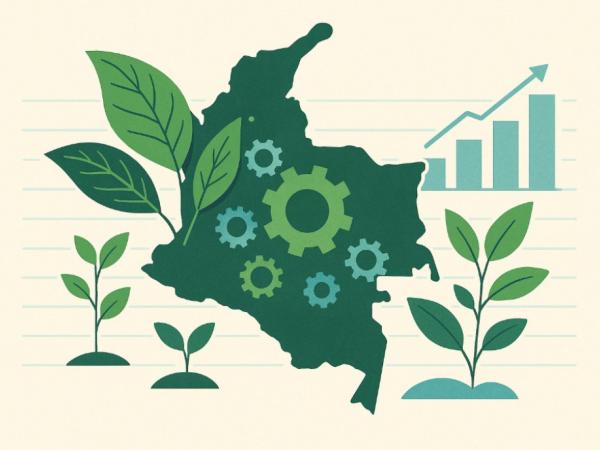
The bioeconomy in Colombia is an engine of growth that has not yet taken off.
Image from ChatGPT
A sector with roots in sustainability
To better understand these accounts, the first thing to say is that the bioeconomy encompasses all activities that sustainably use biological resources such as animals, plants and microorganisms; to generate goods and services with added value. It includes everything from sustainable agricultural production and biofuels to biotechnology, functional foods and environmental bioremediation.
The #BioeconomyAccount presents for the first time official data on the economic value of biodiversity in Colombia 🌿📊.
Figures that show its contribution to GDP, the public investment that drives this transition and its presence in key economic activities.
Furthermore, it is… pic.twitter.com/ADWCFAEzQj
— DANE Colombia (@DANE_Colombia) October 24, 2025
In the Colombian case, Dane estimates that more than 76% of the sector’s added value comes from secondary activities, that is, from manufacturing and industrial processes linked to the transformation of natural resources. In contrast, primary activities (such as agriculture, forestry and animal husbandry) represent 16.9%, and tertiary activities (trade, environmental services, research or nature tourism) represent only 7.1%.
You may be interested in: TO Starting this Friday, the price of gasoline and diesel will increase by $100
Simply put, most of the money that moves the bioeconomy in Colombia does not come from the fields or laboratories, but from the factories that transform biological raw materials; since it is in the industry where value-added processes are concentrated, through the development of foods, biofuels, natural inputs or materials derived from plants and microorganisms.
However, this structure also shows a fragility in which the country continues to depend more on processing than on innovation or scientific diversification, which limits the leap towards a truly competitive bioeconomy.

Piedad Urdinola, director of Dane.
David Morales / Dane
Likewise, during 2024, the behavior by type of activity was uneven since the activities Primary activities grew 17.9%, driven by plant and animal production, plant propagation and the increase in crops linked to bioinputs, and tertiary activities, which include scientific research and specialized services, also showed an expansion of 9.3%.
However, secondary activities, which concentrate most of the economic value, fell 4.2%, which ended up dragging the total result into negative territory.
Other news: Edward Montealegre presented ‘irrevocable’ resignation as Minister of Justice
Declining profitability
The Dane report reveals another key aspect and that is that while job creation in the bioeconomy shows positive signs, business profitability continues to deteriorate, given that the operating surplus and gross mixed income, which is a measure of profits and performance of the capital, decreased 2.6% compared to 2023, going from $1.78 trillion to $1.73 trillion.
In contrast, compensation for employees increased 12.5%, which suggests greater labor formalization and an increase in the demand for qualified talent in scientific and technological activities and puts on the table a mixed behavior that reflects a change in internal structure in which the sector begins to consolidate employment and technical capabilities, but still lacks business scalability and value chains.

The bioeconomy in Colombia is an engine of growth that has not yet taken off.
Image from ChatGPT
Another finding is the low allocation of public resources towards the bioeconomy within of national environmental spending. In 2024, Government spending on environmental activities related to the bioeconomy was $4,778 million, which is equivalent to only 0.04% of total environmental spending and although general environmental spending grew 23.6%, that allocated to the bioeconomy barely increased 11.4%.
Thus, it is evident that despite the political and technical discourse that presents it as an axis of sustainable development, the bioeconomy is not yet among the country’s budget priorities, since its limited public financing translates into a lower capacity to promote innovation projects, technological transfers or industrial scaling of bioproducts.
More information: Ten questions and answers to understand the Constituent Assembly proposed by Petro
Science and innovation: the heart of progress
El Dane highlights the role of the Ministry of Science, Technology and Innovation (MinCiencias), which during 2024 launched the Bioeconomy and Territory Mission as part of the national productive transition strategy. Of the 27 financing mechanisms enabled by the entity, 8 (almost 30%) were specifically oriented towards the bioeconomy, with $27,914 million allocated and $7,295 million in counterpart contributions.
In total, 62 projects were financed (28.3% of the national total) and 23 strategic alliances were formed focused on biotechnology, bioinputs, functional foods, biomass utilization and bioremediation. The training of 70 professionals (66 women, 3 men and 1 intersex person) was also supported, most of them linked to doctoral programs and postdoctoral stays.

The bioeconomy in Colombia is an engine of growth that has not yet taken off.
Image from ChatGPT
On another front, the report highlights that the bioeconomy not only has an industrial dimension or scientific; It also represents a territorial opportunity and says that in the Amazon, for example, the SINCHI Institute reported in 2024 the characterization of 68 native species with 141 potential uses, of which 75 resulted in prototypes of bioproducts such as essential oils, fruit pulps, baked products and natural extracts.
In addition, 33 sustainable management protocols were adopted by the environmental corporations Corpoamazonia and CDA, applied to species such as acaí, chontaduro, copoazú, Brazilian chestnut and yarumo.
Featured news: Comptroller’s Office warns that poverty in the Caribbean persists, despite millionaire investments
Finally, the statistical authority also maintained that green businesses associated with the bioeconomy are concentrated in three main axes, starting with sustainable agriculture and livestock (35.6%), nature tourism (22.5%) and biotrade in natural foods (22%). These three activities represent 80% of the green initiatives registered in the country, showing that the bioeconomy is not not only a scientific concept, but also a productive network with local and community impact.
Piedad Urdinola, director of Dane, closed this presentation by saying that although it is the first time that these accounts are presented, from now on “they will be produced annually, 10 months and 20 days after the close of the reference year.”
DANIEL HERNÁNDEZ NARANJO
Portfolio Journalist