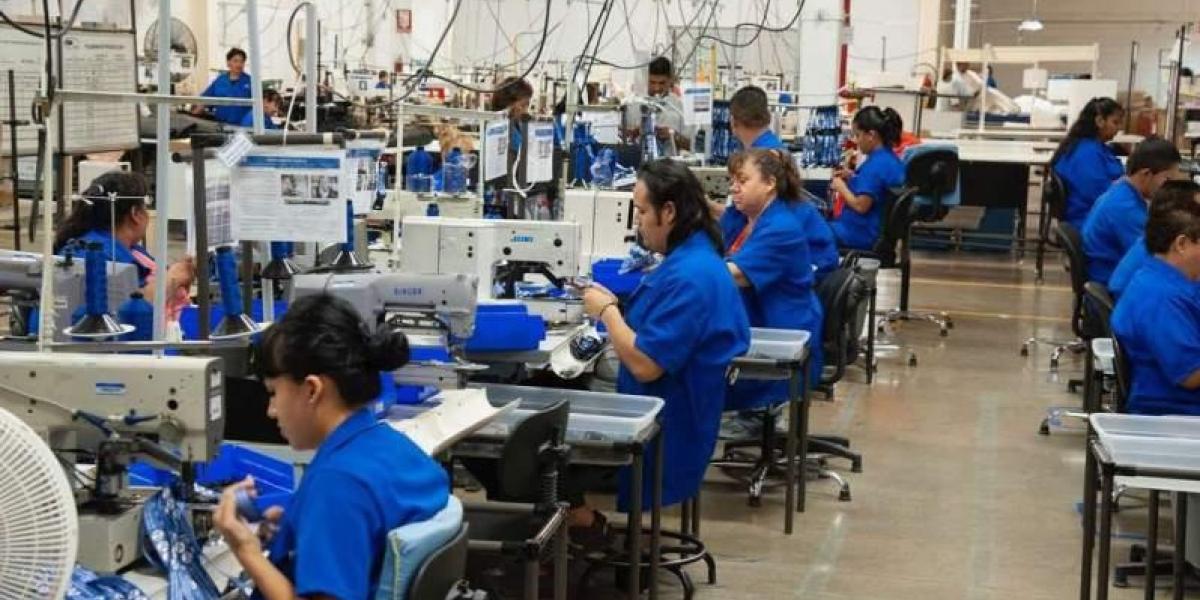
In the export maquiladora industry It creates an environment of uncertainty generated by internal and external factors, which has manifested itself in “caution” on the part of entrepreneurs in the sector to invest, which, in turn, has translated into a stagnation of employment and the number of establishments in operation.
According to figures from National Institute of Statistics and Geography (Inegi)at the end of 2023 there were 5,167 export maquiladora plants in operation in Mexico, which employed two million 914,332 people and by December 2024 there were 5,210 establishments, that is, 43 more (0.8% more) and 21,777 fewer employees (0.7% less).
Of the 5,210 establishments operating as of December 2024, a total of 932 were in Baja California, 722 in Nuevo León, 486 in Chihuahua and the rest in 15 other states.
The entities where they generate the most jobs are Chihuahua, Nuevo León and Baja California. In those three states, as of December 2024, they employed one million, 133,035 people.
If the statistics on the number of employees in the different entities in recent years are analyzed, it is observed that Nuevo Leon registered a relevant increase in the employed population in the sector, mainly from June 2024, unlike the rest of the states in the northern border area, where employment has stabilized or even decreased.
In Baja California, In December 2022, there were 921 maquiladoras in operation, a figure that increased to 933 as of December 2023. In December 2024 there were 932. Meanwhile, the number of employees in these places increased from 377,928 in December 2022 to 363,253 in December 2023 and to 346,373 in 2024.
In Tijuana, Baja California, there were 595 maquiladoras in December 2022; In December 2023 there were 607 and in December 2024 there were 602.
The number of workers in those places increased from 253,651 in December 2022 to 248,944 in December 2023 and 231,596 in December 2024.
Likewise, in Ciudad Juárez, Chihuahuathe number of maquiladoras in operation increased from 321 in December 2022 to 320 in December 2023 and to 322 in December 2024.
The number of employees in these plants went from 313,459 in December 2022 to 295,805 in December 2023 and 275,892 in December 2024. Between 2023 and 2024, 19,911 jobs were lost, representing 6.7%.
He drew attention to the fact that sector statistics show that during the Covid-19 pandemic, a “blip” was generated in job creation that was overcome by 2023, but in 2024 a contraction was generated in the number of people employed in the sector.
If the real salaries in that industry are analyzed, it is observed that the average range is from 14,000 to 16,000 pesos per month per person.
It is striking that in Veracruz It has the highest average salary, with 21,235 pesos. The second place is Baja California, where the average cost of a maquiladora worker is 16,640 pesos. Yucatán has the lowest salaries since the average is 9,919 pesos.
What motivates “caution”?
In interview, the academic at El Colegio de la Frontera Norte, Nogales unit, Humberto García Jiménezstated that the caution shown by businessmen in the sector at the end of 2024 remains until today and is explained first by the neo-protectionist actions of the United States government and the political uncertainty generated in 2024 by the elections in the neighboring country to the north.
In his opinion, in the macroeconomic context it is important to pay attention to the protectionist measures of the government of US President Donald Trump, that country’s trade war with China and the war in Ukraine.
In addition, the uncertainty regarding the review of the T-MEC, which increased during the last hours, as a result of the statements of the president donald trumpin the sense of suspending negotiations with Canada, which would put, at least in the discussion, the possibility of bilateral treaties with Mexico and Canada, instead of the trilateral one, which works until today, and which, in 2026, would have to be reviewed, although everything seems to indicate that there would be renegotiation.
In that sense, the specialist considers that perhaps it would not affect the sector so much if instead of a trilateral treaty there was a binational one, because most of the trade of the maquiladoras established in Mexico is with the United States.
For the academic, in the external sphere there are other factors that add to the environment of uncertainty, such as the technological reconversion processes that the dynamics of the sectors that make up the maquiladora industry are generating.
For example, those related to the automotive industry are not clear about what the transition towards electric cars or pharmaceuticals, that is experiencing changes regarding how it operates in Mexico, in relation to large pharmaceutical companies in the United States and aerospace, which is being reorganized.
Internal factors
On the other hand, he explains that there are internal factors that contribute to uncertainty and “caution” in investing, such as the need for greater electrical infrastructure.
In Tijuana, for example, there is the possibility of opening more industrial parks but the capacity to provide electrical energy is limited. The same thing happens in other places like Nogales, Sonora, where there is space to build more industrial parks, but what has happened is the lack of availability of electrical energy.
Another factor is the lack of availability of water, which limits the possibilities of expansion of expansive industries in the use of that resource.
On a national scale, he added, it is necessary to take into account what analysts say who, at least at the beginning of the year, raised a expectation of low economic growth derived from the external context, but also from structural variables of the country.
Another element generated by uncertainty is the low perception of investing in Mexico. “The current situation is not the best for making investments.” What has happened is that those that are there do not go away, but they do not expand either.
Among those factors that generate uncertainty is also the lack of the rule of law, which is a red flag.
The growth of public insecurity is directly affecting maquiladora establishments in industrial parks, he noted.
In northern border states they have been registering extortion actsrobbery, to the people who work in those establishments.
Another important element is corruption, which continues to be a central factor especially when it comes to opening new businesses and maintaining operations within the formal structure of the economy.
He also considered that the reform of the Judiciary has also raised certain uncertainties regarding the formation of that power.
Opportunities
For the specialist, although reality has shown that it is not automatic, among the opportunities for the sector is the nearshoring boost, particularly what has to do with semiconductors.
In that particular case, it is a process that will require more time because semiconductors do not involve simple assembly, in addition to having a supply chain scattered throughout the world.
The transition towards advanced manufacturing and digitalization also represents an opportunity for the country, which is very important because, precisely, the high-tech sectors are those that are going to be transferred from China to the United States, the supply chain that can be established in Mexico will be focused on what is now known with the characteristics of industry 4.0, which implies digital infrastructure challenges.
In addition, the one that implies the shortage of technical talent that these companies require.
Scenarios
Given the current situation in the sector, for the specialist there are three scenarios: one optimistic, one pessimistic and one intermediate.
The optimist assumes that on the external front there will be a review or negotiation of the T-MEC, which will result in clarity of the rules for trade.
On the internal front, what is necessary is done so that there is availability of the basic inputs for companies to function, specifically energy, water, security, rule of law and that, if the problems are not resolved in the short term, at least there is clarity in the operating rules and greater inputs.
The negative scenario is that the T-MEC negotiation gets stuck, Mexico has less and less capacity to maneuver with the United States, especially due to the problem of insecurity, which can generate rigidities when negotiating and confidence in reaching agreements.
An intermediate, which is more likely to happen, is a combination of both and a lot will depend on the negotiating capacity of the Ministry of Economy and the prudence and good sense of the economic actors. Decisions cannot be made lightly. There has been a productive chain for years that cannot be broken.
The most likely thing, the academic pointed out, is that there will be a gray scenario, where there will be difficult negotiations, minimal progress and a lot of caution in the maquiladora sector.