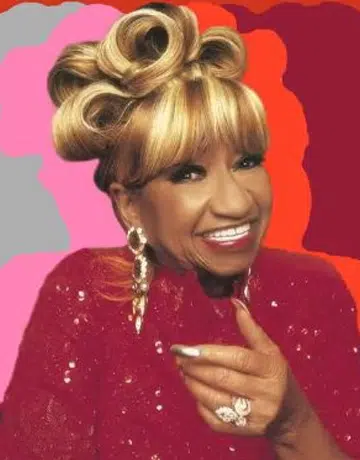
Even 22 years after her death, Celia Cruz remains an international Cuban icon. Their example, when shared with the Cuban people, endangers the continuity of the communist regime.
Washington DC-Celia Cruz He was born one hundred years ago and died twenty-two years ago. His music continues to be censored in Cuba, and the Cuban dictatorship cannot tolerate a group of Cuban artists honoring his memory.
The Cuban theater group El Público, at the Fábrica de Arte Cubano (FAC) in Havana, I had planned a gala on October 19, 2025 to celebrate the centenary of the birth of Celia Cruz. But this activity was not carried out because was censored by agents of the Cuban government.
What do the communists in Havana fear from this black Cuban woman?
Celia was born on October 21, 1925 in the poorest area of the Santos Suárez neighborhood in Havana and lived in a small house with 13 relatives. His mother, Catalina Alfonso, was a housewife and took care of her extended family, while his father, Simón Cruz, He worked as a stoker on the railway. He controlled the steam pressure, managed the water levels, maintained the fire, and regulated the steam injectors that distributed the coal into the locomotive’s hearth.
Celia began singing as a child and began participating in radio show competitions. Her cousin Seraphim entered a contest from the radio program La Hora del Té in 1947. He won the first prize, a merengue cake, for his interpretation of the tango “Nostalgia.”
Fifty-two years later, on April 30, 1999, Celia participated in the Spanish program Séptimo de caballería, where she sang and took part in a round table with the artists Ángela Carrasco, Lolita Flores and Miguel Bosé. Celia spoke briefly about the role his mother played to overcome his father’s objections to his artistic career. “My father didn’t want me to be a singer or an artist. My mother told me: ‘Don’t worry, I’ll take care of him.'”
To appease her father, who was embarrassed that his daughter was in show business, Celia studied to be a teacher, but continued to participate in singing competitions. He recorded his first song in Venezuela in 1948.
FBI files, declassified in 2004revealed that she supposedly flirted with Cuban communists in the early 1950s. If this occurred, it was right around the time Celia was converting in a rising star throughout Cuba after joining the Sonora Matancera orchestra in August 1950.
At the height of his popularity in Cuba, Fidel Castro took power in 1959.
Miguel Ángel Quevedo, a Cuban businessman, hired Celia Cruz to sing with a pianist in his home in early 1959. Quevedo owned Bohemia, Cuba’s most influential magazine, and had supported the revolution. The night of the show at Quevedo’s house, Celia was singing when suddenly the guests began rushing toward the door. Fidel Castro had arrived. Celia continued singing.
Quevedo informed her that Fidel wanted to meet her. Celia responded that she was hired to sing at the piano, and that was her place. If Fidel wanted to meet her, he would have to approach her. However, the commander refrained from doing so.
On July 15, 1960, Celia Cruz was forced to leave Cuba because she refused to submit to the new dictator and wanted to continue living as a free artist. But in 1962, when her mother fell ill and Celia tried to visit her, Fidel Castro prohibited her from entering Cuba. Later, the government prevented that Celia attended her mother’s funeral when she died. Her music was also censored in Cuba because she did not actively support the dictatorship.
In the same Spanish program, Seventh of Cavalry, mentioned above, he was repeatedly insisted that he reconcile with the Cuban dictatorship, “that he open the door.”
Celia he answered them: “I’m not going to say that she is above Cuba. But Catalina Alfonso [su madre] It is close to Cuba, and because of it I am not the one who is going to open the door. I am not because they closed it to me. My mother died and I couldn’t go to bury her because they didn’t want to let me in. That regime is leaving, because it has to leave, then. But for me to go there? No. What you said to me are nice words, but not me.”
Fidel Castro punished Celia Cruz because she refused to kneel before him and for wanting to live in freedom on your own terms.
“I don’t want to go to a country where I can’t talk like I’m talking to you now. They were the first to [poner distancia]. Now, since dollars are so convenient for them, they send all those poor old people here.”
The Buena Vista Social Club and the road not taken
Celia was probably referring to the artists of the Buena Vista Social Club. They served as a sobering reminder of the artists who stayed behind, and some who gave up. Before the American Ry Cooder When I rediscovered them in the mid-90s, some of these world-class artists had spent decades in obscurity and poverty under Castroism.
For example, vocalist Ibrahim Ferrer, who was the lead singer of Pacho Alonso’s orchestra and collaborator of Beny Moré, was semi-retired in a dilapidated apartment in Old Havana, shining shoes to supplement his income. Band leader Compay Segundo rolled cigars to survive financially, and was relatively unknown outside of Santiago de Cuba.
Others engaged in morally compromised acts to maintain good relations with the regime, and this practice continued after they were rediscovered.
Omara Portuondo, who maintained a career as a performer mixing influences from jazz and Cuban romantic music, in 2003 signed a letteralong with other official artists, defending the expedited execution by shooting of three young black men who tried to flee Cuba aboard a passenger ferry that they hijacked in April 2003, in which there were no injuries or deaths.
Celia rejected dictatorship, injustice and defended human dignity
Celia Cruz He refused to participate in that type of deprivation and commitment. She preferred freedom, and spoke against the dictatorship in Cuba.
“[Cuba es] a farm, and he [Fidel Castro] He is the owner.” … “There is a book on Cuban music that could not be published to the world if it does not include Celia Cruz. And they didn’t, because I’m not in it. So they are the most unfair and closed-minded. Because Celia Cruz has to be there, whether they like it or not. “I am Cuba, period.”
The program ended with this response from Celia to the Spanish actress and singer Lolita Flores, a phrase that summarizes his vision of the Cuban government: “I’m going to tell you beautifully: Let the cancer that this country suffers disappear!”
Celia Cruz is the “Queen of Salsa” and in the same way she is the “Queen of Cuba”, the “Queen of a free Cuba” in the sense that Celia occupied a symbolic position in Cuba that represented the national identity and the unity of the people. She is the synthesis of Afro-Hispanicity, of the defense of human dignity and of resistance against tyranny throughout her life.
During the Summit of the Americas in 1994, she asked the leaders of the continent:
“Please, on behalf of my compatriots, I ask you not to help Fidel Castro anymore so that he leaves and leaves us a Cuba free of communism.” She said all artists had been asked to refrain from expressing political messages, but that she had committed an act of civil disobedience.
Finally he was able to return to Cuba in 1990but not to territory controlled by the Castro dictatorship but when offered a concert for Cuban employees who worked at the US naval base at Guantánamo, and collected some Cuban soil that was buried with her in 2003.
Even 22 years after her death, Celia Cruz remains an international Cuban icon. Their example, when shared with the Cuban people, endangers the continuity of the communist regime.
That is why tyranny still fears the Queen and why the political police continue to censor her memory and ban her music.