The US Government defended its intelligence strategy and surgical strikes against fast boats and semi-submersibles.
MIAMI, United States. – In a round table led this Thursday by the president of the United StatesDonald Trump, in the White House, senior government officials described a balance of seizures and operations against drug traffickers with a focus on the Caribbean and Central/South America.
Trump assured that the flow by sea “is almost dead” and that the next front will be by land: “Now they are entering by land (…), the land will be next.” He added that “drugs arriving by sea are about 5% of what they were a year ago, less than 5%,” and that he will take the issue to Congress.
Asked if he will seek a formal declaration of war against the cartels, the president ruled out that step and raised his tone: “I don’t think we are necessarily going to ask for a declaration of war. I think we are simply going to kill the people who are bringing drugs to our country. (…) We are going to kill them.”
The Government defended an intelligence strategy and surgical strikes against fast boats and semi-submersibles. Secretary of War Pete Hegseth summed up the method: “We will track them. We will map them. (…) We will network them and we will hunt them and we will kill them.” At the operational level, he described “kinetic attacks” to “change the psychology of these foreign terrorist organizations” and cited a recent case: “The two who survived the shooting of the semi-submersible were treated by American doctors and immediately returned to their home country, expected to face prosecution.”
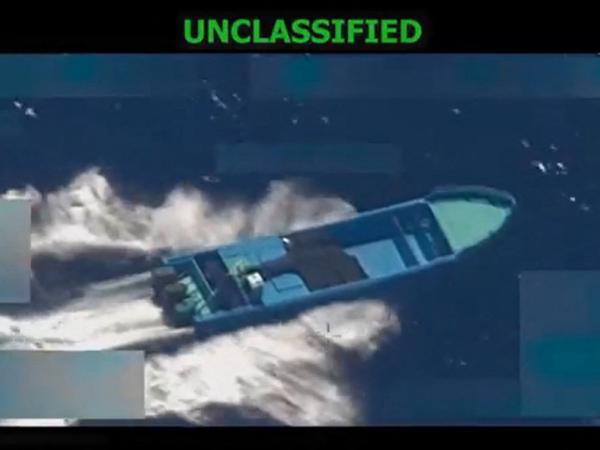
As of this Thursday, the United States has launched nine attacks against vessels allegedly used for drug trafficking: seven in the Caribbean and two in the Pacific. The “narcolanchas” have been destroyed and at least 37 people have died.
Trump insisted that his team knows the logistics of the boats: “We know everything about them (…). When you see five engines, five engines on a boat going about 65 miles per hour, loaded with white powder in silver boxes, that’s generally not a good sign. They’re not going to fish. And you don’t see fishing rods.”
The president linked the tactical turn to a recomposition of the flow: “The ‘sea drugs’ are almost dead and cannot enter so quickly by land. (…) It will be much more dangerous for them.” “You will see it soon,” he said.
At the regional level, Trump denied reports of B-1 bomber flights “near Venezuela,” but remarked: “We are not happy with Venezuela for many reasons. Drugs are one of them.” In addition, he accused the Venezuelan regime of having “emptied its prisons” toward the United States in the past.
Asked about an alleged route to introduce fentanyl from China “through Venezuela,” Trump responded: “They are doing it, yes.” He linked that statement with his tariff policy: “Right now [China] is paying a 20% tariff for fentanyl (…). On November 1, the tariff on China rises to 157%,” and said that the issue will be “top of the list” in his next meeting with Xi Jinping. He added a cost calculation: “Think about this: they make 100 million selling fentanyl in our country (…) [y] “They lose 100,000 million with the 20% tariff.”
Mexico and Colombia were the object of direct accusations. When talking about the cartels, Trump stated: “Mexico is run by the cartels (…). We have to defend ourselves from that.” About Colombia, he said: “Colombia is a drug den. (…) They produce cocaine at levels we have never seen before. And they sell it back here.” He also questioned the president of Colombia, Gustavo Petrowhom he described as “a bad guy, a bully.”
Trump claimed the results under his command: “We have never made progress like we have made,” he said, referring to the decrease in maritime flow and his diplomatic pressure with China over fentanyl. He reiterated that, in parallel to the external front, he will go to the Legislature: “We can go to the Senate, we can go to Congress and tell them.”
The president also publicly defended his security forces and joint units that participate in arrests linked to terrorism and organized crime, criticizing local authorities who, he said, question these operations. Although this is not part of the balance of seizures, it framed the message of “zero tolerance” in the same discourse on drug trafficking and internal security.
In terms of methodology and intelligence, the White House maintained that it can “map networks” and “identify who is connected to whom” within organizations, capabilities that — they stressed — are usually associated with theaters of war such as Afghanistan and Iraq, but that now apply “in our own hemisphere” to what they describe as “foreign terrorist organizations.” According to this logic, “kinetic attacks” are intended to deter future incursions by speedboats and semi-submersibles.
Despite the emphasis on results, no verifiable breakdowns were provided—by type of drug, jurisdiction, date or operation—that would allow auditing the statement that sea trafficking “is at about 5%” compared to a year ago. Nor does it provide independent evidence about the fentanyl route “through Venezuela”, beyond the presidential assertion.