The Cuban Government this Wednesday accused the United States of “intimidating and deceptive pressure” on third countries to vote against the resolution that Cuba presents annually to the UN General Assembly to demand the lifting of the US sanctions against the island.
In a statement to the international press, Cuban Foreign Minister Bruno Rodríguez assured that the Cuban Government has “reliable information of intimidating and misleading pressures” from the United States on “countries in Latin America and Europe.”
The resolution, non-binding and presented every year by Cuba since 1992, has had practically unanimous support from the international community in recent years (187 votes in favor, with only two against; from the US and Israel).
The Minister of Foreign Affairs, @BrunoRguezPwill offer statements to the national and foreign press today.
Wednesday, October 22
⏳ 10:00 am (time of #Cuba)
️ Live on Cubavisión, Cubavisión Int., Radio Rebelde, Radio Habana Cuba, and platforms @CubaMINREX. pic.twitter.com/OtuecVwX7J
— Chancellery of Cuba (@CubaMINREX) October 22, 2025
The resolution is scheduled to be debated and voted on starting October 28. Cuba understands this annual international support at the UN as a diplomatic victory, although it has no practical effects.
Rodríguez stated that Cuba had access to several documents sent by the United States to third countries to “force them to modify their historical position” regarding the resolution.
According to the chancellor, the US has tried in recent weeks to “coerce” allied countries through mechanisms such as “visa deprivation” or “trade tariffs (tariffs)” or repercussions “among their private companies.”
The head of Foreign Affairs assured that in two written communications, dated October 8 and 17, Washington directly urged the nations to which it sent the documents to “reject” the resolution “in accordance with” applicable “legal” measures.
Likewise, Rodríguez accused the North American Secretary of State, Marco Rubio, of working through emissaries to achieve this change, especially to Latin America and Europe.
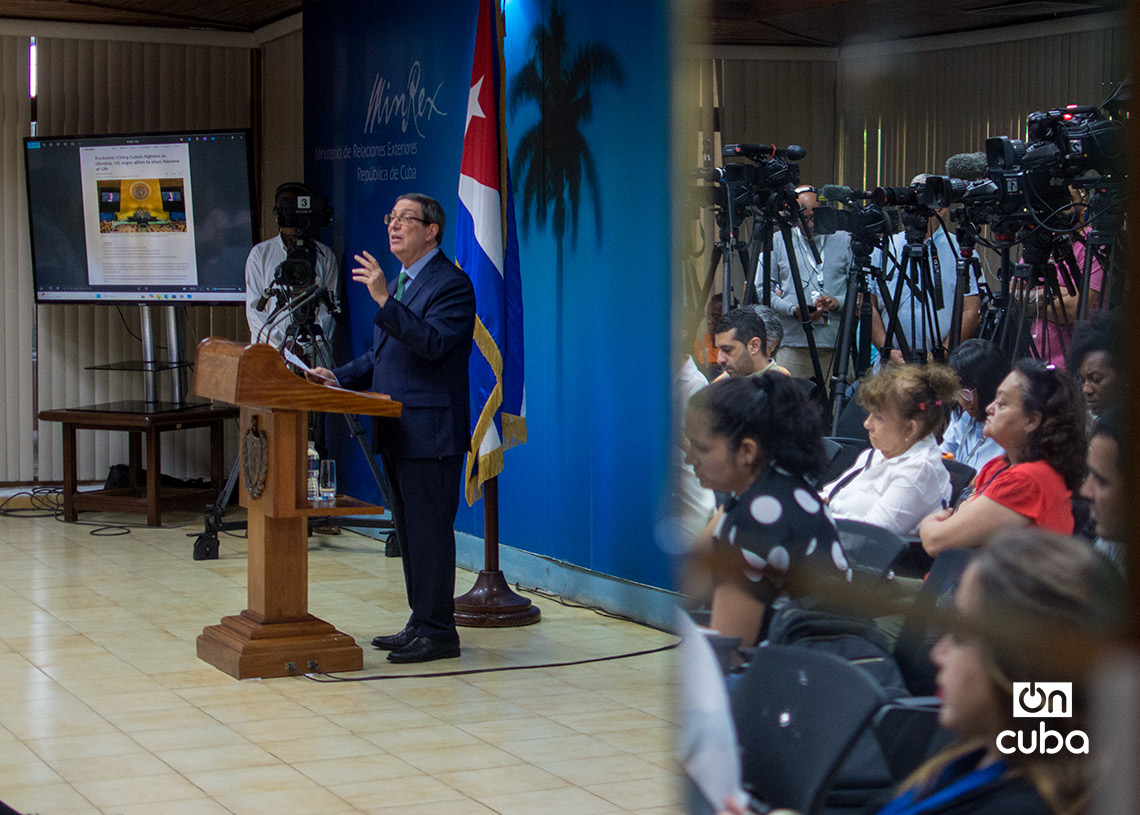
In the writings, always in agreement with the Cuban Government, the US argues that Cuba is a “threat to international peace and security.” “It is pressure with arguments that no one believes in,” said Rodríguez.
Despite this, the chancellor pointed out that the Cuban resolution will manage to “prevail” with an “overwhelming majority.” “It will be a great victory for the revolution,” he stressed.
The Cuban Government has reiterated on several occasions in recent weeks that it “does not participate” in the war in Ukraine, although it acknowledged that there are nationals recruited by Moscow who participate “on their own.”
“The Cuban Government categorically ratifies that Cuba is not part of the armed conflict in Ukraine, nor does it participate with military personnel there, or in any other country,” the Ministry of Foreign Affairs (Minrex) stated in a recent statement.
Days before that statement, the agency Reuters published, based on an internal State Department cable to which it had access, that Washington was pressuring other countries not to support the Cuban resolution on sanctions with the argument that Havana “actively” supports Russia in the invasion of Ukraine.
Cuban government criticizes US pressure to reduce support for its resolution against the embargo
The United States has pointed out that Cuba “actively” supports Russia in the invasion of Ukraine, “with up to 5,000 Cubans fighting alongside Moscow forces.”
Last May, the opposition Cuban Resistance Assembly and Ukrainian parliamentarian Maryan Zablotskyy denounced in Miami (USA) that Russia has recruited up to 20,000 Cubans, of which between 200 and 300 have died.
The estimates come from data from the General Intelligence Directorate of the Ukrainian Ministry of Defense, which reported a list of 1,028 Cuban mercenaries with contracts with the Russian Armed Forces between June 2023 and February 2024.