His mission is none other than the same one he was given years ago in Maquimport and Mariel, or as Cabrisas’ second: to ensure that the Castros rule forever.
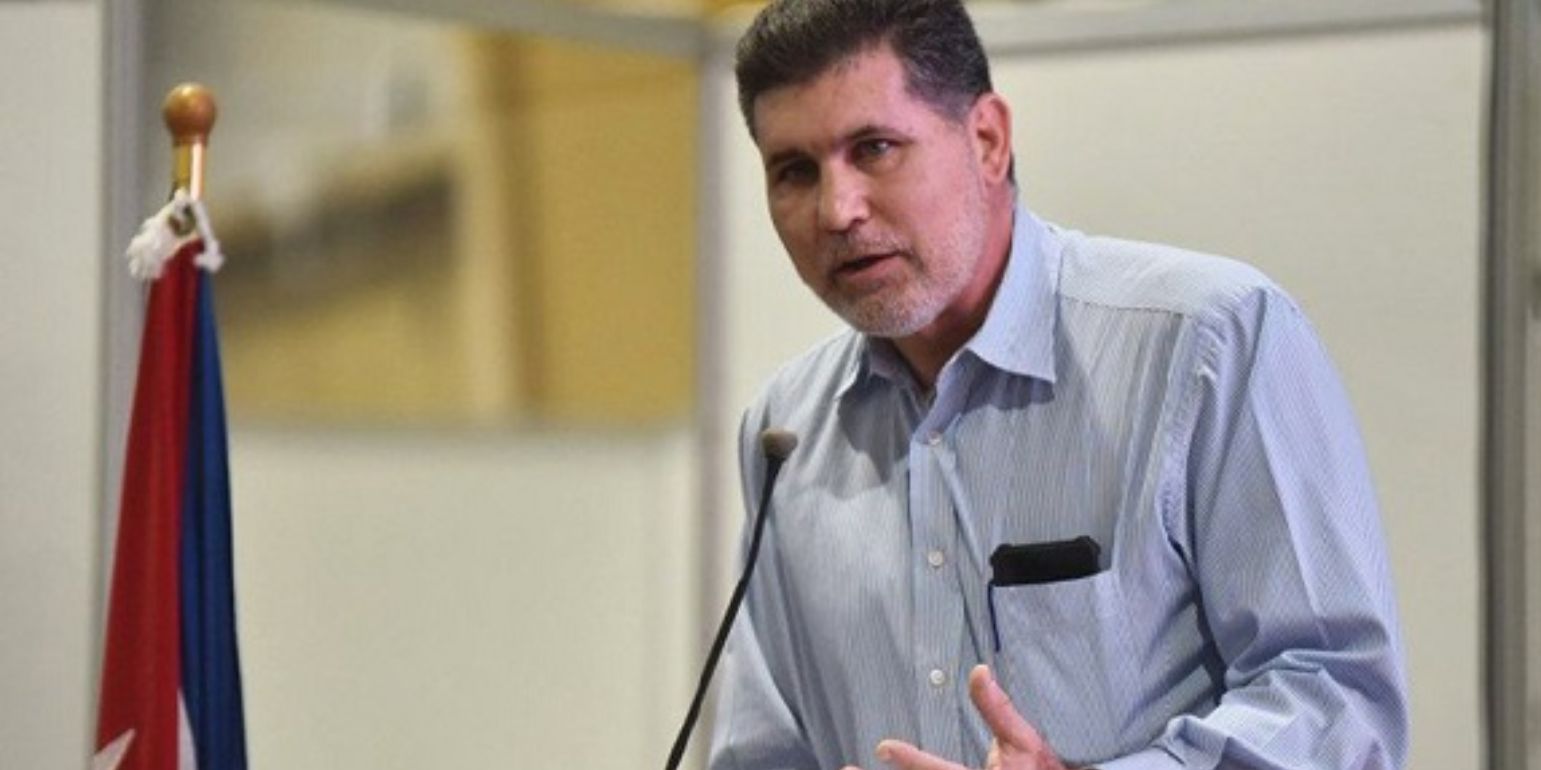
HAVANA.- If three promotions in less than two years are not enough to realize that Oscar Pérez-Oliva Fraga He is getting closer every day to becoming president of Cuba, taking back for his family a position that – according to the thinking of the most obstinate Castroites – should never have passed into the hands of an upstart. We will have to wait for the National Assembly to designate him as a deputy in the coming months so that he has all the necessary ballots to be appointed (not “elected”).
The Cuban communists, as they demonstrated a few days ago with the reactivation of Raúl Castro at the head of the National Defense Council, skip the Constitution whenever they feel like it, and if tomorrow they wanted to replace Miguel Díaz-Canel even for Sandro Castrothey would do so without the need to consult a “Parliament” that is barely useful for voting unanimously.
But, in matters as delicate as these, where it is necessary to preserve the constitutional form so as not to make the absence of democracy so evident, they will surely go step by step although in such an accelerated manner that not only is their desperation to find, before 2028, a new “disciplined and faithful” administrator, but they also reveal their anger with this “reserve of cadres” so disappointing (because it is power-hungry and corrupt) that dismantles the main argument of the dictatorship (unity) when he talks about his “strength.”
There are so many deep divisions within the Cuban regime, there is so much distrust in the ability of the “leaders” to avoid a social explosion, that Castroism has been forced to make visible that power that never left “family” control but that sought to simulate a democratization for the world to see; but, above all, give the populace a punching bag on which to vent anger.
It is because of this distrust that corrodes them that Raúl Castro reappears as head of the Defense Council (when the conditions for a social outbreak become favorable) and not Miguel Díaz-Canel. And it is perhaps so well because of this strategy of “recovery” of total control that Oscar Pérez-Oliva Fraga emerges in a leading role that was reserved for Luis Alberto Rodríguez López-Calleja.
Why a nephew and not the son?
López-Callejawho was being enlisted to replace Ricardo Cabrisas not only in the Ministry of Foreign Trade but also as Deputy Prime Minister, died suddenly in July 2022, having accumulated the necessary requirements for Parliament to designate him as President once Díaz-Canel fulfilled his “decorative” but above all “withstands blows” function. In short, he was placed in that position with total bad intentions, in the midst of the package of unpopular measures of the Ordering Task.
Both Marino Murillo and Miguel Díaz-Canel were the parapet used by Raúl Castro to, if possible, save himself from being the main target of criticism of the terrible government management for which he is responsible. Let us remember that he gave priority to strengthening GAESA and the military elite that surrounds it, sacrificing the living conditions of millions of Cubans in its objective of personal enrichment.
For this reason, no member of the Castro family could become too visible to be hated as useless as Miguel Díaz-Canel is today, who is not immune from blame. He was and is aware of the “mission” entrusted to him, but when he knew of the role reserved for him once, between 2004 and 2008, they had invented for Colonel Alejandro Castro Espín an autonomous entity that stood with supreme power over the Ministries of the Interior and the Armed Forces: the National Defense and Security Commission (CDSN), of which he is its highest head.
The leading role played by Castro Espín in the conversations with the government of Barack Obama; his tour of Europe with the intention of a change of image, offering interviews under the facades of a book author and political scientist; His presence alongside his father on international tours and high-level meetings made many think that Raúl Castro was preparing to transfer power to him. However, this would have been an “unnecessary formality”, especially when at that time Colonel Alejandro, at the head of the CDSN, was the most important man in the Castro regime, with the ability to decide who ascends or descends from power, who lives or dies on the farm he owns.
Let us remember that the dismantling in 2009 of the entire so-called “support team of the Commander in Chief” and his group of “favorites”, even though he was in power, was the work of Raúl Castro, who at the time entrusted his son with the deployment of an exhaustive surveillance system against his targets to be destroyed. This entire operation was carried out secretly, behind the backs of the intelligence and counterintelligence services of the Ministry of the Interior, in the hands of Fidel Castro. Today this entire apparatus responds to the orders of Alejandro Castro Espín.
Between him (with full control of the repressive forces) and Luis Alberto Rodríguez López-Calleja (with full knowledge of each of the threads that move the economy of the dictatorship) they would govern the Island, although only once the conditions were created to publicly emerge as figures who respond to the “popular demand” to fix what the “hands-on” supposedly decomposed. And in this way reaffirm the myth they themselves cultivated that Cuba can only be governed by the Castros.
(An idea that, although absurd, has a significant number of followers inside and outside Cuba, and therefore must be taken into account in the analyzes of possible scenarios of political change).
Not by chance is the exaggerated cult of Fidel Castro promoted by the PCC, and not by chance is the storm of publications and complaints on social networks, from supposed revolutionaries disenchanted with “Canelism,” who begin and end their complaints lamenting the death of the one who “would not let these things happen.”
That Raúl Castro occupied the position where Miguel Díaz-Canel should have been in front of the National Defense Council is not simple “curiosity”, it is a preview of what will happen in the coming months, when the current administrator is eclipsed until he is returned in a couple of years to his rightful place as an accessory piece. Or to reactivate it in another mandate extended by the National Assembly, once they are convinced that it is not yet the ideal time to replace it with the Castro that they are preparing to inherit today, replacing the deceased López-Calleja.
Oscar Pérez-Oliva Fragaa substitute heir
When in July 2013, in the midst of the “Raulista reforms”, it was decided to separate business management from the Ministry of Foreign Trade, Oscar Pérez-Oliva Fraga was already an important member of GAESA in MINCEX, and that is why the decision benefits him enormously by being placed in charge of a company like Maquimport, one of the 12 that formed the Foreign Trade Business Group that year, but perhaps the most important, because it was the mandatory intermediary for the import of machinery and equipment for both the state and non-state sectors.
The above means that Maquimport would become the recipient of those large amounts of dollars that the regime intended to absorb, especially from private enterprises and foreign businessmen who, under the bonanzas of the thaw with the United States, decided to start investing in Cuba, as was the case of the North American company John Deere Financial, which in November 2017 came to sign an agreement with Maquimport for the sale of agricultural machinery to the Island.
Until that moment, Oscar Pérez-Oliva Fraga’s role was to manage these agreements for the benefit of GAESA, perhaps until continuing to rise (as happened when he was named Business Director of the Mariel Special Development Zone) with the perspective of replacing Luis Alberto Rodríguez López-Calleja at some point, but only up to that point, and without much certainty that such a thing would happen.
López-Calleja’s death changed his fortunes, and that was when his meteoric rise began. Without a political profile or military history, the opportunities of getting to where he is today, despite his status as a grandnephew, were almost nil before 2022, much less thinking about the possibility of being taken into account to replace Miguel Díaz-Canel in his position as administrator. However, as in 2018, Raúl Castro once again faces the difficulty of finding a replacement because he does not have much (and trust) to choose from.
Oscar Pérez-Oliva Fraga is a Castro without the last name but, despite that detail, it is not precisely the blood that makes him ideal but rather his status as a unique example in a family that is mostly filled with useless and lazy people or scattered around the world, perhaps saving themselves from what will happen once the evil inflicted on millions of innocent people is reversed.
His mission is none other than the same one that he was given years ago in Maquimport and in Mariel, or as Cabrisas’ second: to ensure that the Castros govern forever, and to make sure that investments, agreements, foreign aid, and everything else they manage to attract under the pretext of prosperous and sustainable development is put at the service of a single family.