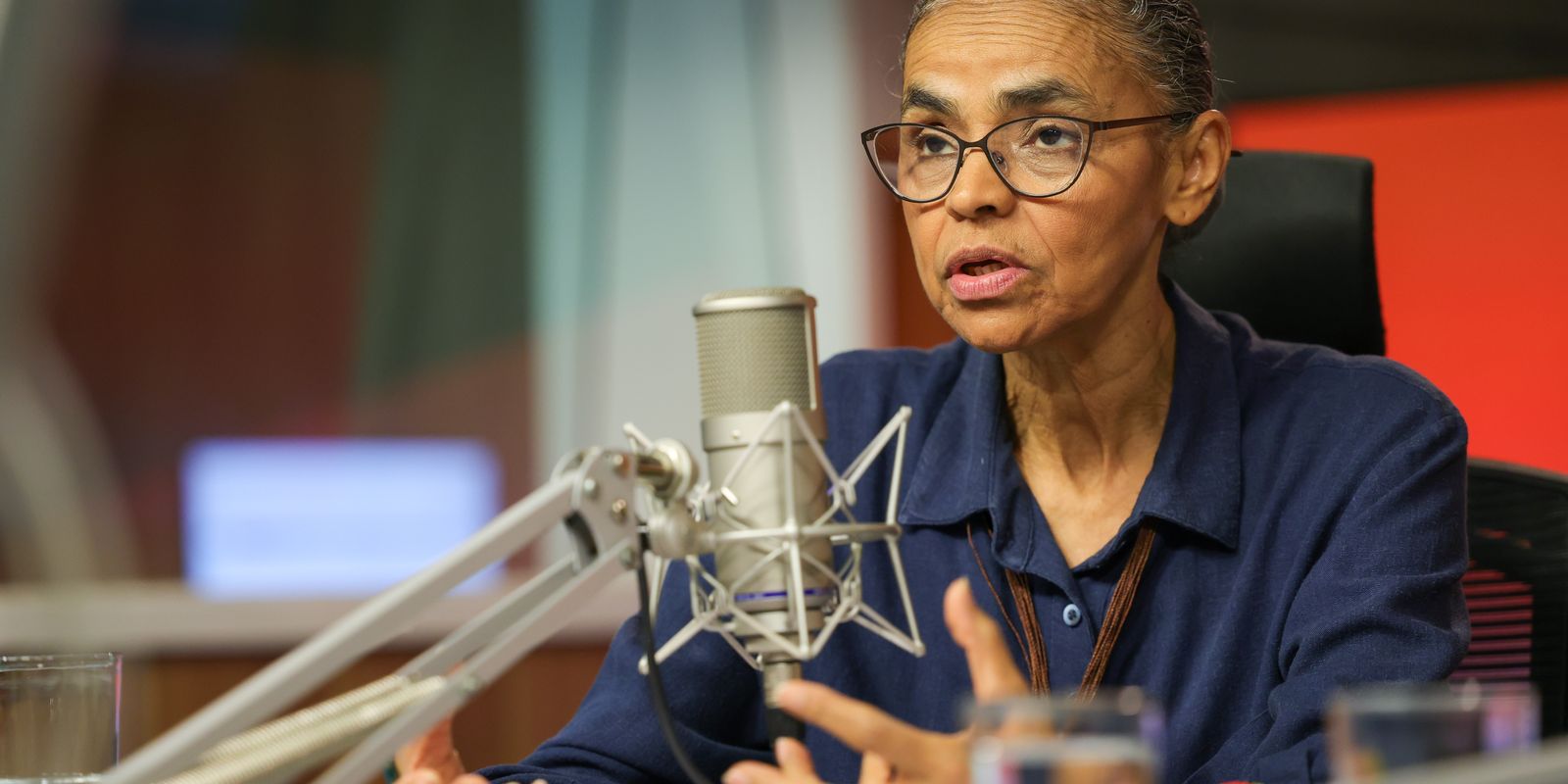
The Minister of Environment and Climate Change, Marina Silva, denied this Wednesday (22) that the decision by the Brazilian Institute of the Environment and Renewable Natural Resources (Ibama) to authorize Petrobras to search for oil in the Foz do Amazonas sedimentary basin was motivated by political influences.
The license to drill wells in block FZA-M-59, in the area of the Brazilian coast known as the Equatorial Margin, was granted last Monday (20).
“The decision made by our Ibama employees was a technical decision. And, if there was any political manifestation, this did not influence the quality work that was done by our technicians. Of course, we live in a political context, it is legitimate for people to have aspirations, but in a republican government, such as President Lula’s, the decision was a technical decision”, said Marina Silva, in an interview with Canal Gov.
She highlighted that Ibama’s rigor can be identified in a series of improvements that were required for Petrobras to obtain the license.
“One of them is the support or relief base for what experts call oiled fauna. In the initial project, the base was in Belém, 800 kilometers from where the oil prospecting was going to take place. And Ibama understood that it was unacceptable, because the transport time for these animals was so long that there would be no rescue”, said Marina.
“Now, we have a base in Belém and another base close to the prospecting site, which is around 160 km away. In other words, all the demands that Ibama made were highly necessary and if it weren’t for Ibama’s rigor, a license would have been issued to the detriment of the environment and Brazil’s interests”, he added.
The minister recognizes that there is a contradiction in exploring more oil reserves on the eve of the 30th United Nations Conference on Climate Change (COP30), which will take place in Belém. Reducing the use of fossil fuels is central to reducing greenhouse gas emissions and combating global warming.
“There is a contradiction that people raise and with good reason. Society is debating not only with Brazil, but throughout the world. We need to get out of dependence on the use of fossil fuels, because that is what is warming the Earth’s temperature. What is the way to do this? Plan fairly so that everyone can make their transitions”, says the minister.
“And, of course, it is not Ibama that makes this decision. The National Energy Policy Council is the one who makes this decision”, he adds.
COP30
Marina Silva also highlighted the efforts that were made by Brazil in preparing for COP30, even in the face of a challenged geopolitical scenario, the accommodation crisis in Belém and the difficulties in obtaining more concrete commitments from countries for climate mitigation and adaptation.
“I hope that the summit can send a strong message that we are in a climate emergency and that from now on we must be able to save not only the planet from the point of no return, but climate multilateralism itself from the point of no return,” said the minister.
“My dream for the end of COP 30 is that, at the end, we can leave an important legacy for our country. To lead by example on the deforestation agenda, to be pioneers in the transition away from dependence on fossil fuel. To leave substantive discussions on adaptation, on what to do about insufficient NDCs. There is no way to resolve the climate if it is not done jointly and in solidarity”, he added.