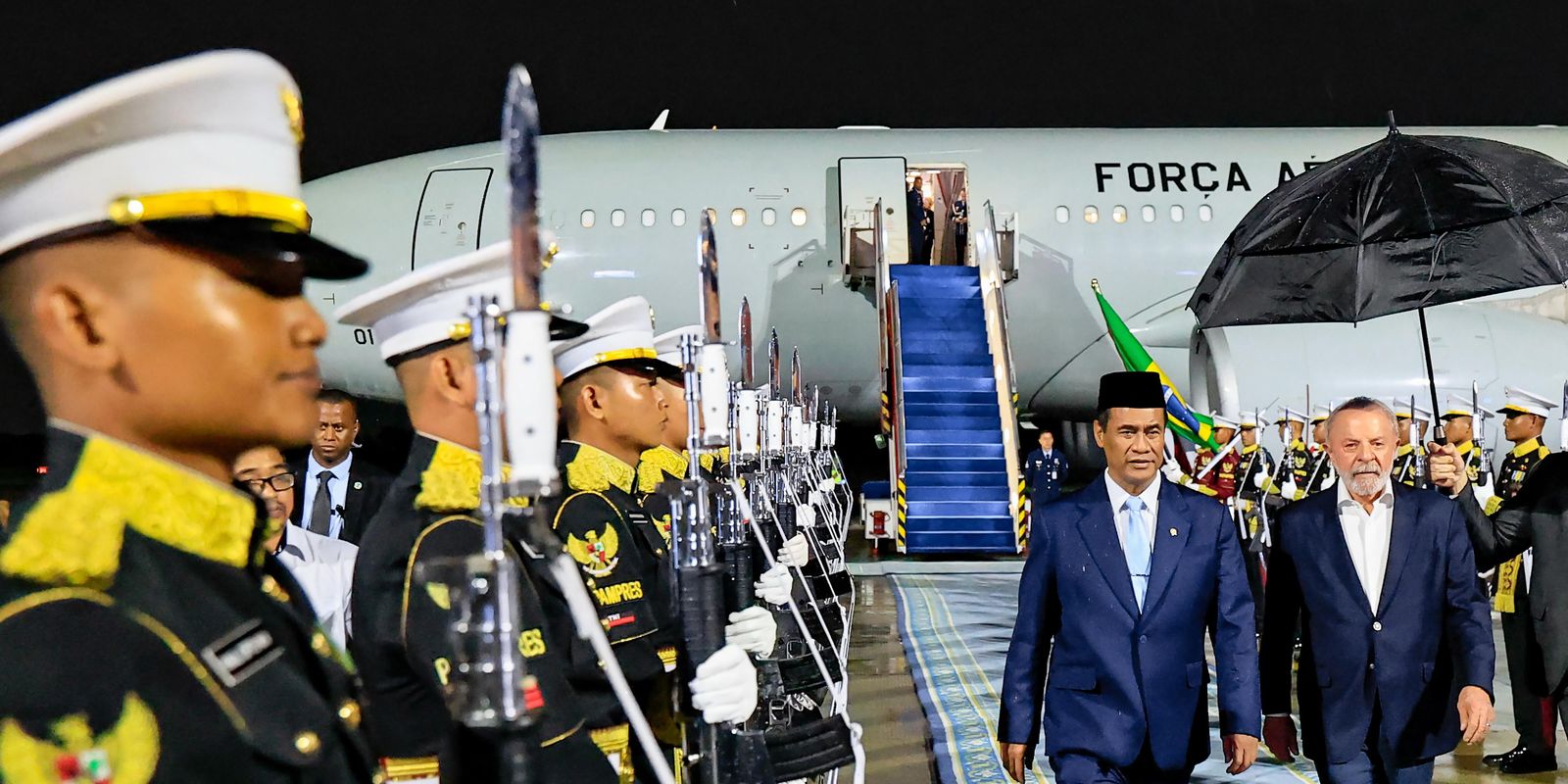
President Luiz Inácio Lula da Silva begins a state visit to Indonesia this Thursday (23). He is already in Jakarta, where he will be received by the country’s president, Prabowo Subianto, to reaffirm the bilateral strategic relationship and discuss other issues on the regional and multilateral agenda.
The official reception will be held in the morning in the Indonesian capital, shortly after midnight Brasília time. Jakarta’s time zone is 10 hours ahead of Brasilia time. On the agenda are cooperation instruments in several areas: science, technology and innovation, energy and mineral resources, sanitary and phytosanitary measures, in addition to statistical cooperation.
Brazil and Indonesia established a Strategic Partnership in 2008, Brazil’s first in Southeast Asia. The bilateral relationship has deepened in several areas, such as agricultural trade, bioenergy, defense and sustainable development. In 2024, trade exchange between the two countries reached a record US$6.3 billion, with a Brazilian surplus of US$2.6 billion.
The president’s agenda also includes participation in the Brazil-Indonesia Economic Forum, with businesspeople from both countries.
Lula seeks political rapprochement with Asian countries and the possibility of expansion of Brazilian trade with a market of 680 million inhabitants. The trip to Indonesia is also a reward for Subianto’s recent official visit to Brazil, which took place in July this year, shortly after the 17th BRICS Summit, held in Rio de Janeiro.
On Friday (24), President Lula has a scheduled meeting with the secretary general of the Association of Southeast Asian Nations (Asean), Cambodian Kao Kim Hourn. The entity’s headquarters are in the capital of Indonesia.
In the afternoon, Lula leaves for Kuala Lumpur, Malaysia. There, the program includes participation in the Asean summit and the meeting of East Asian leaders (EAS), in addition to a possible meeting with the president of the United States, Donald Trump, who has not yet been confirmed.
Brazil is the only Latin American country to maintain a Sectoral Dialogue Partnership with Asean, with political coordination and multisectoral cooperation initiatives.