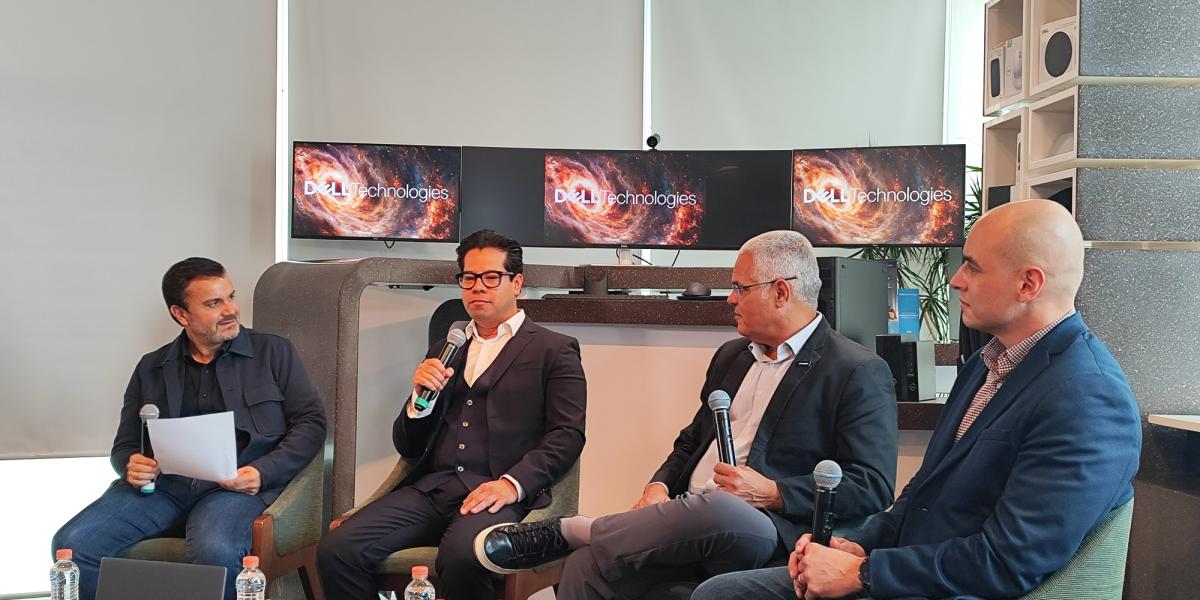
In 55 years of history, Reyes Groupthe family conglomerate behind the Reyma brand, has learned to move with the cycles of the Mexican market: manufacturing, construction, hospitality and, now, a decisive shift towards artificial intelligence (AI).
“The need (to implement AI) arose with the exponential growth of the last 10 years and diversification. A lot of information was generated, structured and unstructured… Senior management told me: ‘this is cool [el tablero]. And what’s next?’” said Abraham Sevillano, director of iNN Innovation and Business at Grupo Reyes, explaining why they made the leap from data dashboards to AI.
The first step was cultural. Instead of forcing managers to navigate complex metrics, Sevillano’s team decided to break that barrier with a conversational agent inspired by the experience of ChatGPT.
“We are going to generate our own agent and you are going to speak to it in natural language. Behind that simple answer, there is an entire analysis,” he said.
The goal of this implementation was to move from the “what is happening” of traditional dashboards to the “what if…” of artificial intelligence models.
AI implementation
To land the implementation of AI tools, Dell and Nvidia They sat down with Grupo Reyes with the aim of designing something viable, limited and formative.
“The first thing was to establish trustworthy communication. Grupo Reyes wanted to develop internal talent. It did not want to buy an out-of-the-box solution,” said Kurt Yáñez, AI Business Development leader for Dell Technologies Mexico.
This approach allowed Grupo Reyes to start with an experimental budget, accompany the development team and convert proofs of concept into solutions with a return.
In parallel, Nvidia observed something unusual in Mexico– Real work with generative artificial intelligence (AGI).
“Few companies are actually developing generative AI concepts, they are using our programs like Nimo, Nimo Cloud to set up their own language model,” said Marcio Aguiar, director of Enterprise for Latin America at Nvidia.
What did Grupo Reyes do with AI?
First, the company centralized its data. Built a data lake to unify structured and unstructured sources and feed models that were replaced until the right fit was found.
“In that year of learning, we began to change models because it didn’t end in what we were looking for; today we already have an agent’s agent, it was an interesting job,” said Sevillano.
Second, they chose boring but critical use cases. Instead of chasing demo shows, they attacked measurable operational frictions. An example was analyze thousands of support tickets to identify trends by business (plastics, construction, hospitality) and prioritize care according to urgency. The result was fewer calls to the call center and a better internal user experience.
Third, they took care of the adoption. They even created a small internal marketing team to “change the image” of the area and communicate in clear language to managers and users: “break that barrier from the technological from the complex to a part of the user understanding you,” Sevillano said. In addition, they enabled channels in Teams and a VIP support service for executives, without tickets, to accelerate the use of the agent.
Infrastructure: start small, scale meaningfully
The technical design of this AI implementation followed the script of “prove value quickly and grow on demand.” The group started with a Dell PowerEdge R760X server with two GPUs (in Sevillano’s own words, “relatively small”), sufficient for the first use cases based on unified information and ticket analysis.
As models evolve into manufacturing and purchasing processes, and access opens to more users, accelerated computing will need to scale.
“If I launch the agent to 4,000 (users with administrative access), my computing power is going to be minimized,” he said.
AI Factory
The support of Dell and Nvidia articulated this approach within an AI Factory-type framework, which consists of identifying business cases, defining models and data (cleaning, governance, access), and only then landing the technological architecture.
“We launched it at Dell Technologies World, a framework that helps implement use cases in a shorter time,” recalled Juan Francisco Aguilar, general director of Dell in Mexico.
Marcion Aguiar added that Nvidia’s software suite is designed to accelerate time-to-market, not just to sell hardware, and allows the “AI factory” to be built by scaling according to demand, that is, without overinvesting in advance.
Return on investment from AI?
Unlike those who promise instant returns, Grupo Reyes separated the evaluation of the AI implementation process into two phases. The first, qualitative, with experience surveys of users and managers; the second, planned for the next cycle, which will be financial, by deploying models directly in production and purchases.
“Right now we have a qualitative part… it has gone very well for us; the next phase is to implement in areas where (the ROI) would be tangible,” said Sevillano.
The time to achieve the first results was reasonable: six months for the technical aspect and around a year for the user experience to be felt in the company’s day-to-day life.
People at the center
Sevillano insists that AI is not an alibi to implement job cuts, but rather a talent accelerator.
“AI is not going to replace any collaborator; it is going to hyper-accelerate their decision-making and we are going to train them,” he said.
The strategy mixes intergenerational mentoring, experience that transmits corporate culture to young teams, with aspirational projects, aligned benefits and a career narrative in AI within the group.
“We do not think about removing [puestos]On the contrary, improving productivity… is our virtuous circle: better quality of life, better decisions, more profitability,” he said.
That vision is in line with Nvidia’s diagnosis. The challenge is not to “replace” people, but to learn to work with artificial intelligence.
“The computer will be working side by side… bringing super relevant information to your business,” Aguiar said.
Scope
The case does not arise in a vacuum. Grupo Reyes is a holding company with a national presence: plants in Mexico City, Ciudad Sahagún, León (corporate), Monterrey, Mérida, Nogales, and a distribution center in Phoenix, in addition to 118 business points in other units.
Its most recognized company, Reyma, rules the single-use disposable market; while in recent years they expanded into the construction and hospitality sectors (salons, restaurants and hotels).
The generational change also weighs. “The owner’s children are coming in and they don’t have access to any system, only our agent and the boards,” Sevillano said.
This practice serves as a thermometer of AI adoption: new senior management no longer wants menus and manuals, they want to ask and decide.
What’s next: production, purchasing and data security
After a year of learning, Grupo Reyes’ plan is to take the models to hard processes (production lines, supply) and open the agent to thousands of users with roles and permissions per business.
This requires more graphics processing cards (GPUs) and a finer security and data governance architecture. The trend is clear, many organizations are already asking to “take to mass production”, repatriating cloud loads to on-premises due to the cost-efficiency relationship and risk control in the use of AI.
That appetite is not exclusive to Grupo Reyes. Dell and Nvidia see manufacturing and finance as spearheading the use of this technology in Mexico, with transportation in the Bajío joining in.
The case of Grupo Reyes does not presume a futuristic AI laboratory, but rather strategic discipline applied to a Mexican conglomerate that operates in various verticals.