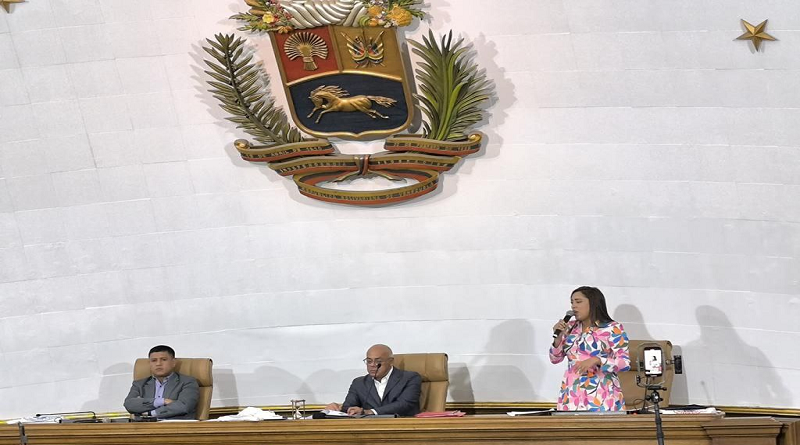
The Chamber of Deputies approved this Tuesday (21) the bill (PL) 4500/25, which amends the Penal Code to increase penalties for crimes committed by criminal organizations. Among them is extortion and human shield. The text goes to the Senate.
In the case of the crime of extortion, it occurs when members of criminal organizations force or constrain the population to acquire essential goods and services, requiring a financial advantage for the exercise of economic or political activity, or when charging for free movement. The expected penalty is now eight to 15 years in prison and a fine.
In relation to the crime of human shield, the project says that the practice of using people as shields, in criminal action, to ensure the commission of another crime. The expected sentence is six to 12 years. The penalty is increased up to double if the conduct is carried out against two or more people, or when carried out by a criminal organization.
Data from the Ministry of Justice and Public Security (MJSP), through the National Secretariat for Penal Policies (Senappen), mapped the activities of 88 criminal organizations in the country in the last three years. Of this total, 46 operate in the Northeast; 24, in the South; 18, in the Southeast; 14, in the North; and 10, in the Midwest.
According to the project’s rapporteur, Coronel Ulysses (União-AC), estimates indicate that between 50.6 and 61.6 million Brazilians, which corresponds to around 26% of the country’s population, are subject to so-called criminal governance.
“The bill arises as a response to the need to provide more effective legal instruments and more severe penalties to curb the escalation of violence and territorial dominance imposed by criminal factions, which challenge the State and terrorize the population”, he argued.
Preventive detention
Deputies also approved bill (PL) 226/2024, which deals with the conversion of arrest in flagrante delicto into preventive detention in cases of arrest. According to the text, the conversion must assess the dangerousness of the agent and whether it creates risks to public order.
This assessment must be taken based on the reiteration of the crime, taking into account the repeated use of violence or serious threat to the person or regarding the agent’s premeditation for committing the crime; participation in a criminal organization; the nature, quantity and variety of drugs, weapons or ammunition seized.
According to the project’s rapporteur, deputy Paulo Abi-Ackel (PSDB-CE), the measure aims to prevent preventive detention from being carried out based on allegations of the abstract seriousness of the crime, and the dangerousness of the agent and his risk to public order must be concretely demonstrated.
“We want to reduce the scope for those abstract interpretations, for that strict magistrate instead of a flagrant arrest, but he already decrees preventive detention, which naturally imposes an additional difficulty on the person who was punished with this determination”, he observed.
The project also deals with the collection of biological material to obtain and store the genetic profile of the custodian in a database, when there is an arrest in the act for a crime against sexual freedom or for a sexual crime against a vulnerable person, or of an agent who is part of a criminal organization that uses or has firearms at their disposal.
According to the rapporteur, the collection will not be done indiscriminately. According to the project, the collection must be carried out, preferably, at the custody hearing itself or within 10 days, counting from its completion. Furthermore, the collection will be carried out by a trained public agent and will respect the chain of custody procedures defined by current legislation and complemented by the official criminal expertise body.
“This innovation does not determine the collection of biological material indiscriminately, but only in cases of extreme gravity that justify the use of this instrument due to its potential for social impact and risk. By restricting collection to the practice of heinous crimes or armed criminal organizations, proportionality is preserved, avoiding unnecessary escalations in the legal treatment of less serious crimes”, he argued.