Havana/In the parish of Nuestra Señora de la Caridad del Cobre, in the heart of Central Havana, the name of Celia Cruz was heard, despite the censorship that the Cuban regime has unleashed against other tributes on the Island for its centenarywhich takes place this same Tuesday. The Guarachera of Cuba symbolically returned to the Island that expelled it from official memory, and did so with music, faith and a gesture of defiance to the silence imposed for decades.
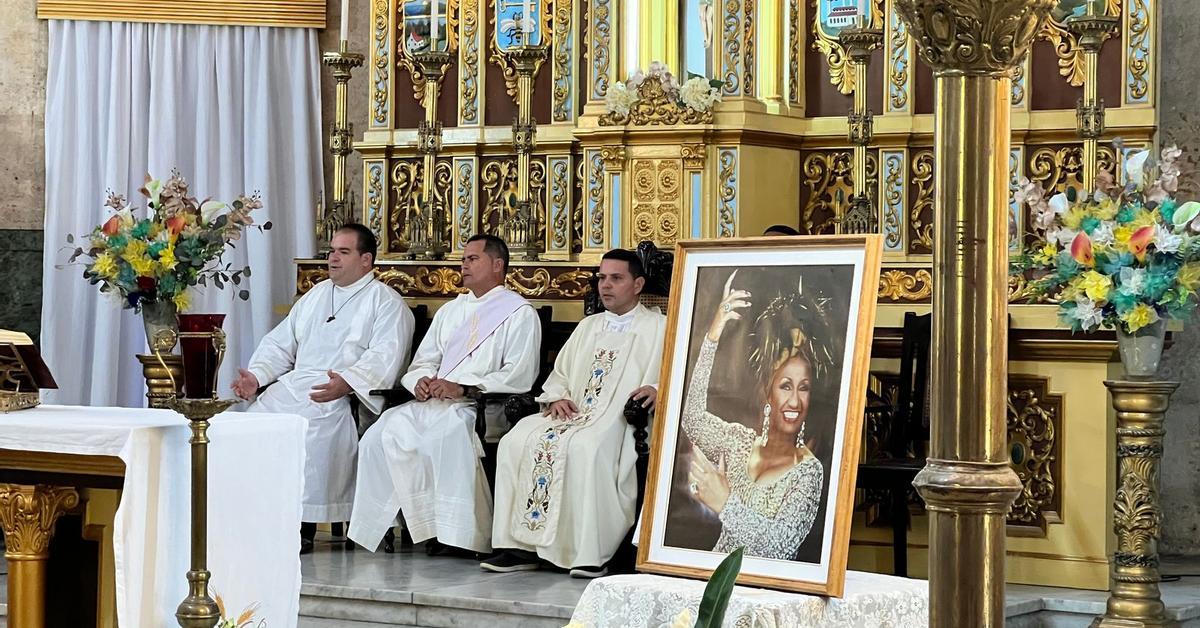
A framed photo of the Guarachera of Cuba, smiling and dressed in sequins, presided over the altar of the church, located on Salud Street, between Manrique and Campanario, where he approached 14ymedio. At her feet, white flowers and lit candles. On the benches, artists, faithful and diplomats shared the same space.
The parish priest Ariel Suárez, in a serene but firm tone, recalled that “faith knows no censorship.” The words were received with a murmur of approval among those in attendance. “This mass was a request from Cuban artists who wanted to pay tribute to a woman who brought the name of Cuba to the world,” he added, while the image of the Virgin of Charity – the same one the interpreter was devoted to – dominated the background of the temple.
/ 14ymedio
Among those present, the chargé d’affaires of the United States Embassy in Cuba, Mike Hammer, did not go unnoticed. “It is an honor to commemorate the life of Celia Cruz here, in her homeland,” he said after the mass. “She wanted freedom for the Cuban people, and that desire lives on in her legacy.”
At his side, artists like Alain Pérez and Haila María Mompié shared memories and gratitude. Pérez, who worked alongside the singer on international stages, did not hide his emotion: “Celia was pure light, an ambassador of our culture. Her love for Cuba never went out, not even when it was forbidden.”
The musician also regretted that, even today, tributes to the singer continue to encounter institutional vetoes. “I would have loved to see all the Cuban artists gathered here, without fear, to sing to him,” said the artist when he saw that many benches in the parish remained empty, given a fear that still persists among Cubans.

/ 14ymedio
Mompié, dressed in white, assured that she carried “Celia’s legacy like a treasure.” The singer released a song in his honor, My life is singinga title that evokes the life philosophy of the Queen of Salsa. “Celia was Caridad – her middle name – and this temple, dedicated to the Virgin, is the perfect place to remember her. Today her spirit is here,” he added.
The mass took place in an atmosphere of recollection, although political tension hovered over the prayers. Outside, several curious people stopped to watch from the sidewalk; Inside, the timbre of the voice of the Queen of Salsa – banned for half a century on Cuban radio and television – seemed to fill the air.
Days before, the National Center for Popular Music had canceled a theatrical show by the El Público company dedicated to the artist, scheduled at the Fábrica de Arte Cubano. The decision sparked a wave of indignation among musicians and citizens, who denounced the censorship as an act of cultural meanness.
In response, the FAC made a symbolic gesture: an empty seat illuminated on the stage and an hour of silence, followed by the music of Celia Cruz. “Celia lives,” it was read in light letters. That same message was repeated again in the mass, now converted into a prayer: Celia lives in the heart of her town.
/ 14ymedio
The young urban musician Yomil showed his tattoo with Celia’s face on his forearm. “She is the only artist that I carry in my skin. She represents the best of us: talent, joy and resistance,” he told the media present. “There is no censorship that can handle that.”
Celia Cruz, who died in 2003 in New Jersey, was never able to return to Cuba. Her last wish – to be buried on the Island – was not fulfilled either. However, his voice continued to reach through informal channels, on cassettes, records brought from exile and family memories.
The mass concluded with prolonged applause. There were no political speeches or slogans, but the meaning was evident. “Celia, Cuba embraces you,” was heard among the benches, while the first chords of the song discreetly sounded. life is a carnival. Some chanted the chorus, others cried.