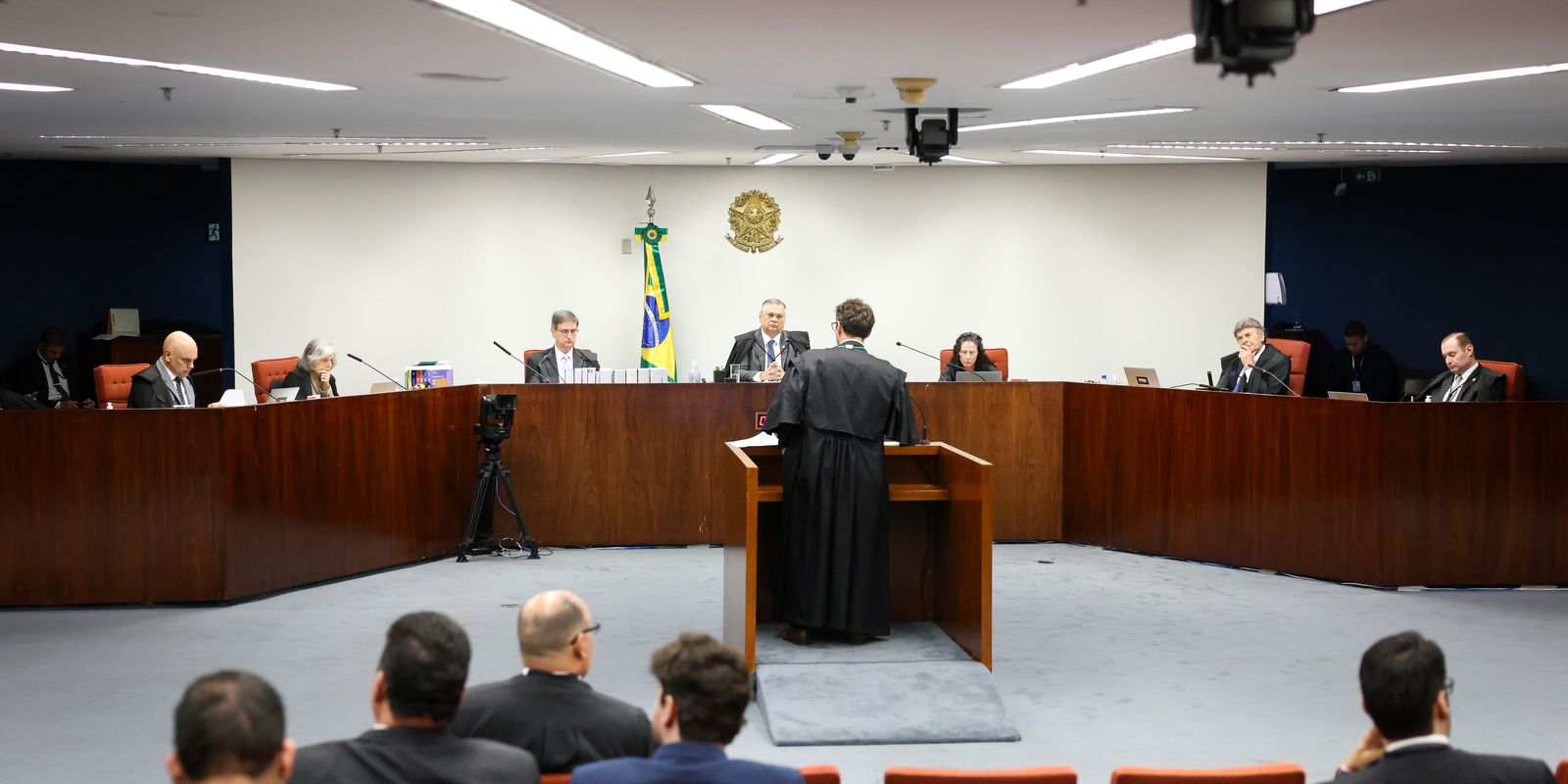
Minister Alexandre de Moraes, of the Federal Supreme Court (STF), voted this Tuesday (21) for the conviction of the seven defendants who make up the disinformation nucleus of the coup plot which sought to keep former president Jair Bolsonaro in power after defeat in the 2022 elections. 
Case rapporteur, Moraes took just over two and a half hours to read his vote, in which he repeated several times that “the existence of a criminal organization had been abundantly proven” which, in division of tasks, committed crimes with the aim of breaking with the Democratic Rule of Law.
When voting, Moraes mentioned the defendants from Nucleus 4, one by one, individualizing the illegal acts carried out and the evidence that supported each conviction, exposing above all written and audio messages taken from the defendants’ devices, in addition to other types of records.
Prints of social networks were also presented by the reporting minister to demonstrate the coordination of acts carried out by the defendants and the dissemination of attacks against the electoral process, institutions and authorities opposed to the criminal group.
The convictions were also based on the testimony of Lieutenant Colonel Mauro Cid, a cooperating defendant who provided the Federal Police with details about the coup plot and the participation of each person involved in the plot.
“There is no doubt, the evidence is abundant”, stated the minister.
Moraes also cited evidence as a draft coup decreewhich is mentioned in conversations between members of this disinformation nucleus, in addition to actions and planning for the coup, such as the Copa 2022 operation and the plan Yellow Green Dagger.
>> Follow the channel Brazil Agency on WhatsApp
For the minister, this demonstrates how the different cores of the plot, including Core 4 of disinformation, acted in a coordinated way to carry out the coup.
“Numerous messages and conversations in all centers, interrelated, that demonstrate this, that there was a draft of the coup, that there was pressure against the commanders of the Armed Forces, that there was monitoring of authorities, that there was a World Cup 2022 operation, based on the Punhal Verde e Amarelo planning”, said the minister.
The minister also mentioned the undemocratic acts of January 8, 2023, when Bolsonaro supporters invaded and vandalized the headquarters of the Three Powers.
Moraes stated that several acts carried out by the defendants sought to “delegitimize the Electoral Court, delegitimize the elections” with the aim of “generating social chaos” and “taking the Republic by storm”.
Absolution
Only in relation to one defendant, the president of the Instituto Voto Legal, Carlos Rocha, did the rapporteur vote for the acquittal of some crimes. Moraes said there was “reasonable doubt” about his participation in the coup d’état itself.
For this reason, only in the case of Rocha, Moraes voted for the conviction of being part of a criminal organization and undermining the Democratic Rule of Law, but acquitted the defendant of the crimes of coup d’état, qualified damage and deterioration of listed property.
Complaint
According to the accusation, members of Nucleus 4 set up a kind of parallel Abin, which used the structure of the Brazilian Intelligence Agency (Abin) to monitor adversaries of the criminal group and produce false information that could be exploited by other members of the criminal organization.
Another central point of the complaint concerns a defamation campaign and virtual attacks against Army and Air Force commanders in 2022, with the aim of pressuring them to join the coup plans.
Members of Nucleus 4 were also accused of producing and disseminating a report with false information about alleged failures in electronic voting machines. The document served as the basis of an electoral action opened by PL, Bolsonaro’s party, questioning the result of the 2022 elections.
“One of the most bizarre things that the Electoral Court has ever received”, commented Moraes.
Defendants
The following are part of this Core 4:
- Ailton Gonçalves Moraes Barros (Army reserve major);
- Ângelo Martins Denicoli (Army reserve major);
- Giancarlo Gomes Rodrigues (Army warrant officer);
- Guilherme Marques de Almeida (Army lieutenant colonel);
- Reginaldo Vieira de Abreu (Army colonel);
- Marcelo Araújo Bormevet (federal police officer) and
- Carlos Cesar Moretzsohn Rocha (president of Instituto Voto Legal).
All seven are responsible for the crimes of armed criminal organization, attempted violent abolition of the Democratic Rule of Law, coup d’état, qualified damage through violence and serious threat and deterioration of listed property.
In general, the defenses stated, in written final arguments, that the PGR was unable to individualize the conduct of each defendant nor did it present complete evidence of the crimes, with the process being made up only of evidence and assumptions, in a generic narrative.
Such allegations were reinforced by lawyers from the courtroom’s rostrum, where each defender had up to an hour to argue in favor of their clients.
Session
The Core 4 trial started last Tuesdaywhen Moraes read the report detailing the progress of the case and the Attorney General of the Republic, Paulo Gonet, as well as the defendants’ lawyers spoke.
This Tuesday, ministers began voting. As the rapporteur, Moraes votes first, followed by Cristiano Zanin, Luiz Fux, Cármen Lúcia and Flávio Dino, who is president of the First Panel and leads the work.
Cores
The coup d’état trial was divided by the PGR, with the approval of the Supreme Court, into several groups, grouped according to their role within the criminal organization.
As a member of Núcleo 1, or crucial nucleus, Bolsonaro himself has already been condemned by the First Panel of the Supreme Court as leader of the criminal organization. Six other people were also convicted in the same trial.
In addition to nucleus 4, nuclei 2 and 3 will be judged later this year. The trial of nucleus 3 is scheduled for November 11th. Group 2 will be judged in December.
Expanded article at 1:08 pm