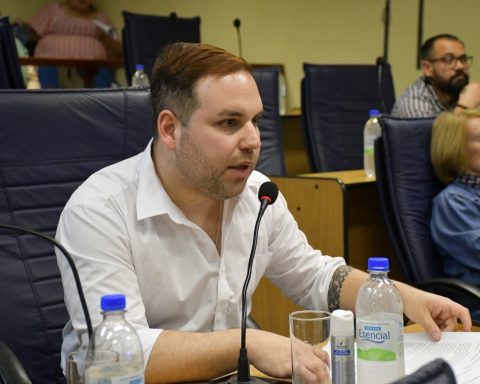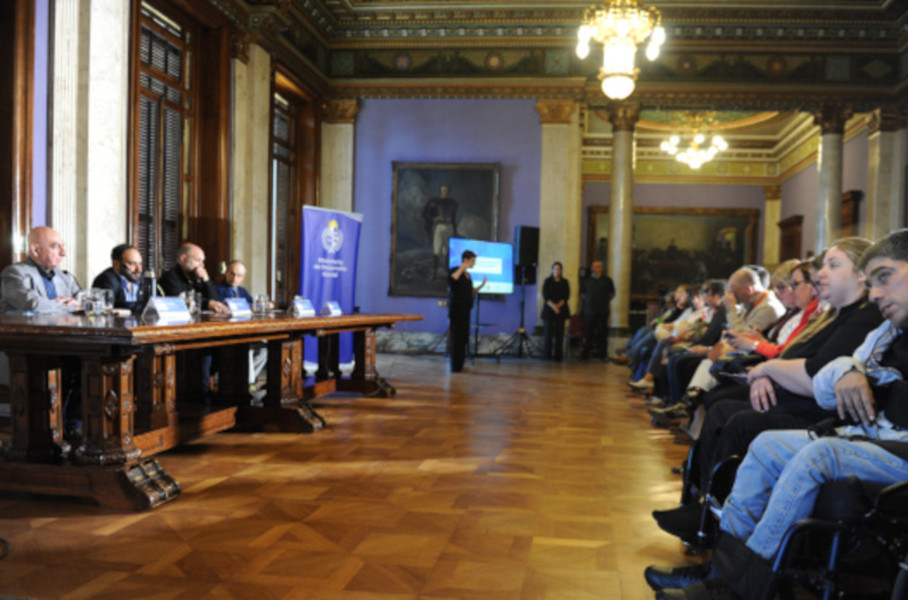
During a press conference, the Minister of Social Development, Gonzalo Civila, pointed out that the data “demonstrate once again that disability, like many other social realities, has determinants that go far beyond the visible.”
The leader highlighted that the prevalence is higher in women, in people of African descent and in inhabitants of border areas and the north of the country. “The approach has to be comprehensive,” he stressed, and highlighted the need for “a policy that takes into account how different inequalities are connected.”
The report reveals that disability affects more than 18,000 children and adolescents (9.2% of the total), more than 82,000 adults (41.5%) and almost 97,000 people over 65 years of age (49.3%).
Rivera (7.7%) and Rocha (7.4%) are the departments with the highest prevalence, while Colonia and Maldonado register the lowest (5.7%). Civila maintained that these data should promote “joint work by the entire State,” and announced that the five-year budget includes the creation of the National Disability Institute. “It is a long-standing demand from organizations linked to disabilities,” he stated.
The minister explained that the new institute will operate within Mides, but in coordination with other areas of the State. “There has to be a very direct relationship with health, education, care and employment policies,” he indicated. He also highlighted that the initiative “will focus on the participation of people with disabilities and their organizations in the construction of policy.”
For his part, the national director of Disability, Federico Lezama, reported at a press conference that the study made it possible to “verify and measure the social gaps” faced by people with disabilities. As detailed, 50% of children and adolescents with disabilities live with unsatisfied basic needs, compared to 36% of those who do not have it.
“We have an unequal Uruguay in access to rights when living with a disability,” he noted, adding that the commitment now is to develop “a strategy and a public policy to reverse that gap.”
Education and employment
In terms of education, the report shows that 7% of people with disabilities aged 25 years or older did not access primary education, compared to 3% of the population without disabilities.
46% of people with disabilities completed primary school, while only 7% completed secondary education. At the tertiary level, 11% of people with disabilities reached that level, compared to 27% of those without disabilities. Lezama warned that these educational levels later determine “the possibility of accessing a job.”
The study also shows differences in employment. Among people aged 20 to 64, the activity rate is 57% in those with disabilities and 85% in those without.
The employment rate is 49% and 79%, respectively, and unemployment amounts to 14% in the population with disabilities, compared to 8% in the population without it. Among those with a low educational level, 35% of people with disabilities have access to employment, compared to 69% of people without disabilities in the same condition.
“The data show that there are barriers to access and that it is becoming more difficult to complete educational cycles,” said Civila, while also raising the need for a cultural change in society. In this sense, he maintained that people with disabilities must stop being seen “as a needy individual who only needs help.” Along these lines, he pointed out that “we must bet on the power of people, on everything they can give, on everything they can contribute to society.”
Lezama recalled that historically there is “a relationship between poverty and disability” and explained that in many cases a family that lives with a person with a disability faces higher costs of living and difficulties maintaining income.
Civila concluded that the data in the report should serve to question the social structure. “If we have such compelling inequality data, there is obviously something in our society that is not right,” he stated. In his opinion, to achieve lasting changes it is necessary to rethink the way society is organized and place the dignity of people at the center of public policies.
UyPress – Uruguayan News Agency