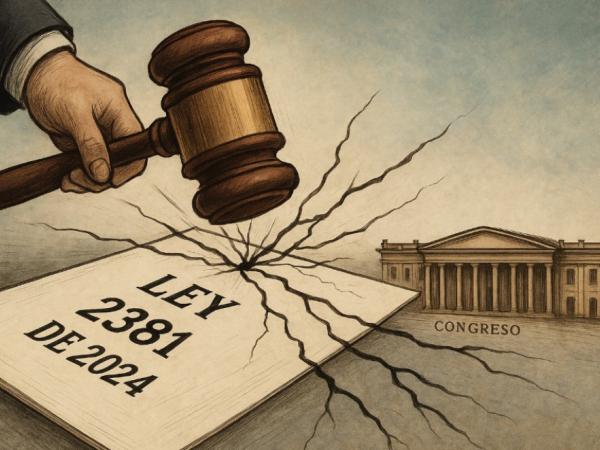
The debate on the pension reform of the Government of Gustavo Petro entered a new phase of legal tension in which, waiting for the Constitutional Court to define the fate of Law 2381 of 2024, which transformed the system of savings in a pillar model, a new resource threatens to further delay its discussion.
In the last few hours, a citizen filed a challenge against Judge Jorge Enrique Ibáñez Najar, author of the presentation that proposes overturning the norm due to alleged irregularities in its legislative process.
Check here: The US could announce a new tariff package on Colombia in the next few hours
The request, addressed to the General Secretariat of the Court, asks that Judge Ibáñez be removed from the process studying the unconstitutionality claim filed by Senator Paloma Valencia, of the Democratic Center; arguing that there are “founded causes of political bias, ideological enmity and manifest prejudice against the current National Government”, which would compromise the impartiality of the reporting magistrate.
The document is based on articles 29, 209, 228 and 230 of the Constitution, as well as Decree 2067 of 1991 and the standards of judicial impartiality recognized by the Inter-American Court of Human Rights and maintains that Ibáñez was appointed by the Council of State, which he describes as an organization with a conservative tendency, in a political context “of direct opposition to the current Government.”
Constitutional Court
Courtesy
Due to this, he warns that this circumstance “objectively compromises his independence.” in the face of decisions that affect essential policies of the Executive, such as the pension reform” and affirms that in the presentation that analyzes the constitutionality of the law, Judge Ibáñez “uses evaluative expressions and judgments of political convenience that go beyond the legal analysis” and that show “a preconceived and unfavorable position towards the social and economic purposes of the reform.”
In his opinion, the text prepared by the magistrate moves away from the technical and neutral standard expected of the Court and adopts “a political and ideological tone” that puts public trust in the high court at risk and therefore requests the Constitutional Court to admit the appeal, declare the impediment founded and separate Ibáñez from knowledge of the process, ordering the distribution of the file to another magistrate.
More information: Controversy over an article in the 2026 Budget that would allow pension funds to be moved
It also requests that the challenged magistrate be informed so that he can render his explanations within the legal term and includes the presentation prepared by Ibáñez, his identity document and publications that, according to him, would evidence the political position of the magistrate.
Challenges in queue
It should be noted that with that of Ibañez, the Constitutional Court currently has two challenges to resolve, since in addition, in recent days, a similar appeal was filed against Héctor Carvajal, who was President Petro’s lawyer and a contractor for Colpensiones, the entity that would benefit the most from the entry into force of the new system. In this case, it was Senator Paloma Valencia who challenged Judge Carvajal, alleging that he “conceived about the constitutionality of the reform” before reaching the high court.

Jorge Enrique Ibáñez, new president of the Constitutional Court.
Courtesy – API
In the case of Ibáñez, the scenario is reversed, since while the Government considers that his presentation is loaded with political biases, sectors of the opposition see him as the strongest voice in defense of strict constitutional control over the processing of laws. Its 83-page document concludes that during the extraordinary sessions of the House of Representatives on June 27 and 28, 2025, the procedural defects detected in the first review were not corrected.
For this reason, the magistrate proposes to declare the entire law unenforceable and alleges that the call for extraordinary sessions was made with just five hours’ notice, when Law 5 of 1992 requires a minimum of three calendar days and that the decision-making quorum in the June 27 session was not met, since there were only 62 registered representatives, a sufficient number to deliberate but not to approve decisions.
Also read: Petro Government has gone into debt almost 17 times the IMF credit, warns former minister
Finally, he points out that the Chamber voted not to continue the debate on the articles, which, in his opinion, constituted deliberate disobedience. to Auto 841, which had ordered the discussion to be resumed to correct the errors detected by the Court.
If this proposal succeeds, the pension reform would be annulled in its entirety, forcing the Government to present a new bill and restart the process from scratch, a possibility that has generated alarm in the Executive, where they consider that an adverse ruling would put at risk the objective of guaranteeing a minimum floor of protection for older adults and expanding Colpensiones coverage.

Colombia should begin the debate on the pension age as soon as possible, according to experts.
Image from ChatGPT
A starting line debate
Despite all the tension, it must be made clear that the Constitutional Court has not yet begun deliberation and that the challenge against Ibáñez must be resolved before the case can be discussed in the Plenary Chamber. If the judge is removed, the file will be reassigned to a new rapporteur, which would further delay the substantive decision. Meanwhile, the resolution of the incident against Judge Carvajal is also awaited, which leaves the Court in an unprecedented procedural labyrinth.
It is worth remembering that a few weeks ago, the Court defined the impediment presented by Carlos Camargo, the new magistrate who recently joined the court. In his initial statement, Camargo warned that during the congressional vote in which he was elected he received the support of Senator Paloma Valencia, who is leading the annulment lawsuit against the pension reform. However, the Court concluded that there were no grounds for impediment and denied the appeal, considering that this support did not compromise its independence.
You may be interested in: Horizontal property and coexistence: this is how the noise law works in the country
Sources from the high court who spoke with Portafolio said that it is not ruled out that, given the political polarization of the case, a third way may arise, which would be to declare the partial unenforceability of the law, preserving some articles and correcting the aspects. observed procedures. However, they made it clear that the atmosphere is far from calming down.
Thus, the degree of political and legal pressure surrounding the high court in a decisive year for the Government’s economic agenda remains on the table and that in this context, the recusal against Judge Ibáñez not only widens the controversy, but also delays the possibility of a final decision on one of the most ambitious projects of the Petro administration.
DANIEL HERNÁNDEZ NARANJO
Portfolio Journalist