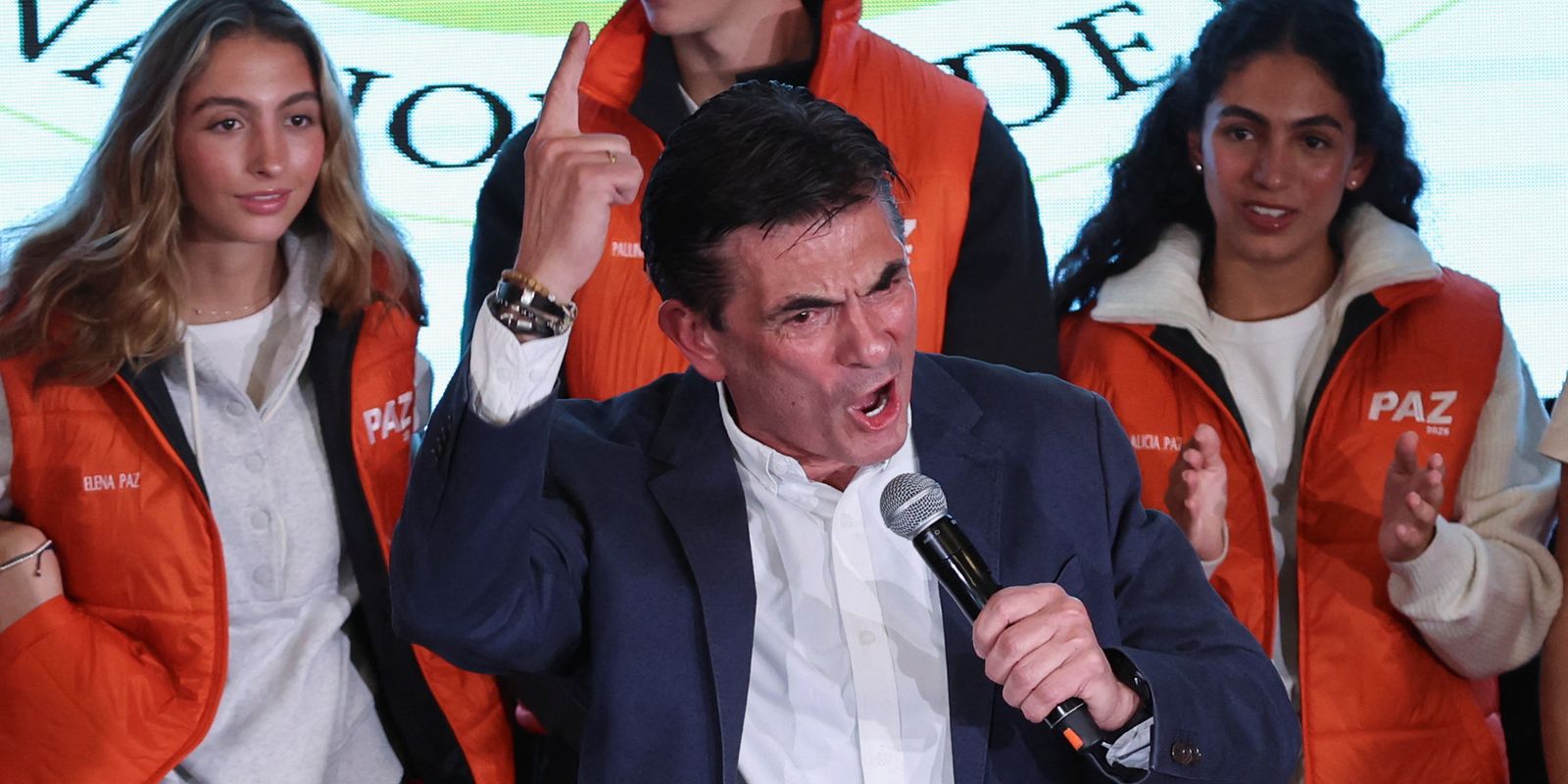
Center-right senator Rodrigo Paz won the second round of elections in Bolivia this Sunday (19), defeating his conservative rival Jorge “Tuto” Quiroga and marking the end of almost two decades of Movement to Socialism (MAS) governments.
Paz, senator from the Christian Democratic Party (PDC), obtained 54.5% of the votes, ahead of Quiroga’s 45.5%, with 97% of the ballots counted by the Bolivian electoral court. However, the PDC was unable to obtain a legislative majority, which will force the new president to establish alliances to govern.
The new president will take office on November 8th.
“We need to open Bolivia to the world,” Paz said during his victory speech in La Paz, after Quiroga quickly conceded defeat.
Rodrigo Paz Pereira was born in 1967 in the Spanish city of Santiago de Compostela, thousands of kilometers from the Altiplano, when his family was in exile during the military dictatorships in Bolivia. He was 12 years old when his father was the only survivor of a suspected air raid.
Paz is the son of former Bolivian president Jaime Paz Zamora (1989-1993), who governed under the auspices of dictator Hugo Banzer after the so-called “Patriotic Agreement”. This agreement allowed Paz Zamora to receive the support of Congress and be sworn in as president.
During his term, he approved the privatization law and defended the commercial and medicinal use of coca. He was accused of corruption and links to drug trafficking, but was never convicted. Part of his political legacy was transferred to his son, Rodrigo Paz, now elected president of Bolivia.
Change
The victory of the 58-year-old senator, father of four, marks a political shift for the South American country, governed almost uninterruptedly by the Movement to Socialism (MAS) since 2006, which previously had the support of the country’s indigenous majority.
Paz’s apparently moderate platform, which promises to maintain social programs and promote private sector growth, appears to have resonated with left-wing voters disillusioned with the MAS, founded by Evo Morales, but wary of Quiroga’s austerity measures.
Both candidates campaigned on reversing elements of the MAS-era state model, but differed on the drastic nature of the measures.
Paz advocated gradual reform, including tax incentives for small businesses and regional fiscal autonomy, while Quiroga proposed drastic cuts and an International Monetary Fund (IMF) bailout.
“We are heading towards a new stage of Bolivian democracy in the 21st century,” Paz said in an interview with Reuters two days before the elections on his family’s farm in the gas-producing region of Tarija, in the south of the country.
“We will try to build an economy for the people”, he said, in which “the State is not the central axis”.
Like his opponent, Paz promised to improve diplomatic relations with Western countries, including the United States, after years of Bolivia’s alignment with Russia and China.
In late September, he revealed plans for a $1.5 billion economic cooperation agreement with U.S. officials to secure fuel supplies.
Movements
Paz’s electoral support in the first round was boosted by his running mate, Edman Lara, a former police officer known for his viral TikTok videos denouncing corruption.
Lara was dismissed from the National Police in 2024 due to a disciplinary process, but his populist appeal helped Paz connect with younger and working-class voters.
Bolivia’s main union, the Central de Trabalhadores de Bolivia (COB), warned that it would oppose any threat to the social and economic gains it has made, stressing that the new government will need political skill to avoid the specter of street protests.
The country’s social and indigenous movements are preparing to begin a new stage of resistance in defense of social achievements and national sovereignty.
Biography
In 2002, Rodrigo Paz joined Congress as a representative of the Tarija department, but between 2010 and 2020, he returned to the city of the same name, where he served first as a councilor and then as mayor. Several projects he promoted in that city were questioned due to alleged overpricing and failure to execute.
For the past five years, Bolivia’s new president has served as a national senator for the Citizen Community alliance, led by former president Carlos Mesa. According to expert Hugo Moldiz, Paz’s political profile was built from that legislative house, where he maintained critical but constructive interventions in relation to Luis Arce’s government.
In 2019, Rodrigo Paz joined the Coordination for the Defense of Democracy, which played a fundamental role in Bolivia’s political crisis. The group actively pushed for a second electoral round, arguing the existence of alleged fraud. The accusations presented by the Coordination were fundamental for the subsequent annulment of the general elections and the subsequent coup that overthrew President Evo Morales.
* With information from Reuters and Telesur. Reproduction of this content is prohibited.