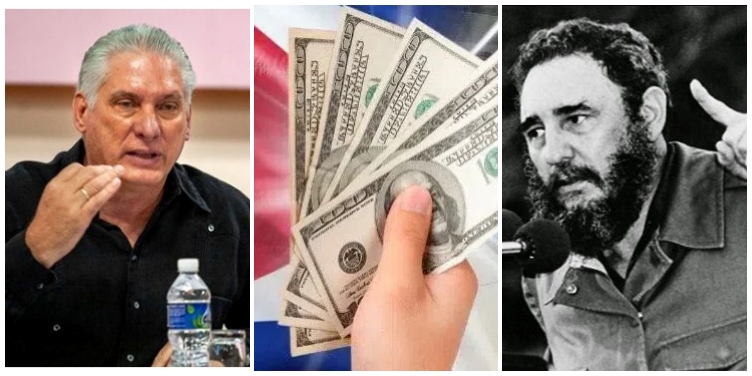
The origins of the debt date back more than 50 years, when dictator Fidel Castro was in power.
LIMA, Peru – A newspaper report The Nation revealed this Sunday the million-dollar sum that Cuba owes Argentina as a result of loans to the Castro regime that are more than 50 years old.
The Island is Argentina’s main debtor, highlights the local media. The origins of the debt date back to August 24, 1973, when the dictator Fidel Castro was in power and received a line of credit for 600 million dollars from Buenos Aires to finance the sale of tractors, agricultural machinery, trucks and vehicles.
“The intention was to export Fiat 125, Renault 12, Ford Falcon, Ami 8 and Peugeot 404,” the note states.
Specifically, Cuba currently owes the South American country 1,278.75 million dollars. However, the non-payments of the Havana regime over the decades have increased the interest, exceeding the principal capital itself.
According to data from the Investment and Foreign Trade Bank (BICE) consulted by The NationUntil last August, the interest on the debt recorded was 1,722.06 million dollars.
“This last figure is also increasing: between March of last year and the latest available data for 2025, it rose exactly 113.28 million,” the publication highlights.
Cuba: notorious debtor to the regime’s management
Beyond Argentina, the Castro dictatorship has turned Cuba into a notable debtor to several countries, especially in the Eurasian region.
At the beginning of this month of October, the Government of Spain approved in the Council of Ministers this Tuesday an agreement for the “treatment” of the debt that Cuba still maintains with the Spanish State, which involves the restructuring of 194 million euros, 142 million Canadian dollars and 811,000 US dollars.
In an opinion article published in The Objectivejournalist Pablo Cambronero assures that “beyond the rhetoric used with the term restructuring,” behind the agreement “there seems to be a forgiveness of the debt of a declared dictatorship.”
The measure is part of a sequence of debt relief instruments activated by Madrid in favor of Havana during 2025. On July 4, transcended the launch of a Debt Conversion Program with Cuba that will allow up to 375 million euros of bilateral debt to be transformed into investment projects, signed in Seville by the Minister of Economy, Commerce and Business, Carlos Body.
According to an official note released by La Moncloathe funds will be directed to “key sectors such as energy, water or food security, among others”, through “innovative debt relief instruments that are oriented towards concrete results and effective cooperation.” The same communication framed the announcement at the 4th International Conference on Financing for Development and linked the initiative to the “Global Hub for the conversion of debt into investments for development.”
On the other hand, in a new episode of geopolitical opportunism that characterizes the relationship between Russia and the Cuban regime, the deputy prime minister Russian Dmitry Chernyshenko announced on May 7 that Moscow would invest more than 1 billion dollars in projects in Cuba.
The statement was made after official talks between both governments held in the Kremlin, headed by Vladimir Putin and Miguel Díaz-Canel, in what the Cuban propaganda apparatus describes as a “strategic alliance” but which, in practice, consolidates the economic subordination of Havana to foreign interests.
The new financial commitment is part of the so-called “Plan 2030”, signed in 2023, which contemplates Russian investments in critical sectors such as electricity, agriculture and public lighting.
But behind the solidarity discourse, what is consolidated is a deeply unequal relationship: while Moscow seeks to strengthen its international influence and gain allies in a context of global isolation after the invasion of Ukraine, the Cuban regime clings to any source of financing that allows it to remain in power, without considering the real impact on the lives of its citizens.
Barely a month after the million-dollar Russian investment became known, last June, the Cuban Government admitted the existence of debts with Russian companies and assured its intention to settle them in the future, “when the necessary conditions are created.”
This was stated by the Minister of Foreign Trade and Foreign Investment, Oscar Pérez-Oliva Fraga, during the Russia-Cuba business dialogue held at the Saint Petersburg International Economic Forum (SPIEF-2025), as reported by the Russian state agency RIA Novosti.
“Cuba confirms the existence of liabilities with Russian companies and declares its willingness to fulfill its financial commitments,” said the Cuban minister. However, he warned that to do so requires “strengthening the national economy and guaranteeing the necessary resources,” which makes compliance with obligations subject to the country’s future economic recovery.