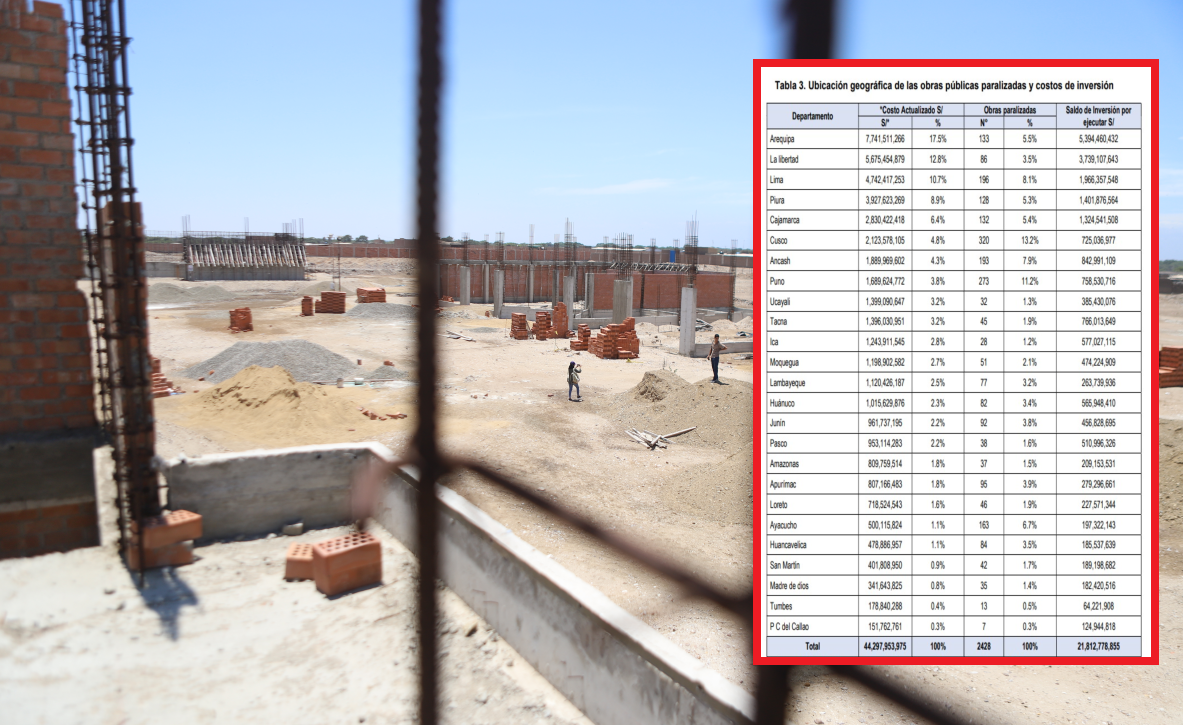
Roads, schools, hospitals and drinking water and sewage systems that have been left in iron, bricks, cement and a lot of dust. All of these are projects that were announced with great fanfare and that, currently, are detained due to negligence or irregularities of the national government, regional governments and municipalities. It is a problem that has been going on every year and has been getting even worse to the detriment of millions of Peruvians.
As of June of this year, throughout the country There are 2,428 paralyzed public works because they have not had any type of progress for six months or more, according to a latest technical report from the Comptroller of the Republic.
YOU CAN SEE: Rafael López Aliaga resigned as mayor of Lima without fulfilling 25 promises of his municipal government plan
The worrying thing is that The State has already spent close to 22.5 billion soles and needs an additional 21,812 million so that all these projects can be completed. This is because the updated cost of the investments totals 44,297 million soles.
The largest number of paralyzed works is in charge of the provincial and district municipalities (1,732). They are followed by the national government (369) and regional governments (327). In investment amounts, the list would be flipped. The regional governments have projects without progress for 17,339 million soles, followed by the national government, with 17,252 million and the municipalities, with 9,706 million. This happens because mayors formulate smaller projects.
Likewise, the regions where the stopped projects are concentrated are Cusco (320), Puno (273), Lima (196), Áncash (193) and Ayacucho (163), reveals the control report (see infographic).
This is the hot potato that the authorities will leave of the Executive in July 2026; as well as the regional governors and mayors in January 2027.
“There is nothing worse than an investment made by the State that is paralyzed. “It would have been better not to execute,” responds the executive vice president of the Peruvian Chamber of Construction (Capeco), Guido Valdivia, who adds that in a single year the cost of all stopped public works grew by 25%, going from 36,000 million soles, in June 2024, to 44,000 million, in June 2025. “It is a real problem. And it is not only because of the new works that increase the number but also because of the updating of those that are not progressing and are deteriorating,” he explains.
serious deficiencies
But why do these problems occur? According to the Comptroller’s report, the projects are paralyzed by iContract breaches (610), lack of financial resources and liquidity (516), deficiencies in the technical file (249), discrepancies, controversies and arbitrations (222), abandonment of the work (193), among other causes.
Former Comptroller Nelson Shack responds that the paralysis of public works “is the final symptom of the problem of public investment in Peru, since the underlying cause is the low execution and management capacity of the entities“Former comptroller Fuad Khoury adds that It is also because of corruption which appears due to the low level of integrity of the officials.
And while that happens, the portfolio of projects continues to increase without those that are being executed being concluded. That is another problem, says the Comptroller’s Office official, Luis Portugal.
“There is a saturation of the system because in Peru There are 131,000 investments with a construction component of infrastructure in progress, but the State has the capacity for 45,000. It is overloaded almost three times its capacity,” he mentions.
Despite this, he explains, the authorities want to execute these investments, but they are only moving forward with some because a new management comes in and, due to prioritization, they paralyze them due to resources and begin another work that was a campaign promise. “This has an impact on the saturation of the system,” says Portugal.
In the case of local governments, he states that the problems arise because there is a high turnover of officials, with each change in management. “The most complicated thing is that, according to Servir, only 2% have optimal capacity to execute investments,” he says.
YOU CAN SEE: Public universities demand that President José Jerí not normalize more deaths or violence in protests
Meanwhile, according to sectors, Portugal responds that there are more paralyzed works related to transportation and communications, housing and sanitation, and agriculture. There are many roads that are not completed; fiber optics that are very expensive, drinking water systems and schools with poor technical records, and an irrigation system with conflicts.
But that’s not all. The largest number of stopped projects corresponds to the contract execution modality (1,208), followed by direct administration (1,185), details the latest report from the Comptroller’s Office.
“There is a vicious circle in paralyzed works. A bad technical file is made that must be corrected later, but that implies a new deadline and an increase in the budget. The officials get scared, they don’t accept and, in the end, the project stops and goes to arbitration,” says Capeco spokesperson Guido Valdivia.
Due to this, he proposes that projects be regulated by direct administration, which no one monitors because they are emergencies. “They are smaller amounts, but a commission made up of professional associations can inspect them. Banks and insurance companies, through Asbanc and Apeseg, must also present a virtual platform so that the authorities can review the companies’ bonds.in order to know if they have liquidity. Furthermore, new investments should not be approved if the executors have paralyzed works.”
Comptroller Actions
Comptroller César Aguilar has indicated that, from August 2024 to September 2025, 382 public works have been reactivated for an amount of S/5.1 billion. Of these, the Comptroller’s Office intervened in 221 through the new control service, which is equivalent to 58% of the reactivated total. “This is a strategy of technical and preventive support, institutional articulation and management commitments between the actors involved.”
The reactivated projects are concentrated in key sectors, such as transportation, housing, sanitation, health and education. “The aim is to avoid the deterioration of structures, the loss of public resources and the risk of new stoppages compromising the completion of projects,” he said.
Claim from municipalities
The Network of Urban and Rural Municipalities of Peru (Remurpe) has been denouncing the paralysis of more than 1,200 works carried out two years ago due to the lack of adequate financing by the Government.
Héctor Lolo Antonio, mayor of Tayacaja and vice president of Remurpe, pointed out that the Government, through the Budget Law and the Supplementary Credit Law, has allocated only between 15% and 30% of the financing necessary to complete the works, which cover critical sectors, such as education, health, road infrastructure, water and sanitation.
“There is a fight between the MEF and the ministries. In the MEF they tell us to go to the Housing and Transportation sectors; and we go there and they tell us to go to the MEF. We don’t know what to do. We have had 200 protests and that is going to explode because the residents of our towns will come to Lima,” he said.