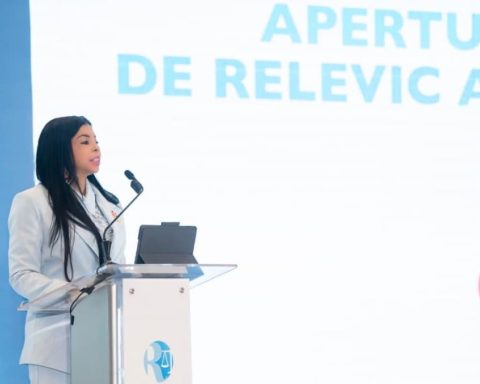
The president of the Executive Committee of the Inter-American Press Association (SIP), Gabriela Vivanco, said this Saturday, on the third day of the 81st General Assembly of the organization in Punta Canathat the American continent lives “under the shadow of a democratic decline marked by polarization and the advance of authoritarianism.”
In addition, Vivanco warned of the growth of “disinformation and systematic attack against media and journalists” in his presentation of the Committee’s report within the framework of the Board of Directors of the SIP.
Likewise, the president of the Committee stated that the SIP “has risen to the challenge” and has “documented threats in a thorough and timely manner with early warnings and missions to countries in crisis.”
In this sense, the SIP This year he carried out missions to Guatemala, Panama, Costa Rica and Peru.
“The missions of freedom of the press “They are a powerful example of the organization’s commitment and the solidarity of its members. Each visit provides direct support and a clear voice in the face of local authorities and risks to demand respect for the minimum guarantees that allow journalists and media to operate with freedom and independence,” commented Vivanco.
Cases against journalists
On the other hand, in her speech at the Board, the president Press Freedom Commission and Information of the SIPMartha Ramos, pointed out that the organization has followed up on six emblematic cases of crimes against journalists.
- These are the deaths of the Colombian journalist Guillermo Cano, murdered in Bogotá in 1986; Julio Daniel Chaparro and Jorge Enrique Torresjournalists murdered on April 24, 1991 in the municipality of Segovia, in Antioquía (Colombia).
Also, the SIP continued its surveillance of the murder of Mexican journalist Francisco Ortiz Franco on June 22, 2004 in Tijuana (Mexico) and of his compatriot Alfredo Jiménez Mota, who disappeared on Saturday, April 2, 2005 in Mexico.
Finally, Ramos also commented on the case of the Guatemalan journalist Irma Flaquer Azurdiawho disappeared on October 16, 1980.
“Almost 40 years after the disappearance of the journalist (Flaquer Azurdia) the claim continues to be to clarify the facts, identify those responsible and guarantee justice,” said Ramos.