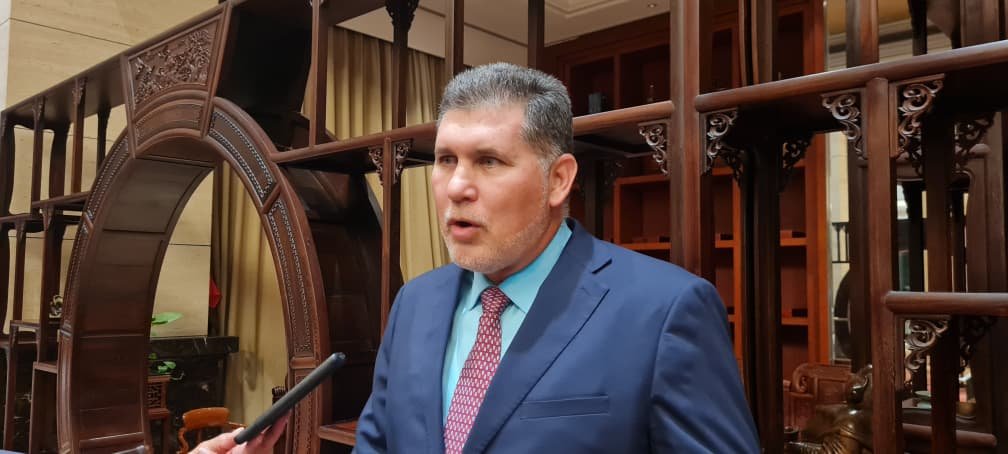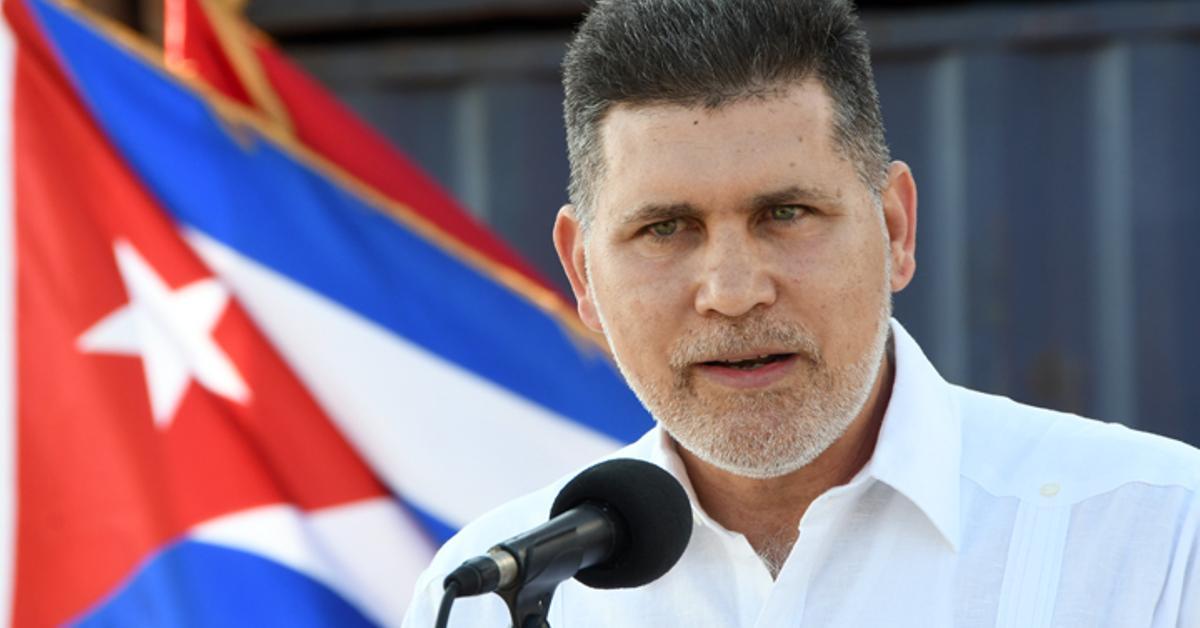
Havana/The Cuban Government announced this Friday the promotion of Oscar Pérez-Oliva Fraga to the position of deputy prime minister of the Republic. The appointment, approved by the Council of State at the proposal of the president and with the approval of the Political Bureau, reinforces the trend that the highest responsibilities in the country are concentrated in figures closely linked to political and economic power.
At 54 years old, Pérez-Oliva will also maintain his position as Minister of Foreign Trade and Foreign Investment, one of the most sensitive portfolios of the national economy in the midst of the deepest economic crisis in decades. The appointment was announced in prime time on National Television News.
At the top of the Cuban regime there is no room for surprises or outsiders. Although the official media has omitted any reference to his family ties, Pérez-Oliva is the grandnephew of Fidel and Raúl Castro, son of the biologist Mirsa Fraga Castro and grandson of Ángela Castro, sister of the founders of the Revolution. He is also the nephew of José Antonio Fraga Castro, who presided over the powerful company Labiofam until 2014.
Their surnames, therefore, are no strangers to high power structures. The new generation of technocrats, to which Pérez-Oliva belongs, moves within a closed elite that combines family legacy, party discipline and absence of public questioning of the prevailing model.
Now he adds the responsibility of deputy prime minister, replacing Ricardo Cabrisas Ruiz, who died in mid-September.
Graduated in electronics engineering, Pérez-Oliva has spent his entire career within state structures. He directed the Maquimport Company – one of the key state importers –, later assumed the Directorate of Business Evaluation in the Special Development Zone of Mariel and was later promoted to vice minister and first vice minister in the portfolio that he has directed since May 2024. Now, just over a year later, he adds the responsibility of deputy prime minister, replacing Ricardo Cabrisas Ruiz, died in mid-September at 88 years of age.
The area managed by Pérez-Oliva is strategic. In the midst of the productive collapse and the collapse of state income, the Government has relied on foreign capital as a lifeline. Your portfolio is in charge of attracting investments, managing contracts and, above all, controlling the gateway of foreign currency to a system that desperately needs it. In fact, it is a position with more real power than many social ministries.
A no minor detail distinguishes Pérez-Oliva from the majority of his colleagues in the Council of Ministers: he is not a deputy to the National Assembly. In a country where legislative “elections” are closed processes controlled by the Party’s own structure, this condition shows that its power does not come from any popular mandate – although symbolic – but directly from the party leadership.
If this situation continues until the “elections” of 2028, Pérez-Oliva could become one of the most visible faces of the Executive without having passed through Parliament. Nor would it be an isolated case, since several ministers and senior officials have held key positions without being deputies, confirming the practical irrelevance of the legislative body in real decision-making. Although being a parliamentarian would be essential for him to occupy the position of President of the Republic.
His technical and reserved profile fits perfectly into the logic of “continuity”
Pérez-Oliva’s promotion does not point to a change of course. The Government maintains the strategy of recycling middle managers who have grown within state structures, without incorporating external voices or figures with any level of autonomy. His technical and reserved profile fits perfectly into the logic of “continuity” that has dominated the political scene since Miguel Díaz-Canel Bermúdez assumed the presidency.
During his ministerial management, Pérez-Oliva has not presented any proposal for significant opening or structural reforms. He has defended the policy of attracting foreign capital under strict state control and has reiterated the official discourse that blames the US embargo for internal economic problems, avoiding any mention of planning errors and the lack of legal guarantees for investors.
Looking ahead to the renovations planned for 2028, the leadership is betting on teams that can guarantee the continuity of the model without internal challenges. In this sense, Pérez-Oliva is an ideal fit: disciplined, with a family pedigree, without his own political base and with experience in a strategic economic area. A new face for an old structure that remains immovable.