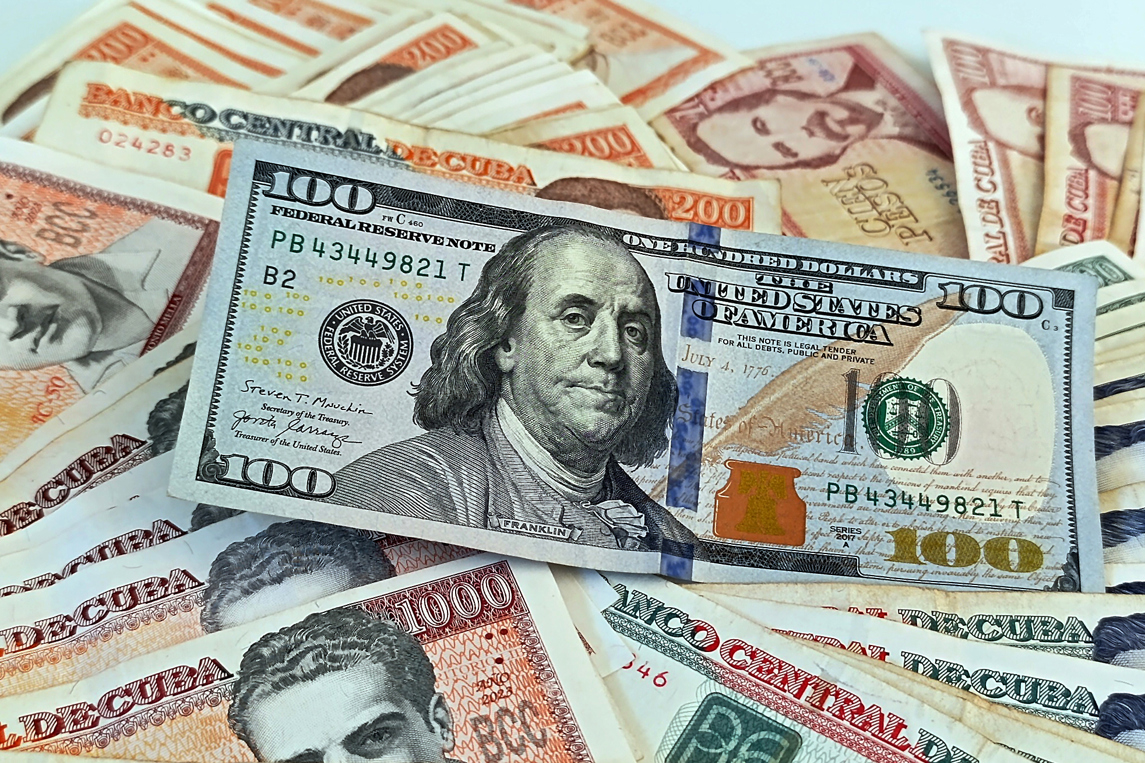
With the euro already comfortably installed above 500 pesos (CUP) in the informal market of Cuba, also the dollar points to that barrier.
At least, this is what would happen in “an extreme scenario” of currency behavior, in the opinion of analysts. In a moderate one, the US currency would reach 473 pesos, according to the forecasts by economist Pavel Vidal, a student of finance on the island.
We are no longer far from that scenario, after the value of the dollar reached 465 CUP this Thursday and established a new record in the Cuban informal market, according to the independent media The Touchused as a reference by currency buyers and sellers.
This is a new increase in the sustained rise of this currency in the Cuban informal market. two months agohad reached 400 CUP, an unprecedented limit until then, and last week Its price was already at 450 CUP.
Meanwhile, the euro remains at the 520 pesos it reached the most recent weekend, while the MLC fell again to 200 pesos, a barrier that it had fallen below in August and which it had once again surpassed in September.
Update of informal currency market rates in Cuba
Date: 10/16/2025Image 1: Representative rate of the informal market (elTOQUE)
EUR: 520.00 CUP
USD: 465.00 CUP
MLC: 200.00 CUPThere are offers in the ranges:
EUR: from 415.00 to 545.00 CUP
USD: from 400.00 to 530.00 CUP
MLC:… pic.twitter.com/r2pYuUUtTR— The Touch (@eltoquecom) October 16, 2025
No visible changes in the short and medium term
The constant rise in the value and the euro in Cuba’s informal market – and the consequent depreciation of the peso – occurs in the midst of a worsening of the economic crisis on the island and, in the opinion of independent experts, no changes are in sight in the short and medium term.
The economic recession, high inflation and the fall in domestic production have accentuated a scenario of economic uncertainty and have triggered the demand for foreign currency, which translates into an increase in its price outside the official rate.
Added to this is the increase in dollarization in the country, both in state services and establishments—to the detriment of those increasingly in national currency and the MLC—and in informal and private channels.
The excess of currency, the significant decline in tourism and its income, and the growing competition between economic actors for the foreign currency necessary to sustain their offers, are also factors that drive the upward trend of the dollar and the euro in Cuba.
In this difficult context, Vidal—a professor at the Pontificia Universidad Javeriana in Cali, Colombia and who leads the Observatory of Currencies and Finance of Cuba (OMFi)—foresees an increasingly volatile informal exchange market, which responds not only to traditional variables but also to appreciations about the current economic direction and speculative purchases.
Thus, the dollar and the euro must continue to increase their prices in Cuba, even though the new exchange regime has not yet come into effect. confirmed by Prime Minister Manuel Marrero last July before the National Assembly and announced for the second half of the year.