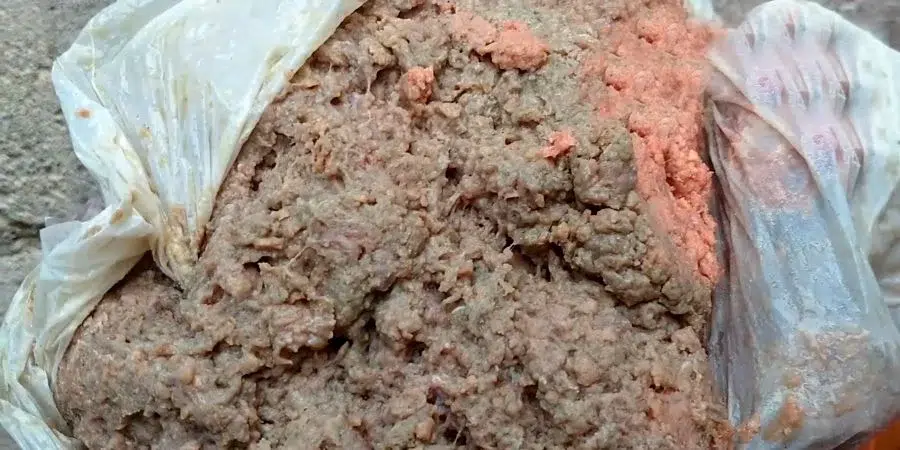
The poor condition of the meat sold through the ration book is a problem that recurs regularly.
HOLGUÍN, Cuba. – “The children’s mince that arrived at the booth was sold rotten. People didn’t want to buy it, and with good reason. No one would eat that because it was spoiled. If they know it’s no good, they can’t sell it,” complains Holguin native Marlene Batista, mother of a five-year-old girl.
The poor condition of the meat sold through the ration book is a problem that recurs regularly. The experience is a domestic drama with direct consequences at the family table.
Another Holguin native, Yanet Cruz Marrero, relates her frustration this way: “I was happy when they told me that mincemeat for children had arrived, but when I went to buy it there was a bad smell in the booth and I didn’t even queue. I can’t give spoiled food to my son. I gave him a plate of white rice with a fried egg, and thanking God that the egg and oil for frying appeared.”
“When I found out that the picadillo was no good,” says Beatriz González, “I thought about my grandchildren. God cannot forgive that.”
The consumption of spoiled foods is a direct threat to public health, especially children’s health. Ernesto Cedeño gives his opinion on the health risks of this situation: “If that mincemeat is consumed in poor condition, an outbreak of diarrhea can form. And the worst thing is that there are many people who cooked it and ate it spoiled, because they had nothing else to eat.”
This warning is not hypothetical. There is even a precedent in this northeastern province: In April 2012, a mass poisoning left more than 80 children and workers at the Holguín Airport Military Community hospitalized. They had eaten the hash that was served in that center. Many of the children were reported to be in serious condition and most suffered vomiting, diarrhea and high fever.
The search for those responsible becomes a labyrinth of excuses and crossed accusations. The cause of the problem is attributed to infrastructure deficiencies, aggravated by the energy crisis that is plaguing the country. Ricardo, a locker who asked to identify himself only by his first name, details a chain of logistical failures that seem inevitable.
“The problem is that there is no power [eléctrica] to keep the meat frozen in the box. Also, most of the boxes do not have refrigerators to preserve the meat and, to that, we must add the defects of the refrigerators of the distribution trucks. In all that hustle and bustle of distributing it, with the heat and the time lost along the way, the mince spoils.”
Julián Domínguez shares that vision and regrets the waste of such a necessary product: “I understand that the problem is the power that goes out all the time; there is no refrigeration anywhere. The butcher shops don’t even have refrigerators that can be used.”
However, other Holguín residents rule out that the cause is only the lack of refrigeration at the sales points or booths. Ramón Santiesteban suspects that the problem is in the supply chain: “If in the morning they take out the fresh minced meat from the meat, it cannot be that at noon it is already rotten,” he reasons. “That had never happened here. This time, they took it out rotten from the meat [la empresa cárnica de la provincia]”.
“Here the blame is like a hot iron that no one wants to grab. They say it’s because of the blackout, that if the truck that looks like an oven with wheels… What’s wrong! The cold chain here was broken a while ago, if it ever existed. But for me, it’s that that meat is already coming out rotten from the Meat Combine,” says Carlos Batista Vega.
In the midst of the debate, the warehouse employee, known as a locker, is on the front lines, facing the wrath of consumers. “They know that that meat stinks, that it is rotten, and yet they sell it,” says Jorge Luis Marrero.
But not everyone sees the locker as the culprit. José Miguel Fernández believes that the worker is one more victim of a dysfunctional mechanism.
“The locker is the last link in the chain, the one that shows its face and receives the insults. They tell it: ‘This is what it is, send it away’. If you refuse, they look for a bigger problem. Here the big problem is in the people who plan and distribute without caring about the quality of the hash. For them, we are numbers to report, not people with children to feed.”
Similar incidents have been reported in other places in Cuba. In July 2020, Emma Gronlier Blanco, a resident of Marianao, Havana, denounced the sale of soy mince in poor condition. “I can’t eat this. Tell me where I have to go with this hash.” [a quejarme] because I am the mother of a family and I have two little girls [que alimentar]”.
In March 2021, in Camagüey, Lili Morales showed a similar product and expressed his indignation: “Look, people of Cuba. Look, government that fights for the people and by the people: that is the hash, the meat [al] that they raised the price. What is that, gentlemen? “How disgusting!”
According to the NGO Food Monitor Program“During the summer of 2025, Cubans experienced one of the toughest periods in recent years, marked by the collapse of basic services, extreme food shortages, and fear of protesting.”
Desperation has led to extreme survival strategies, such as hunting wild birds, like the bee horn (Tyrannus dominicensis) in Eastern Cuba, where their meat is being sold in the informal market for 400 pesos per pound, and even the consumption of domestic animals, a taboo that is broken by necessity.














