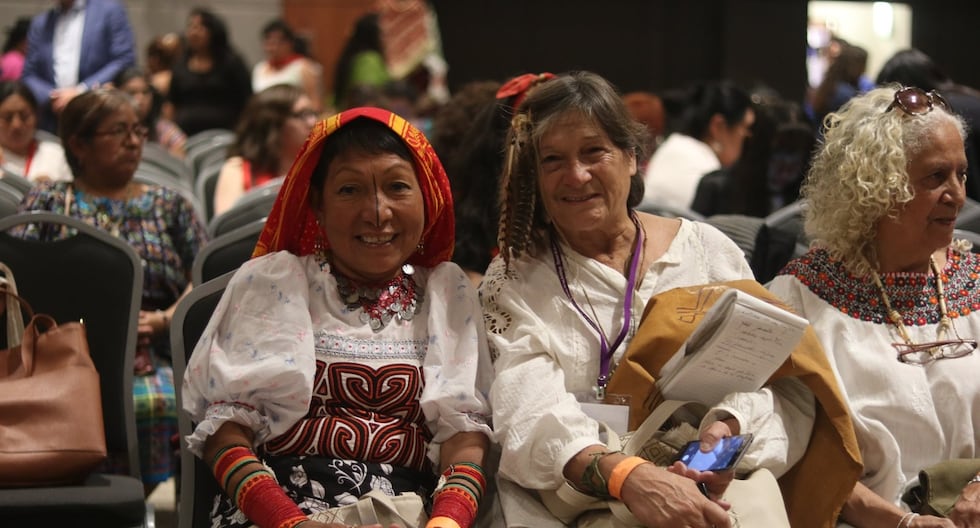
Under the motto “Feeling, thinking and making the future”, the IX Continental Meeting of Indigenous Women of the Americas It will bring together key personalities of the movement that represents the diversity of voices and the realities and priorities of indigenous women, adults, seniors, youth and children.
Organized by Chirapaq and the Continental Link of Indigenous Women of the Americas – ECMIA, which this year will celebrate 30 years of organic and autonomous life, This event will take place until October 19, at the Sheraton Lima Hotel & Convention Centeris considered the most significant for the indigenous movement on the continent.
Likewise, indigenous people from the continent who hold public and political positions will participate; United Nations agencies and organizations such as Amnesty International, who will take stock of the current situation of indigenous women in the region, make agreements and give recommendations to advance the exercise of indigenous women’s rights and define a continental agenda.
PROGRAM
The program includes seven thematic panels where political contributions, experiences and achievements will be shared to encourage reflection and dialogue.
18 working groups will also be developed to build proposals based on a deep and participatory analysis on specific topics.
The panels will address topics as diverse as: Indigenous women and youth in the contexts of systemic crisis, dispossession and multiple violence: resistance, political agendas and transformative proposals; Rights of indigenous peoples, women, youth and children. Advances, setbacks and challenges.

There is also political participation of indigenous women and youth: strategies for advocacy and the transformation of decision-making spaces; Access to financing for indigenous women and youth. Challenges and opportunities; Impact of development agendas on indigenous peoples, women, youth and children; Indigenous youth and girls: Efforts to exercise rights and Construction of the indigenous women and youth movement.
INAUGURATION WITH SPIRITUALITY CEREMONY
The opening of the IX Meeting will take place on Thursday, October 16 at 5.30 pm. Tarcila Rivera Zea, Quechua-Chanka, president of CHIRAPAQ Center for Indigenous Cultures of Peru, Continental Coordination of ECMIA, will welcome the delegations and guests who will be dressed in their beautiful and colorful traditional dresses and clothing that identifies them.

The event will begin with a Spirituality Ceremony that will feature the active participation of Caleen Sisk-Franco, spiritual leader and chief of the Winnemem Wintu tribe, from northern California, United States; Rosalina Tuyuc Velásquez, indigenous politician and activist, Maya Kaqchikel, from Guatemala, who in 1994 received the National Order of the Legion of Honor of France, a decoration that was awarded to her for the promotion of human rights and her bravery in the defense of indigenous communities and in 2012 she obtained the Niwano Peace Prize in Japan, which highlighted her commitment to reconciliation and the construction of peace in Guatemala.
Also participating will be the Peruvian leader of the Aháninka people, Nelly Marcos Manrique and
Yessica Sánchez Comanti, ambassador of Asháninka culture, who will perform a harmonization song accompanied by the telluric sound of Waqrapuku, a traditional Ayacucho.

Sofía Painequeo, singer-songwriter and leader of the Mapuche people, Chile, will fill us with her voice and the sounds of the Kultrún, ceremonial drum and trompe, opening the way to the IX Continental Encounter.
PERMANENT PARALLEL ACTIVITIES
Starting on Friday the 17th and throughout all the days of the Meeting, you can visit the Mezzanine of the Sheraton Hotel from 10:00 am to 8:00 pm, the Fair for exhibition-sale and exchange of arts of indigenous peoples of the Americas with the exhibition of textiles, ceramics, props, among others.
The Knowledge Fair will also share publications and materials produced by indigenous and allied organizations (studies, primers, manuals and guides), the Photographic Exhibition on the trajectory of the indigenous women’s movement and the Videowall with the projection of videos that cover 30 years of history, struggles and achievements for the rights of indigenous women.