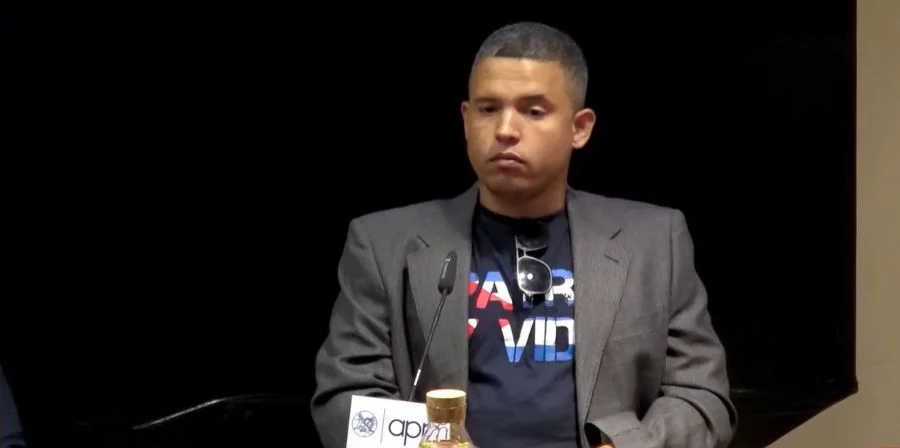
Luis Robles Elizástigui and José Daniel Ferrer met virtually at a press conference this Wednesday.
MIAMI, United States. – Activist Luis Robles Elizástigui and opposition leader José Daniel Ferrer, both former Cuban political prisoners forced into exile, denounced the repression, torture and cruel treatment in the island’s prisons during a press conference held this Wednesday in Madrid, Spain.
Robles recounted the humiliations suffered during four and a half years of closed prison and Ferrer, for his part, described in detail methods of punishment, forced feeding and humiliations to which, he said, he was subjected in confinement. The leader of the Patriotic Union of Cuba (UNPACU) also explained that he left Cuba to reorganize the democratic struggle from exile with the intention of returning without asking the regime for permission.
Luis Robles Elizástigui: “They made me live a nightmare”
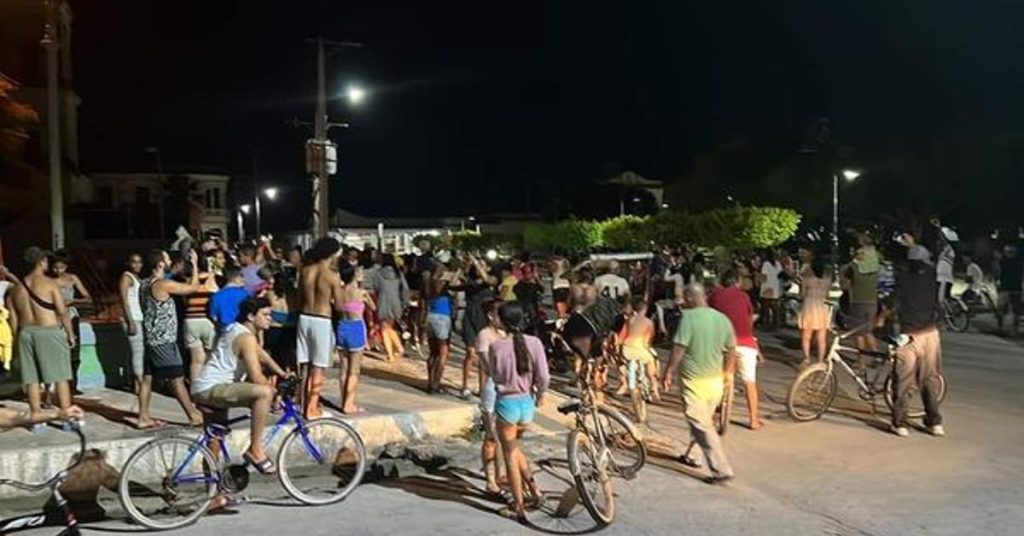
Robles Elizástigui introduced himself as “a young man who, without being linked to anything political, decided one day to express what he felt as a Cuban.” “I decided to demonstrate peacefully in the streets of Havana, demanding first of all freedom for the people,” he said. He then added that in his peaceful protest, for which he was sentenced to five years in prison, he asked for the end of the repression against dissidents and the release of the protesting rapper. Denis Solis.
Robles Elizástigui, known as “the young man with the banner,” said that, in prison, he was “a victim of rape, repression, persecution, countless punishments, and lack of medical care.” He also assured that, thanks to the complaints spread by his mother, Yindra Elizástigui Jardinesand through himself, his situation was known: “They really made me live a nightmare, as if I were one of the biggest terrorists in the country.”
The activist insisted that his protest sought to show that in Cuba “just the fact of expressing a different opinion and generating a certain amount of controversy among the people is enough for the dictatorship to consider you an enemy.”
At another time, the young man addressed the Cuban people and expressed that the situation on the Island was going to continue as long as there was silence. “Silence makes you complicit in what was done wrong,” he said. Likewise, he explained that he made the decision to protest because he did not want to “continue being complicit in what was wrongly done.”
Robles Elizástigui described the conditions of his confinement: “In prison they put me in a punishment cell without having done anything, just to punish me. They even kept me separated from people so that I had no contact with anyone. They kept me for days without food, without any hygiene,” he said.
Regarding the penitentiary system, he was categorical: “The prisons in Cuba today are a center of extermination. The prisoners are starved to death, they are not given medical care, the prisoners are tortured (…). Torture is something normal and silence is something imposed (…). The prisons in Cuba today are hell,” he asserted.
The young man also expressed his greatest wish at present: “For that fascist regime to disappear would be my greatest dream, and to be able to return to my country and live in a prosperous land where all Cubans can build a different life,” he said.
During the press conference, the director of the NGO Prisoners Defender, Javier Larrondo, recalled that Robles Elizástigui keeps a brother imprisoned and called him “hostage of the dictatorship.”
José Daniel Ferrer: “The only thing that has always worked in Cuba is the repressive machinery”
Connected remotely from Miami, United States, José Daniel Ferrer presented himself as “much better for being able to be here.” [en el exilio]” and sent “a fraternal hug” to those present and to Robles Elizástigui: “I know that he is a very brave young man and that he had and will continue with that civility, that firm will to give his contribution (…) in favor of the cause of freedom and democracy in Cuba,” he said.
In his opinion, in Cuba “the only thing that has always worked – and continues to work, unfortunately – is the repressive machinery, which generates terror and paralysis in hundreds, thousands, millions of Cubans.”
Ferrer described pressures and punishments designed, he said, to break him. He stated that the decision to leave the country had been made before the “intense and cruel series of torture, beatings and humiliation” that he suffered during his last period in the Mar Verde prison in Santiago.
The opposition leader also denounced that his jailers beat and humiliated him with the aim of forcing him to “ask for things” from the Catholic Church and the United States Government”, and convey that “the tyranny wanted dialogue” with Washington. Ferrer pointed out that the regime was willing to release the political prisoners that the United States requested in exchange for relief from sanctions and the removal of Cuba from the list of States that They promote terrorism. “I flatly refused,” he stressed.
The UNPACU leader also recounted the authorities’ intention to force him to submit to prison rules: “They did not want José Daniel to come out as the political prisoner who never put on a uniform, who did not stop to count the prisoners, who did not accept impositions.”
Later he added that, “after 10 days of beatings and torture” in which they made him swallow food “violently,” there was “the greatest humiliation” he had ever received: “They hit me inside the cell, dragged me, put me in front of a camera, immobilized me, squeezed me on different sensitive parts of the body, covered my nose, forced me to open my mouth, inserted a dirty stick into me, and, with a funnel, pour almost three quarters of a liter of putrid soup (…). Since they knew that I was going to vomit that, the order was: ‘If he vomits it, collect the vomit and put it back in.’
According to his testimony, he accepted certain impositions “for a matter of surviving” and being able to continue his fight, as well as to protect his children.
The former political prisoner of the Black Spring (2003) added that from prison, “confined for months without communication with the outside world,” the effectiveness of his political work was null, so he decided to leave to “reorganize and make the fight for the democratization of Cuba as effective as possible,” with the “firm commitment” that he will return to the Island.
Ferrer maintained that he will not ask the regime for authorization to return: “I am not going to go to the Embassy or the Consulate [de Cuba en Estados Unidos] to request authorization to return to Cuba. I will get on a boat (…) with as many Cubans as want to accompany me. If no one wants to return, I will return alone, and I will only take with me a white rose and a satellite phone to say ‘I am arriving at the Malecón.'”