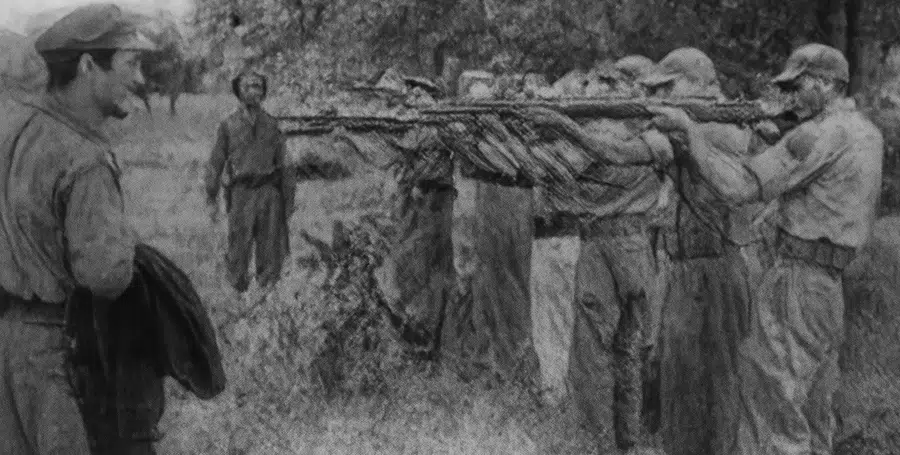
More than 70 people were executed without procedural guarantees on January 12, 1959 in Loma de San Juan, in Santiago de Cuba, in one of the first repressive actions of the newly established regime.
PUERTO PADRE, Cuba.- Using a bulldozer in the open field, instead of gravediggers with picks and shovels in a cemetery, it is precisely the work of the tractor-knife, acting as a funeral digger many hours before the “revolutionary court” ruled, that tells us about the premeditation and illegitimacy of those death sentences. The ditch, long and deep, would be a wall and burial place for the victims, but at the same time it proves prima facie of the first crime against humanity perpetrated by the Castro regime on January 12, 1959, in Loma de San Juan, Santiago de Cuba, just twelve days after taking power.
Raúl Castro, then military chief of the former Oriente province, is accused of being the intellectual author of this judicial orchestration that ended the lives of more than 70 people, judged very summarily and unconstitutionally. The accusation is not unfounded. On January 2, 1959, and due to the ratification of Bonifacio Haza Grasso in the position of chief of the police of Santiago de Cuba, Luis Buch and Armando Hart, commissioned by the provisional president Manuel Urrutia Lleó, went to the Moncada Barracks to meet with Raúl Castro, who told them: “As soon as he consolidates control of the regiment, the summary courts of war for those accused of murders and torture.”
Waiting for a response from Raúl Castro that would never come, Bonifacio Haza Grasso, who had been treated condescendingly by the Castro brothers, was the last to be shot on January 12, 1959 in Loma de San Juan, Santiago de Cuba.
Let us agree that soldiers, paramilitaries and collaborators of the police and intelligence services at the service of the dictatorship of Fulgencio Batistain force in Cuba from March 10, 1952 until December 31, 1958, produced deaths and torture, constituting crimes and serious violations of human rights, but these crimes did not give rise to other abuses in the name of “revolutionary justice”, and even less so when many of these crimes constituted res judicata; Remember that the amnesty that freed Fidel Castro and other attackers of the Moncada Barracks was not only for the imprisoned revolutionaries, but also to favor the soldiers convicted of excesses committed in that and other events of a political nature.
Going against article 25 of the 1940 Constitution, which expressly prohibited the death penalty, it was as early as before the end of the first half of January 1959, when the nascent Castro totalitarian regime began the executions en masse of the so-called “minions of the dictatorship”, but who would then continue killing his own comrades opposed to communism, whom he would call “bandits”. And the San Juan massacre was the first of those crimes against humanity committed by the Castro regime.
According to information provided for this article by the writer, journalist and historian Pedro Corzo, who chairs the Institute of Cuban Historical Memory against Totalitarianism, this is the “list of victims, reconciled to date, but not necessarily 100% correct. At least one individual who appeared on the list was not shot”:
- 1. Eladio Abreu Pedroso
- 2. Antonio Alvarez
- 3. Fernando Álvarez Díaz
- 4. Fidel Aragon
- 5. Israel Arencibia
- 6. Ángel Balboa López
- 7. Antonio Borrero
- 8. José Bravo Montalvo
- 9. Leonel Calas de la Rosa
- 10. Pedro Calas de la Rosa
- 11. René Caso Pérez
- 12. Pedro Castillo Ramírez
- 13. Victor Castro Lora
- 14. Francisco Cavada Polanco
- 15. Emerico Chacón Santa Cruz
- 16. Armando Chaviano Reyes
- 17. Benito Cortés Maldonado
- 18. Juan Daubinot Bell
- 19. Aristides de la O
- 20. Evelio de la Rosa Beltrán
- 21. Enrique Despaigne Noret
- 22. Fernando Díaz Rodríguez
- 23. Raúl Diez Zamora
- 24. Raúl Duarte Anaya
- 25. Facundo Durán Matos
- 26. Arturo Estrich Clavijo
- 27. Ernesto Fernández Valverde
- 28. Luis Gamboa Alarcón
- 29. Ángel Garay González
- 30. Alfredo Raimundo Gil
- 31. Manuel González Guillot
- 32. Juan Gutiérrez García 3
- 33. Antonio Gutiérrez Valdés
- 34. Bonifacio Haza Grasso
- 35. Ramon Heredia
- 36. José Hernández Morales
- 37. Heliodoro Herrera Duque
- 38. Alfredo Jim Jaume
- 39. Ángel Leiva
- 40. Aristonico López Despaigne
- 41. Aristides López Toledano
- 42. Pedro Martí Morales
- 43. Alberto Martín Céspedes
- 44. Armando Martín Montero
- 45. Eleidoro Montes de Oca Mayeta
- 46. Antonio Morales Carrillo
- 47. José Morffi Castillo
- 48. Nicolás Novas Fernández
- 49. Rafael Ocaño Collado
- 50. Eraclio Oduardo
- 51. Federico Oliu Cordero
- 52. Pedro Olivera Azains
- 53. Domingo Orea Gross
- 54. Miguel Ignacio Orea Gross
- 55. Orlando Ortiz Verdecia
- 56. Gaspar Palencia
- 57. Manuel Piña Martínez
- 58. Armando Plutín
- 59. Luis Portuondo Rodríguez
- 60. Manuel Prats Cervantes
- 61. Antonio Ramírez Caballero
- 62. Antonio Reytor
- 63. Juan Rivera Nordet
- 64. Pedro Rodríguez Pérez
- 65. Juan Romero Ramírez
- 66. Celso Saavedra Pineda
- 67. Francisco Saavedra Romero
- 68. Alcides Soler Fuste
- 69. Benigno Torres del Toro
- 70. Filiberto Torres López
- 71. Juan Torres Martínez
- 72. Juan Urula Cossío.
Through continued totalitarianism disguised as “social justice”, an inhuman and cannibalistic socio-political and economic procedure has crushed the Cuban nation since January 1, 1959 and until today. And the San Juan massacre is just one example. These are the first victims of Castroism and there is no way to bring them back to life, nor ways to punish their dead executioners; But legally, one day there will be review procedures and ways to restore the historical memory of each of those people in its proper measure, and when that moment arrives, their relatives and those who by trade undertake the healing of the nation, must keep their names in mind, because where justice does not reside there is no room for forgiveness.