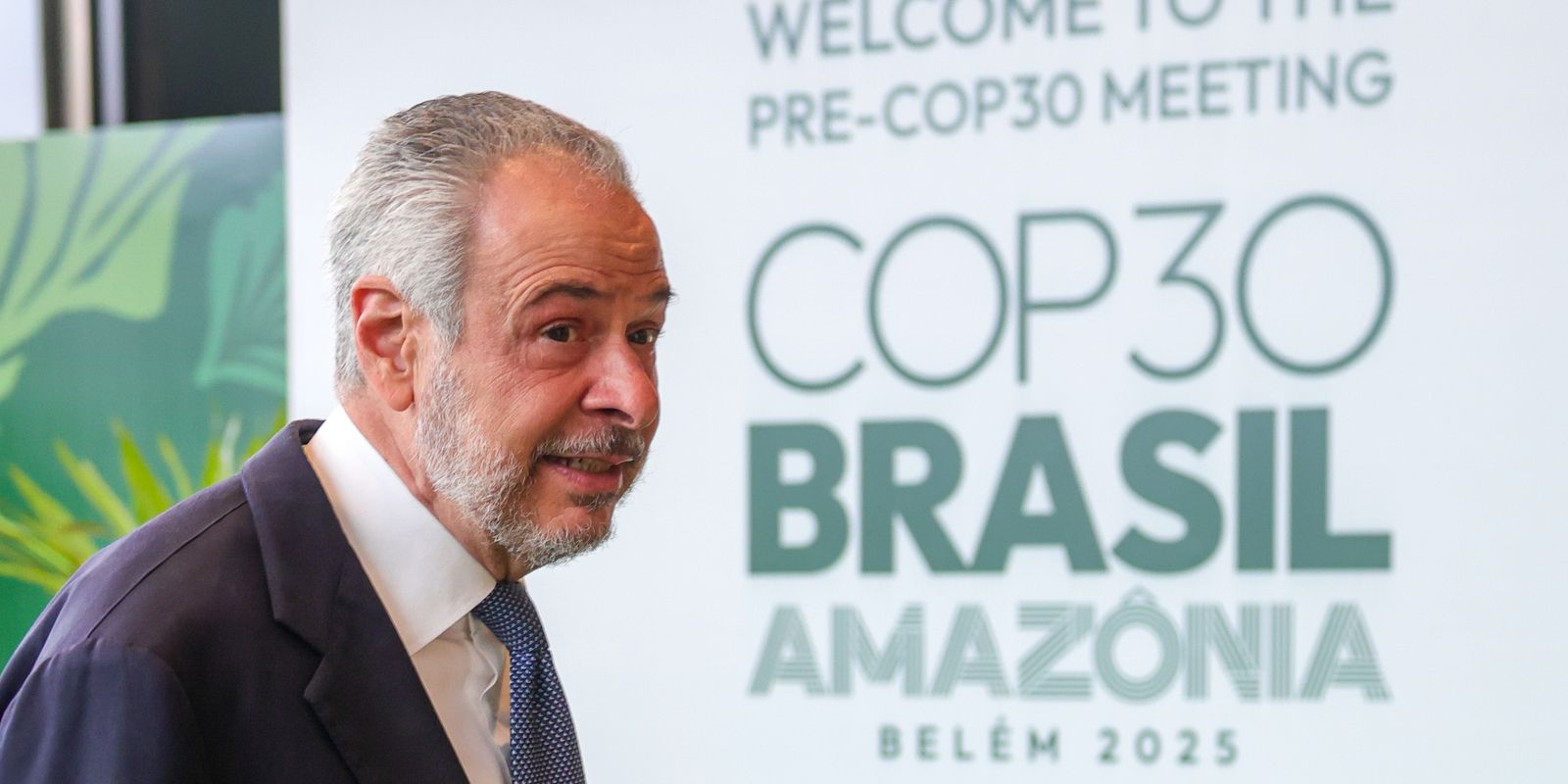
For two days, negotiators from 67 countries met in Brasiliaat Pre-COP, to align positions in the preparatory event for the climate change conference that will take place in less than a month, in Belém.
The Pre-COP, which ended in the early evening of this Tuesday (14), did not create formal agreements or announcements of new goals, but it facilitated the construction of prior understandings for the long negotiations that will follow in the unprecedented Amazon COP, starting on November 10th.
In the opinion of ambassador André Corrêa do Lago, designated president of COP30, it was possible map the main points of understanding and possible impasses.
“What happened here, and what was extremely useful to do this Pre-COP, is that we now have this much better mapped out, because they [países] They were very clear on the limits of what they could or could not accept in the negotiation process. So, there’s still a lot left to do because there’s a lot,” he told reporters at a press conference to evaluate the meeting.
According to Corrêa do Lago, of the total of 140 official topics in the COP30 negotiations, the majority are administrative. “There are, let’s say, about six or seven [temas] very important, and about 20 really important. So, there is already a whole map, I think it has made significant progress”, he said.
“The COPs have this suspenseful dynamic that I wish we didn’t need at the table, [mas] I think we reached some pre-consensus without confirmation that they are already [consensos]”, he added.
In the same vein, the Minister of Environment and Climate Change, Marina Silva, also assessed that the Limits placed on the table create possibilities for more targeted conversations during COP30.
“Even though there are some clearer signs of the limits, I think there are hooks so that these limits can talk to each other, challenge each other and deepen differences in order to find paths”, he pointed out.
Among the different issues addressed in the Pre-COP, the Minister of the Environment reinforced the sessions on climate and nature, in order to guarantee financing for forest preservation and ocean conservation actions .
“Climate extremes already require that governments and all of us have to act locally and globally, both in terms of resources and technology, solidarity, because climate change has no borders, extreme phenomena, sometimes torrential rains, make no difference in relation to the borders of Brazil with Peru, Brazil with Bolivia and fires, the same thing”, stated Marina Silva.
Other relevant discussions included the topic of energy transition, including the Brazilian proposal to quadruple sustainable fuels by 2030and also for a priority for the climate adaptation agenda.
“The session on climate and nature, for example, it was very clear that there is a consensus that new economic instruments are needed to value nature”, highlighted the executive director of COP30, Ana Toni, adding that the participants agreed that it should “be a COP of implementation and solutions”.
In the field of climate goals, the Pre-COP did not change the scenario much. To date, 62 countries out of 195 have formally submitted their Nationally Determined Contributions (NDCs), representing just 31% of global emissions.
Large regions that pollute the atmosphere, such as the European Union and India, with delegations present at the Pre-COP, have not yet renewed these commitments, which are precisely those agreed upon since the Paris Agreement, 10 years ago, to ensure that the planet’s temperature does not exceed 1.5ºC by the end of the century.
“THE [reunião] bilateral agreement with the European Union was very clear, a very strong commitment in relation to its NDCs. They are absolutely committed to obtaining an NDC and ensuring a leading role for the European Union in this context. The group of 77 [bloco de países emergentes] and other groups were also very clear about what they intended to have in Belém”, pondered the president of COP30, about the meetings of the last few days.
Civil society
The perception of civil society entities is that the Pre-COP managed to activate a climate favorable to the construction of multilateralism, but there was a lack of more forceful signaling on the topic of forest protection.
“Where are the forests in the COP30 negotiations? After all, one of the great differences of COP30 is that it takes place in the largest forest on the planet, which plays a central role in combating and adapting to the climate crisis, but which is also on the verge of collapse. In Pre-COP30, the last round of conversations before Belém, we did not see countries engaging in conversations about the urgent protection of forests”, says the international policy specialist at Greenpeace Brazil, Camila Jardim.
One of Brazilian initiatives on this topic is the launch, at COP30, of the Tropical Forests Forever Fund (TFFF, acronym in English for The Tropical Forest Forever Facility). The fund will be a financing mechanism, with an estimated value of US$125 billion (around R$680 billion), aimed at preserving these forest biomes, present in around 70 countries, and which are crucial for regulating the rainfall regime and capturing carbon in the atmosphere.
Created by Brazil, in conjunction with Colombia, Norway, the United Kingdom, France and the United Arab Emirates, the fund has also been supported by nations that have huge areas of tropical forests, such as Ghana, the Democratic Republic of Congo (DRC), Malaysia and Indonesia.
The Tropical Forests Forever Fund will also have, among its rules, the direct transfer of 20% of its total resources to communities of indigenous and traditional peoples who live in and preserve these biomes, reinforcing the community’s role in preservation. Each hectare preserved will be compensated in the amount of US$4.
“Nature-based solutions can generate up to 30% of the emissions reductions needed by 2030, but receive less than 3% of climate financing. The Baku-Belém route and other negotiation axes, such as Article 6.4 of the Paris Agreement on carbon markets, need to contribute to closing this gap and aligning resources with opportunities for nature. Likewise, the TFFF needs concrete buy-ins and resources to fulfill your role. This is not only possible: it is essential to meet climate goals”, pointed out Gustavo Souza, senior director of Public Policies and Incentives at Conservation International.